

The investigation into the death of Border Police Sgt. David Hoyer Amrani, who was fatally shot after opening fire in Netanya’s Kiryat Hasharon neighborhood, is still in its early stages, with new details emerging about the minutes leading up to the deadly encounter.
Ynet has learned that because police officers were involved in the shooting, the case is expected to be transferred in the coming hours or days to the Justice Ministry’s Police Internal Investigations Department. Amrani’s funeral is due to take place Sunday at the Even Yehuda cemetery.
The Netanya shootout


Amrani, 20, was shot by police and Border Police personnel after officers said he opened fire in the area. He was initially listed in critical condition and later died of his wounds. No one else was injured.
Before the confrontation, Amrani was seen carrying an M16 rifle. Officials initially suspected he might be suffering from combat trauma, but the Defense Ministry’s Rehabilitation Department said he had not been treated there for post-traumatic stress disorder and was not known to the system as a PTSD patient.
Amrani enlisted for compulsory service in the Border Police in August 2024 and served in the West Bank, including in Hebron after completing his training. People who knew him said there was nothing in the days before the incident that suggested what was about to happen. They said he had even ironed and prepared his clothes for another workweek before leaving home with his weapon.
According to testimony collected at the scene, Amrani spent roughly 20 minutes moving between residential buildings while firing bursts into the air. Police who arrived initially identified him as an armed suspect without knowing the circumstances and reportedly feared a possible terrorist attack.
Witnesses said that at one stage Amrani advanced toward officers while continuing to fire into the air. A gunbattle then broke out and he was shot. He later died of his wounds.
Neighborhood resident Avigail Cohen told ynet that the shooting went on for an extended period and sent residents scrambling for cover.
“There were lots of shots and it took the police time to arrive,” she said. “He was shooting into the air. People went into safe places. We were in the garden with my little sister, everything was calm, and then we saw people panicking. We started hearing bursts of gunfire.”
“We went up into buildings, into people’s apartments,” she added. “He started moving toward our area and we hid in the apartment of a wonderful woman. It lasted something like 20 minutes.”
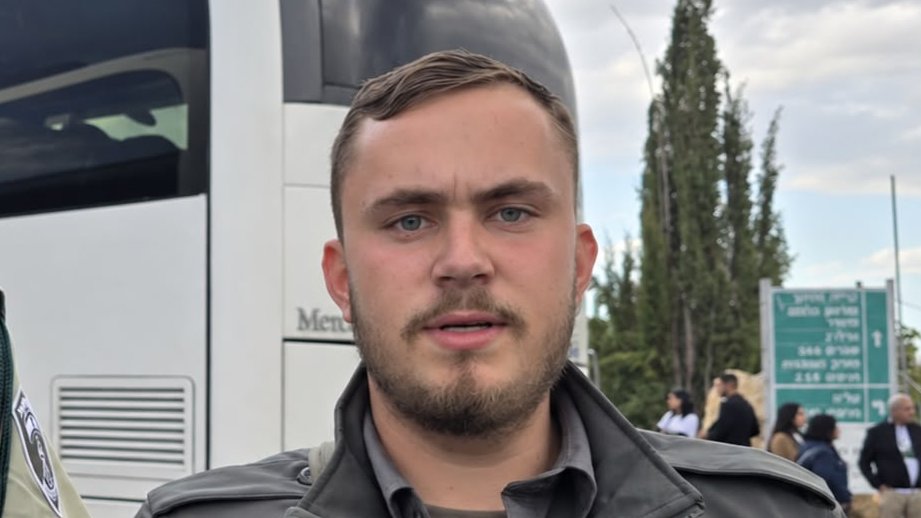
Border Police Sgt. David Hoyer Amrani
(Photo: Israel Police)
Her brother Harel said he first heard gunfire from the direction of the stadium.
“I saw him reach my building. He barricaded himself there,” he said. “I reported all the details to the police and ran to my room to get my weapon, to be ready. He looked lucid. He just moved between the buildings and fired into the air.”
The new details are also raising questions about whether there were warning signs that were missed before the shooting.
Attorney Idan Kleiman, chairman of the IDF Disabled Veterans Organization, told Ynet that he understood Amrani had previously asked to be transferred to another sector.
“That is a warning light,” Kleiman said. “If someone had taken it seriously and asked ‘why?’ we might have reached the stage of support and treatment. There has to be a very clear address, a phone number, for every soldier and member of the security forces, and treatment has to begin as soon as distress appears.”
“In his case there was a warning sign, and unfortunately the system apparently did not pick it up,” he added.
Kleiman warned that similar cases could recur if security personnel are not identified and supported earlier.
“I think we are on the edge of an abyss,” he said. “Israel knows how to find its fighters when it wants them to go out to the battlefield, but it also has to know how to find them when they come back and take care of them.”
“We will not be able to prevent everything. There will unfortunately be tragedies, but we have to make an extraordinary effort to care for these brave fighters and save as many as possible.”