

Just months after launching at the IDF’s School for Computer Professions, known by its Hebrew acronym Basmach, the second class of the military’s new AI researchers course has completed training. Twenty graduates will now be assigned to units and branches across the IDF, where they will provide artificial intelligence solutions and develop systems tailored to operational needs.
Since emerging onto the global stage, artificial intelligence has become a central tool across nearly every sector. The shift has also reached the IDF’s C4I and Cyber Defense Directorate, which recently established a dedicated AI division known as “Bina” to lead the military’s efforts in the field. The AI researcher role was created as part of that initiative.
Gallery
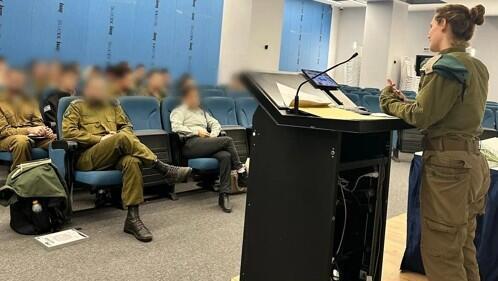
Graduates will provide artificial intelligence solutions and develop systems tailored to operational needs
(Photo: IDF)
“In abstract terms, the mission of these soldiers is to provide solutions to different problems in their respective units using AI tools,” said Capt. R., a graduate of the first course who went on to command the second class. “We mainly deal with text, image and audio, although sometimes our work extends beyond that.”
The position combines research and development.
The first stage is research. “We read a great deal of academic papers and professional literature,” Capt. R. said. “The requirement is to be involved from end to end. If we are not deeply familiar with the material, we won’t fully understand the operational need or select the most suitable tool.”
The next phase involves rapidly developing an intermediate system while simultaneously building the core AI-based feature on top of it.
The researchers’ work spans much of the military, particularly operational domains. They frequently analyze audio collected in the field, classifying and sorting it for mission use. Others develop systems designed to improve identification and alert mechanisms. Some examine visual content and use it to map terrain. Others help design AI-based tools and systems for specialized projects.
The latest course, which included 20 participants, lasted six weeks, one week longer than the first class. Trainees began with theoretical foundations.
“They learn what artificial intelligence is, how it operates and how it is structured,” Capt. R. explained. “They first cover the entire foundation of the field.” From there, they move on to understanding signals and how systems interpret data.
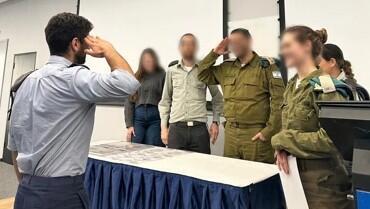
'They learn what artificial intelligence is, how it operates and how it is structured'
(Photo: IDF)
The final stage focuses on refining research skills. “By the end, they know how to handle any information they receive, extract what is relevant to their specific development and implement it,” she said. “The course is very intensive. It significantly improves the ability to process large volumes of information quickly and apply it to operational needs.”
Most participants arrive with backgrounds in data science, and many hold academic degrees. “In general, many of those here are in their second role in the army,” Capt. R. noted, though some in the current class joined directly from civilian life.
Their work differs depending on the unit they join. Within the C4I and Cyber Defense Directorate, for example, researchers focus heavily on text analysis, often compared to finding a needle in a haystack.
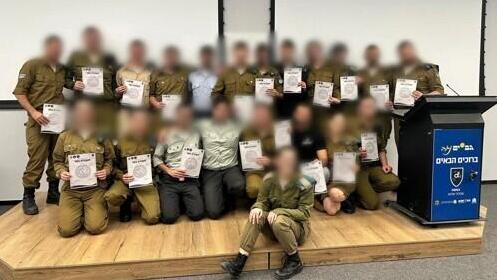
Graduates will integrate into units across all branches and regional commands
(Photo: IDF)
“We often develop systems to summarize long documents, flight debriefings or operational investigations where protocols contain massive amounts of content,” she said. “Sometimes there is a need to locate specific information within a very large database. We program tools that identify reliable and relevant information quickly.”
The graduates will integrate into units across all branches and regional commands, each working with systems embedded with dedicated AI capabilities.
“The mission is to add new capabilities to existing mechanisms based on needs arising from the field and from the units themselves, and to layer them onto current systems,” Capt. R. said.
Before concluding, she highlighted the collaborative nature of the emerging AI research community within the military.
“Because we all come from different parts of the army and specialize in different areas at a high level, we can maintain an advanced level of knowledge sharing,” she said. “I can consult with someone who specializes in audio or visual analysis, and vice versa. It creates a productive environment that allows us to exchange expertise and achieve results that a few years ago we would not have imagined.”