


Senior ministers are accusing Prime Minister Benjamin Netanyahu and his close ally, Strategic Affairs Minister Ron Dermer, of bypassing the Security Cabinet and managing negotiations with the United States alone over the wording of a proposed UN Security Council resolution to establish an international stabilization force for Gaza.
According to multiple coalition sources, members of the Security Cabinet, including ministers from the smaller decision-making forum, have been excluded from discussions and denied the opportunity to review the draft text or contribute to Israel’s official position.

Ministers from the hardline Religious Zionist Party warned that the resolution—if passed—could amount to a de facto “Phase B” of a diplomatic agreement over Gaza’s future, presented to the Cabinet only as a fait accompli. Finance Minister Bezalel Smotrich and National Security Minister Itamar Ben-Gvir had previously said they agreed to remain in government during “Phase A”—which included the hostage deal and ceasefire—only on condition that Hamas would be disarmed in the next stage and Gaza fully demilitarized.
Now, they claim, Israel is on the verge of committing to a framework they were not involved in shaping.
Settlement and National Missions Minister Orit Strock, a member of the Security Cabinet, sent a formal letter to Netanyahu on Wednesday demanding the draft resolution and accompanying U.S.-Israel memorandum be brought for immediate discussion in the Cabinet’s upcoming meeting.
“The draft resolution on Gaza has already been sent to the UN, and the memorandum of understanding between Israel and the U.S. is currently being formulated,” she wrote. “Yet neither document, both of which will determine Gaza’s future and the feasibility of our war objectives, has been presented to the Cabinet or the smaller forum.”
Strock also criticized the exclusion of ministers from decisions about who would enter Gaza, under what authority and with what oversight. “No input has been sought on the composition of forces, their mandate, operational scope, disarmament definitions, Hamas’ status or the role of the Palestinian Authority,” she wrote. “This violates assurances made during the last Cabinet meeting and contradicts the norms of coalition governance on matters of such critical national importance.”
Tensions escalated after the United States circulated its formal draft to the UN Security Council, outlining a framework for international transition mechanisms in Gaza. The plan includes the creation of a temporary governing body, the “Board of Peace,” to oversee reconstruction funds, and a temporary International Stabilization Force (ISF) to operate in coordination with Israel, Egypt and the Palestinian Authority.
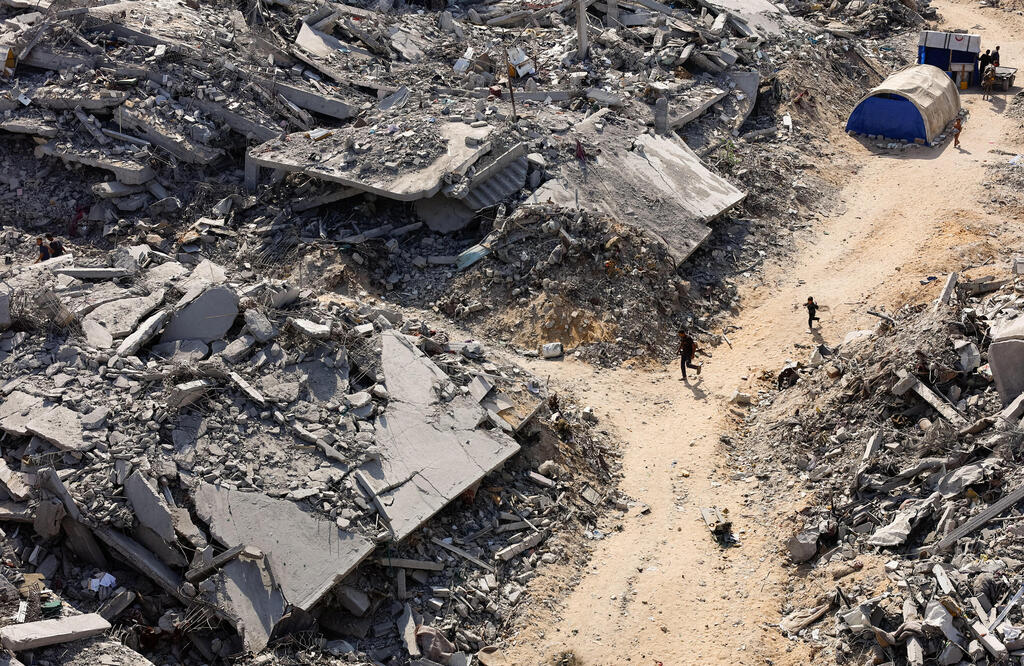
Gaza City
(Photo: REUTERS/Mahmoud Issa)
According to defense officials, the draft is still subject to revisions following feedback from Arab and European states. While Israel opposes Turkish involvement in the force, officials acknowledge it will likely play a role in Gaza’s reconstruction efforts.
The resolution is modeled on a 20-point plan unveiled in September by U.S. President Donald Trump and aims to ensure long-term stability in Gaza and disarm armed factions.
Under the draft, the ISF would receive broad authority within defined limits. The force would operate under unified command sanctioned by the Board of Peace, and in coordination with Israel and Egypt, without altering existing security agreements.
The ISF would include troops from participating nations and be tasked with enforcing the ceasefire, stabilizing the security environment and preventing the resurgence of terrorist activity. It would also oversee the disarmament process, including the destruction of terror infrastructure and enforcement of permanent disarmament for all non-state armed groups.
In addition, the ISF would protect civilians and humanitarian shipments, escort aid convoys, open humanitarian corridors and help establish new vetted Palestinian police forces. It would also coordinate with regional and international actors to rebuild civil infrastructure, facilitate the movement of goods and people and ensure civilian oversight over Gaza’s new administrative systems.