


Avi Pazner, a former Israeli ambassador to Italy and France, warned Monday that Israel could face unprecedented diplomatic isolation and sanctions resembling those imposed on South Africa in the final years of apartheid if the government or its policies do not change. Pazner, who also served as communications adviser to former prime minister Yitzhak Shamir and later chaired Keren Hayesod, made the warning in a message to an internal group of former Foreign Ministry officials, details of which were obtained by ynet.
“Most of us witnessed the process South Africa went through when economic and diplomatic sanctions were imposed on it in the mid-1980s, leading to the collapse of the apartheid regime in the early 1990s,” Pazner wrote.
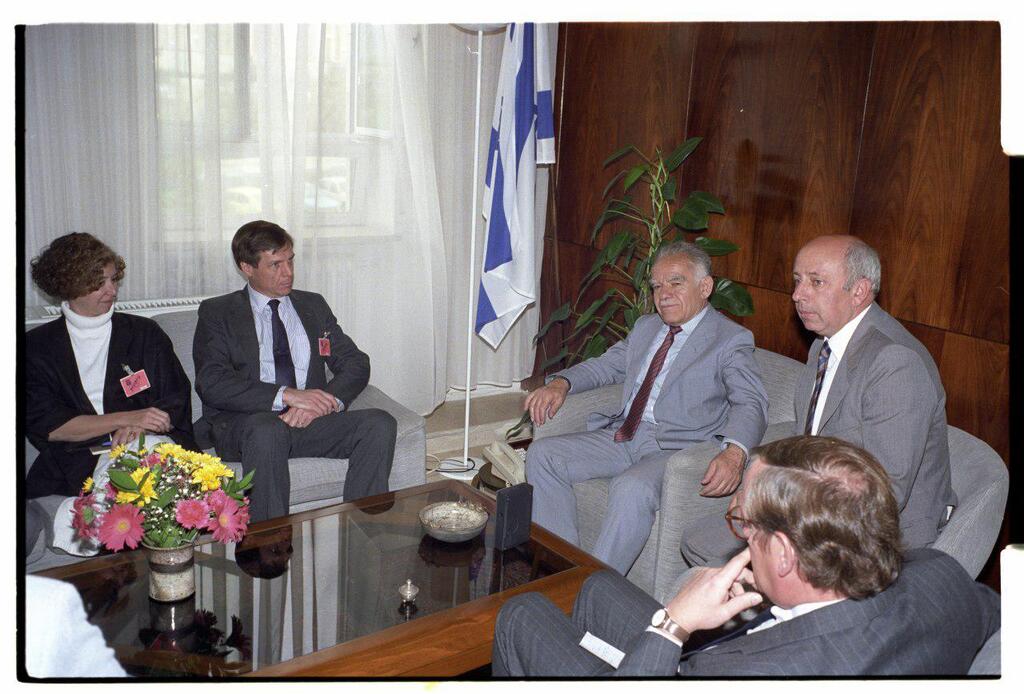
Pazner (right) with former prime minister Yitzhak Shamir, 1988
(Photo: David Rubinger)
“At the moment, apart from isolated cases such as in the Netherlands, the sanctions are not being applied, and for now they are directed only at the West Bank,” he continued. “But if the current coalition wins the election, I have no doubt that Israel will enter a situation we have never experienced before in terms of sanctions and boycotts, which will expand from the territories to the entire country.”
His message came amid controversy over customs inspections of passengers arriving in the Netherlands on flights from Israel.
Israel’s Foreign Ministry issued a warning overnight to Israelis planning to travel to the Netherlands following reports of unusually lengthy baggage inspections. The ministry said travelers could face “lengthy and intrusive baggage checks” after a Dutch order banning goods originating in Israeli settlements in the West Bank, East Jerusalem and the Golan Heights took effect.
According to the Foreign Ministry, violating the order is a criminal offense that could result in fines or imprisonment.
Yedioth Ahronoth columnist Nahum Barnea wrote Monday that several Western European countries that were once considered among Israel’s closest friends were preparing potentially severe sanctions.
“It is no coincidence that these measures have not been completed,” Barnea wrote. “They will keep the weapon loaded and the safety on until October 27, and then, if Netanyahu forms a government, they will begin to act.”
Separately, former Supervisor of Banks Yair Avidan told ynet Monday that there was significant uncertainty over how far sanctions could go and how widely they might spread.
“In an extreme scenario, which could become a working scenario, the sanctions could include leading European banks ending banking activity with Israeli banks,” Avidan said.
His comments came as several countries, mainly in Europe, discuss sanctions targeting Israeli companies and potentially Israel’s banking and financial system over violence in the West Bank and the continuing stalemate in the Gaza Strip.