

Who said Israeli politicians never keep their election promises? Benjamin Netanyahu told the UN that the whole world was against us, and he seems determined to make good on that promise day after day. What was once a defensive instinct has hardened into a governing approach: assume hostility abroad, expect isolation and prepare Israelis to live with the consequences.
And that is not the only promise that may be fulfilled. Bezalel Smotrich told ynet that Israel should “go to war” in the West Bank and “do there what we did in Gaza.” We have had plenty of wars, but I cannot remember an Israeli politician ever waving one around as an election promise. Quite the opposite. Politicians once promised peace, Netanyahu more than most.
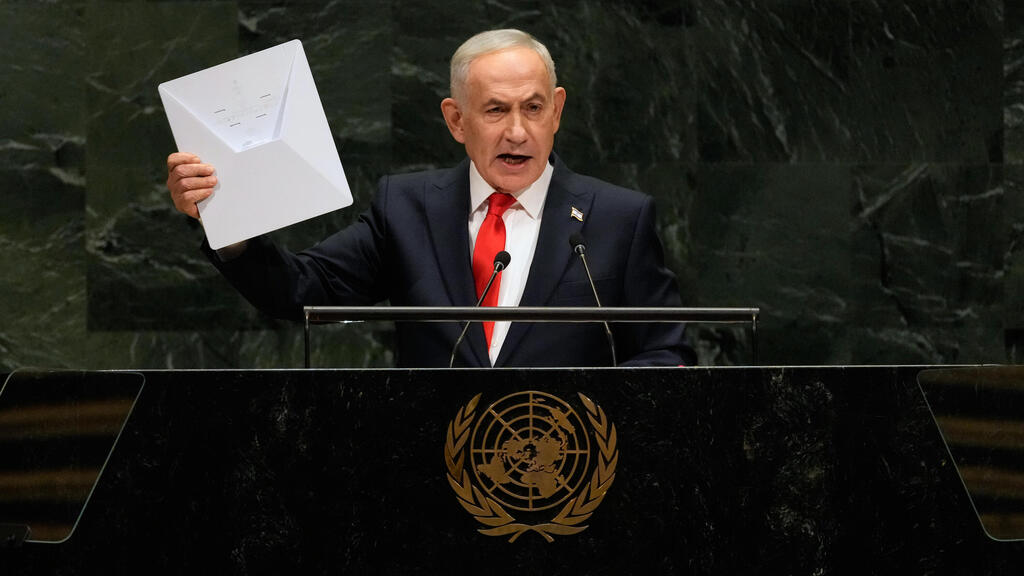
Prime Minister Benjamin Netanyahu at the UN
(Photo: AP Photo/Seth Wenig)
Election campaigns naturally focus on the past: what the incumbent government did, where it succeeded and where it failed. That is especially true this time, when the divide between success and failure has been so stark and so painful. Still, I suggest putting that reckoning aside for a moment and asking what the future may hold. That matters because many Israeli voters appear willing to turn the page on what has happened over the past four years, but I doubt they have fully considered what another term for the current coalition could mean.
The sanctions waiting in Europe
Start with the international arena. A group of European governments, including Britain, France, the Netherlands and Norway, have moved toward restrictions connected to Israeli settlements in the West Bank. Britain has announced plans for a broader sanctions regime and restrictions on settlement trade, while a group of European states and Canada have backed or considered similar measures.
In my view, some of the greatest potential damage lies in measures designed to separate Israel economically from the territories it has controlled since 1967. A narrow interpretation could complicate life for hundreds of thousands of Israelis and thousands of businesses in the West Bank, and perhaps also affect activity connected to East Jerusalem and the Golan Heights. A broader interpretation could create a chain effect: pressure not only on those doing business in settlements, but on companies doing business with companies that do.
The Netherlands has already imposed a ban on importing, buying and selling goods originating in Israeli settlements, including goods carried in travelers’ personal luggage. Dutch lawmakers have also debated ways to distinguish West Bank settlers from other Israeli travelers for visa purposes, although a September motion calling for an examination of suspending visa-free travel for settlers was rejected.
None of this is fair or proportionate in my view, and some of it carries an antisemitic odor. But fairness does not make the danger disappear. Israel has become a consensus issue abroad, and not in a way that serves us.
The pressure to boycott Israel is increasingly coming from below, from the street. Our problem, unfortunately, is with democratic countries. With dictatorships, for the moment, we are getting along rather well.
The boycott impulse has spread through sports, culture and academia. Ireland’s soccer establishment has pushed UEFA to suspend Israel, while Irish and other European broadcasters have moved to boycott Eurovision over Israel’s participation. The next battleground could be the international institutions in which Israel still participates, from European sporting bodies and Eurovision to Horizon Europe, the European Union’s flagship research program.
The canceled flight to Mauritius this weekend illustrates how fragile Israelis’ freedom of movement can become. Mauritian authorities refused landing permission to an Air Seychelles flight arriving from Israel, forcing its cancellation, according to the tour operator involved.
From there, the possibilities multiply: airlines denied refueling, flights from Tel Aviv canceled, weapons shipments prevented from being loaded or unloaded. Decisions by a labor union, air traffic controllers, baggage handlers or security staff could be enough to disrupt traffic. In my view, what begins in Europe will not necessarily remain there.
Sparta, or Masada?
Netanyahu has spoken of the need for Israel to become a kind of “super-Sparta,” a country capable of standing on its own. But what he is really offering, I fear, is not Sparta but Masada: a fortress under siege whose story ends in heroic suicide.
Is that what most Israelis want? I do not believe so.
Few people around the world know the name Gadi Eisenkot. Everyone knows Netanyahu. He is no longer merely a politician who appears in the news. He is a symbol and a global brand.
If he succeeds in forming the next government, that fact alone may be enough for many of Israel’s opponents abroad. Before he gives Smotrich the West Bank war he is calling for, before Itamar Ben-Gvir gets his way on Arab citizens of Israel, before Tally Gotliv gets her way with the judiciary or Yaakov Bardugo with the free press, the boycotts could already be underway.
There are processes in the life of nations that become extremely difficult to stop once they gather momentum.
I do not want to prophesy disaster. I want to issue a warning.
Three years after Oct. 7, warnings are something Israelis have learned, painfully, not to dismiss.