

A day after Foreign Minister Gideon Sa'ar said all activists aboard the “Spring 2026” flotilla intercepted by the Israeli navy en route to Gaza would be released in Crete, the Foreign Ministry said Friday morning that two of them “involved in terrorism” will be brought to Israel for questioning.
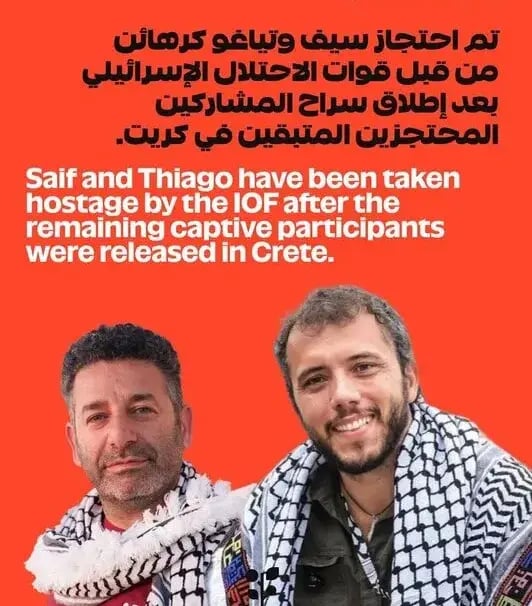
One activist, Saif Abu Kashk, a Palestinian living in Spain, is suspected of having ties to Hamas, the militant group that governs Gaza. Another, Thiago Avila, a Brazilian national, is suspected of illegal activity. Flotilla organizers called for their release, saying, “They were taken hostage.”
Gallery
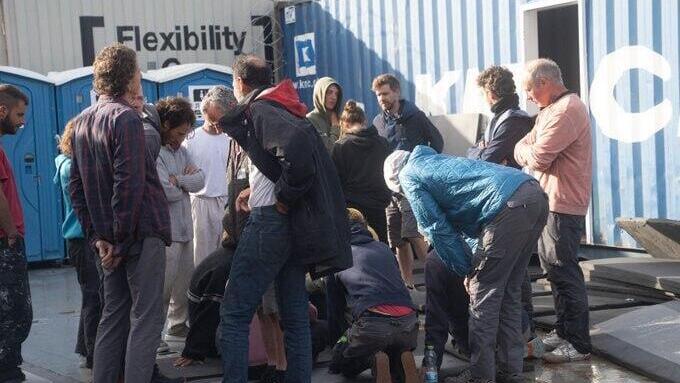
Flotilla activists to Gaza upon their arrival in Crete
(Photo: Foreign Ministry spokesperson)
In a statement, the Foreign Ministry said: “Two flotilla activists involved in terrorism will be brought to Israel for questioning and the rest will disembark in Greece. As published by the Peace Council and the U.S. State Department, humanitarian activity in the Gaza Strip is managed by the Peace Council, and this flotilla led by Hamas is another provocation intended to divert attention from Hamas’ refusal to disarm and to serve the external interests of professional provocateurs. Israel will not allow a breach of the lawful naval blockade on Gaza.”
Avila, who attended the funeral of Hezbollah leader Hassan Nasrallah, has also been accused of “inappropriate sexual behavior” toward at least three female volunteers during the voyage. A Brazilian activist on the flotilla said the allegations reflect cultural differences. “For some people in the organization it’s very strange that we Brazilians hug a lot,” she said. “We sleep close to each other and share rooms.”
Abu Kashk is a Palestinian political activist based in Barcelona, Spain, who has been involved in organizing several flotillas to Gaza.
Israeli officials said the decision to bring the two suspects to Israel via the navy is unrelated to their countries of origin. Israel’s relations with Spain and Brazil are at a historic low. Spain’s government, led by Prime Minister Pedro Sánchez, has taken one of the most critical lines against Israel within the European Union. Under Brazilian President Luiz Inácio Lula da Silva, ties have deteriorated from a war of words to a practical rupture. At the same time, officials noted that, in practice, detainees from other countries are not being brought to Israel.
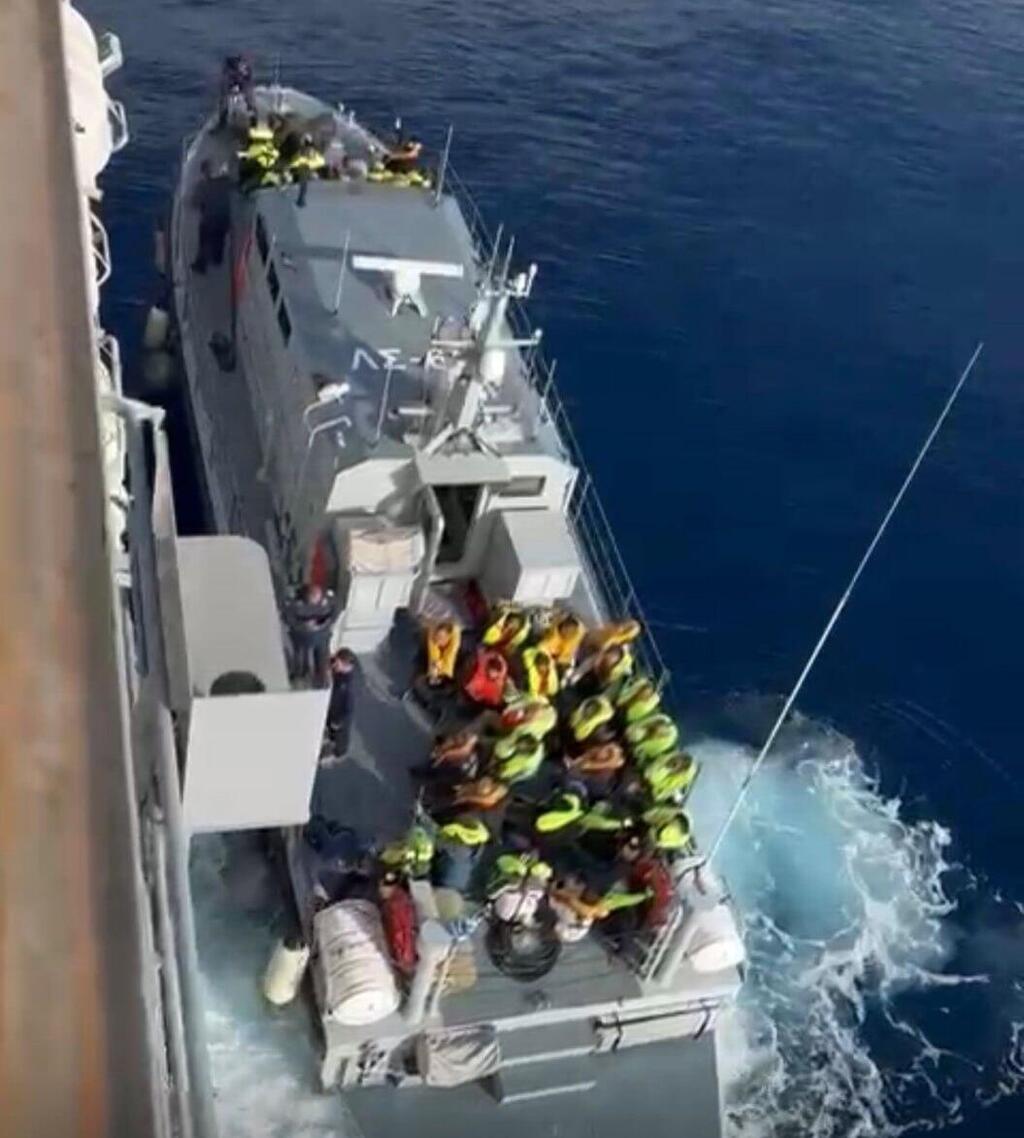
(Photo: Foreign Ministry spokesperson)
Meanwhile, Agence France-Presse reported that activists detained at sea near Greece arrived in Crete and were then transported by four buses to a local town. Greece’s Foreign Ministry said authorities were in contact with Israel regarding the disembarkation of flotilla participants and “ensuring their safe return to their countries.”
Several European countries criticized Israel over what they called “blatant violations of international law.” The office of Italian Prime Minister Giorgia Meloni issued a statement condemning the Israeli navy’s interception of dozens of vessels bound for Gaza. Before Saar’s announcement, the Italian government demanded the “immediate release” of all Italian citizens it said were “unlawfully detained.”
Italy also called on Israel to respect international law and ensure the safety of those on board, though it did not specify how many Italians were detained by the Israel Defense Forces, or IDF, the military. A statement from Rome said: “The government reaffirms its commitment to continue providing humanitarian assistance to Gaza in cooperation and in accordance with international law.”
Spain said it “strongly” condemned the takeover of the flotilla and summoned Israel’s chargé d’affaires. A French Foreign Ministry spokesman said 15 French citizens were on board and that “our top priority right now is the safety of the citizens who were on the flotilla,” calling on “all parties” to respect international law.
After the IDF took control of the vessels, Israeli officials outlined the decisions leading up to the operation and how it would be presented internationally. “The scale of the flotilla was something we had not seen, and it led to the understanding that there was an operational need to address it early with preventive action,” they said.
Flotilla activists enjoying themselves aboard an Israeli vessel
(Video: Foreign Ministry spokesperson)


As in previous flotillas, the Foreign Ministry led and managed the response and was responsible for public messaging, in full coordination with the IDF, the navy, the Population and Immigration Authority, Israel Police and the Israel Prison Service. “This is the fifth flotilla. The system already knows the model and how everyone works together,” officials said.
They noted that with such a large number of vessels, “the potential for friction is much greater.” They added: “There could have been escalation. The decision was to handle it early. No one wanted another Mavi Marmara,” referring to the 2010 raid on a Gaza-bound flotilla in which violence broke out.
On flotilla activists’ reported intention to block an Israeli vessel, officials said: “They lost their judgment. It proved they are dangerous, and the State of Israel understood it needed to act quickly, far from Israel’s shores and gradually, given the mass of vessels.”
Officials emphasized that the IDF and the Foreign Ministry acted in full coordination. “Immediately after Shayetet 13,” the navy’s elite commando unit, “took control, the first images reached Israel, and we were stunned to see condoms and bags that allegedly contained drugs resembling cocaine.”
They said one of the first decisions was “not to wait and to immediately expose the flotilla’s true face to the world.”