


Israel was not surprised by reports suggesting that Iran is set to reject the latest U.S. nuclear proposal. The key question now is whether the United States will continue pursuing negotiations—or return to the military option, as President Donald Trump has repeatedly threatened in the past.

Although Iran is expected to formally decline the offer, reports have also pointed to a significant American compromise that could potentially shift the dynamics. According to Axios, the proposal does not require dismantling all of Iran’s nuclear infrastructure and would allow uranium enrichment on Iranian soil to a low level of 3%, for a period to be determined through negotiation.
Israel’s official response over the weekend was silence—strategic, perhaps, to avoid appearing as the party pushing the talks toward collapse, especially amid claims from Trump administration officials that Israel is pressing for war with Iran. The assessment in Jerusalem is that Iran’s rejection won’t be the end of the road and that the Americans are likely to give negotiations another chance. Still, the gap between the sides appears substantial.
Danny (Dennis) Citrinowicz, a veteran Iran analyst who served nearly 25 years in Israel’s military intelligence and is now a research fellow at the Institute for National Security Studies (INSS), believes that without a deal, a military strike may return to the table. “Given that neither the Americans nor the Iranians want to see talks collapse and spark escalation, it's likely another attempt at negotiations will be made,” he said. “Iran’s answer is unlikely to be a flat-out rejection, but rather a basis for continued dialogue, while holding firm to its red lines.”
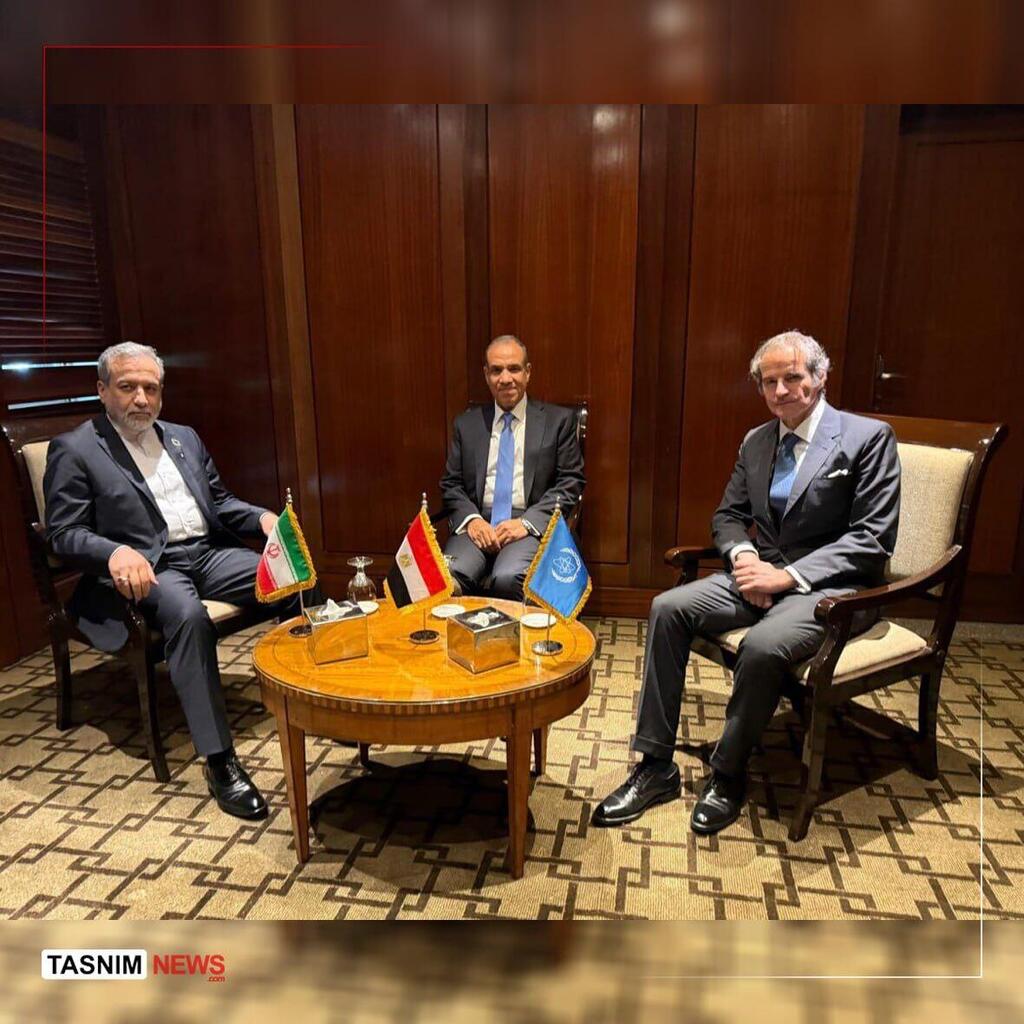
Iranian FM Abbas Araghchi, Egyptian FM Badr Ahmed Mohamed Abdelatty and IAEA chief Rafael Mariano Grossi
Citrinowicz added that intermediaries—chiefly Oman—are expected to work tirelessly to keep the framework alive. Referring to Trump’s statements during his recent visit to Saudi Arabia, he said that even if talks fall apart, the U.S. may revert to its “maximum pressure” strategy against Iran. One component of this diplomatic push is a meeting today in Cairo between Iran’s Foreign Minister Abbas Araghchi, Egypt’s Foreign Minister Badr Abdel Aati, and IAEA chief Rafael Grossi—a move seen as part of Tehran’s effort to ease tensions following a critical IAEA report on its nuclear program.
Time, however, is running out. The tough new IAEA report has raised the stakes, and France, Germany, and Britain may soon invoke the "snapback" mechanism, which would reinstate all international sanctions on Iran if it is found in violation of the nuclear deal. Without a creative solution to the enrichment issue, escalation appears almost inevitable—especially if Iran withdraws from the Nuclear Non-Proliferation Treaty in response.
Negotiations between the U.S. and Iran have reached a crucial juncture. Both sides want an agreement, but the fundamental divide—particularly over uranium enrichment on Iranian soil—remains unresolved. Unless the U.S. shifts its position or a clever workaround is found, the chances of a diplomatic breakthrough are slim.
Earlier, the U.S. proposed forming a multinational consortium that would provide enriched uranium to several Middle Eastern countries seeking civilian nuclear energy. The consortium would be collectively owned, allowing Iran to access enriched material without importing it from abroad. Under this proposal, enrichment would occur outside Iran and under strict supervision by both the U.S. and the IAEA, ensuring that uranium is enriched only to 3.67%—suitable for civilian reactors, but far below weapons-grade.
The idea came from Steve Witkoff, President Trump’s special envoy. However, Iran reportedly rejected the offer because it did not recognize Tehran’s right to enrichment. Supreme Leader Ali Khamenei has repeatedly stated that this right is non-negotiable. Iran has signaled willingness to compromise—but only if enrichment is allowed to continue within its borders.
According to Citrinowicz, the Trump administration does seek a diplomatic solution, but often approaches it through a business-like, corporate lens—aiming to leverage the other party’s weakness to secure a favorable deal. Washington appears to believe that Iran's economic and security vulnerabilities will force it to forgo enrichment in exchange for sanctions relief. But for Iran, enrichment is not just a technical or economic issue—it’s central to the regime’s identity and legitimacy. Tehran will not surrender it, regardless of the price.
Get the Ynetnews app on your smartphone: Google Play: https://bit.ly/4eJ37pE | Apple App Store: https://bit.ly/3ZL7iNv
Dr. Raz Zimmt, director of the Iran and Shiite Axis Program at the INSS, emphasized a similar point. “Iran certainly wants sanctions lifted and the economic pressure eased, but it has shown in the past that it is willing to compromise only up to a point—it won’t abandon core principles, especially the right to enrich uranium on its own soil. This isn’t just a national right for Iran; it’s seen as an insurance policy for regime survival.”
He added that Iran’s leadership has mocked Libya’s Muammar Gaddafi, who gave up his nuclear ambitions in exchange for sanctions relief—calling the benefits he received mere “candies.” Zimmt warned that if the U.S. believes it can persuade Iran to give up its red lines in exchange for economic incentives, it may soon discover not just a gulf between their positions, but also a cultural chasm between the negotiation styles of American real estate moguls and the Islamic Republic.