

The grief clock of Rachel Goldberg-Polin and Jon Polin ticks in time units only they can measure, marking a year since the loss of “six beautiful souls,” including their son Hersh, whose body was returned for burial in Israel after being murdered in Hamas captivity.
It counts with horrifying precision the weight of their son who stood 6 feet tall and was brought to burial weighing 52 kilograms, the days that passed since he was dragged wounded and bleeding from a party that became a massacre, the IDF soldiers who fell defending the homeland, the number of war days that have not come to an end, and in quiet defiance on their shirt collar - the 688 days, correct as of Monday's interview, in which 20 hostages have been suffering underground in Gaza.

Despite the relentless toll of their grief clock, they do not shy away from words. Instead, they face, with a kind of reverent fear, the weighty questions that have been forced upon them—just like the reality they never chose, since that cursed morning when terrified children huddled in a shelter that became a death trap. They have no privilege of escape, no way to flee a calendar closing in on them: on one side, news of the looming operation to capture Gaza City; on the other, the first memorial marking the day their son was murdered by his captors.
The thought of IDF forces once again approaching an area that endangers hostages, parallel to dozens of memorial events for Hersh, who has meanwhile become a Jerusalem icon whose face is familiar in every home in Israel, traps them like tongs moving without prior warning.
Nevertheless, they are ready to deal with every question, if only for the small chance it will awaken those who need to hear: "We can make a deal to bring home our loved ones, our children, our family members, we can bring them home now," says Jon in a quiet and measured voice, "but if you are an influential person around decision-makers or a member of this government, and you don't want to bring home these people we can return - then take your children, put them there instead of Matan and Avitar and Rom and Eitan and all of them, and then go and bother to make a deal. The people have been there 688 days, and their families have already paid a high enough price, so let's stop torturing them."
Rachel continues: "The hostages and their families have served their time, and if someone from the leadership feels that someone needs to be in those tunnels, hungry, filthy, hungry, and tortured - they can choose people from their own families, or go there themselves in their place."
Are you worried this might happen again, that the IDF will approach, and God fo, hostages will be executed?
"When it was revealed that Hersh and five beautiful souls were killed, there were some in Israel who were surprised," says Jon, "by various things: that it happened, that Eden Yerushalmi weighed 36 kilos and Hersh weighed 52 kilos, and so on. They shouldn't have been surprised. They knew the hostages were being tortured and starved, and they should have recognized the risk when hostages are held for 11 months by a terror organization, and the terror organization might decide to execute them. So no one should have been surprised, but today? Certainly and definitely no one can claim they are surprised."
What do you know today that we didn't know a year ago?
"We know much more," says Rachel. "We heard from all the hostages who came out in January and February, we met Or Levy, Eli Sharabi, Ohad Ben-Ami, we heard testimonies firsthand, and we know what's happening inside the tunnels today. Let's not let anyone pretend they don't know what's happening there."
And there's what the government says publicly, like Minister Amichai Eliyahu, who suggested treating hostages as prisoners of war. Many Israelis also think it's impossible to sacrifice the future of an entire people for 20 people, that the fate of the nation cannot be decided because of the narrow consideration of 20 hostages, and that borders must be strengthened through settlement.
"To sacrifice even one person is a Torah prohibition. A prohibition of child sacrifice to Molech," says Rachel. "To decide that I sacrifice one child for a hundred million people, that's a Torah prohibition, certainly someone else's child - so that's not a choice they can make."
And Jon adds, "To try to use hostages as an excuse to do something for Israel's security is an insult. Look what happens to the State of Israel when we sit here shouting at each other and arguing whether to save the lives of our brothers and sisters and loved ones. For 76 years, the State of Israel has done crazy, difficult, challenging, dangerous, and creative things to save our people, and now they're just reacting to Hamas proposals. If someone wants to go and implement what they think should be done to conquer Gaza or anything else, that's a separate issue, and only after we bring home our people who can still be saved. Hostages cannot be an excuse for implementing someone else's political plan, that's not what we do as Israelis, that's definitely not what we did in the first 76 years, and I hope that's not who we've become now."
The year that passed since they received the news of death in their home hasn't distanced them from the scene, and they still dedicate most of their time to the struggle: "On October 7, one part of our life ended," says Rachel, "and we call it 'the before,' and since then we're in 'the after.' In the past year, when Hersh and five beautiful souls were killed, we moved to a track even further away from the planet we were thrown to when he was kidnapped, but our goals remained the same: to bring these precious ones home.
"And unfortunately, after 688 days, there are still 50 people we need to bring back, so we've been doing this full-time since October 7, 2023. We have a community and dear close friends who hold us. We don't have here in Israel the extended family structure that many people were blessed with. Since the end of 2023, the headquarters has been a kind of home for u; it's natural for us to continue coming there and doing advocacy for the hostages abroad, mainly in English. We sometimes do things very publicly and sometimes very quietly, because both are needed, unfortunately."

(Photo: Michal Chelbin for TIME)
Their quiet tone, along with a clear preference to be interviewed in English, are the only hints that they were not born into Israeli life. After 17 years in the country, they are confident enough to still call themselves “new immigrants,” demonstrate flawless familiarity with military acronyms, and maintain a wide network of friends across Israel who immigrated around the same time. They ask about mutual acquaintances from the religious kibbutz, recall stories of Hersh and his sister returning from Kibbutz Shluhot brimming with memories from “summer on the kibbutz,” and fall silent when I tell them about two of their daughter’s friends—Shenav and Hemda—who were murdered at Nova.
"What are their names?" Shem and Shenhav. "Family name Yaakov," they immediately remember and add: "They were in the death shelter. Their nephew was also murdered, 18 years old."
They know every name and every family, remember everyone, and can say something about them. Where they were kidnapped from, where they were murdered, and how long they were held in captivity. The conversation with them flows but is measured. They remind me at the beginning of the interview that they have no interest in talking politics, only to ensure no parent goes through what they went through. They rarely smile but aren't sunk in mourning, submit kindly to the photographer despite the difficulty of detaching from the painful conversation, and later ask in a moving WhatsApp message to thank and apologize for being brief in time due to a packed schedule of memorial events.
"I think our strength comes from a different voice," says Rachel. "It's a voice that doesn't scream, point, blame, shout. It's a tsunami of whispers. There's power in it. It causes change. Thousands have approached us to say that for the first time, they see things differently, because they hear about what's common to all of us from the way we talk about our experience. And we don't lose hope. Redemption happens drop by drop; it takes time. We continue Hersh, act in his way and hope that some of this light will reach the people of Israel and heal them."

The Hamas tunnel in Rafah where bodies of six murdered hostages were found
(Photo: IDF)
Their terrible wound from the day of kidnapping was reopened savagely on August 31, 2024, when IDF forces maneuvering in Rafah searched a tunnel and found inside the bodies of Eden Yerushalmi, Ori Danino, Alex Lobanov, Almog Sarusi, Carmel Gat, and Hersh, their son, may their memory be blessed. Four days earlier, IDF forces found and rescued hostage Farhan Qadi in the same area, which led to difficult questions regarding the IDF's combat objectives. Investigation of the incident by the IDF revealed that Hamas lookouts spotted IDF forces approaching the tunnel and ordered the terrorists to murder the six hostages. Based on forensic examination results, it was estimated that the terrorists shot the six hostages to death with several shots from close range, and that the hostages were murdered approximately 48-72 hours before their examination.
Examination of the bodies found gunshot wounds to the heads and other places, and autopsy revealed they were systematically neglected and starved. Evidence of previous injuries was also found on the six; binding marks were found on one, and on all of them, signs of time underground and inside a narrow, low tunnel were apparent. Initially, approached, Hamas denied murdering the hostages and claimed they were killed by Israeli bombing, but later admitted indirectly that it gave instructions to murder hostages when IDF forces approached.
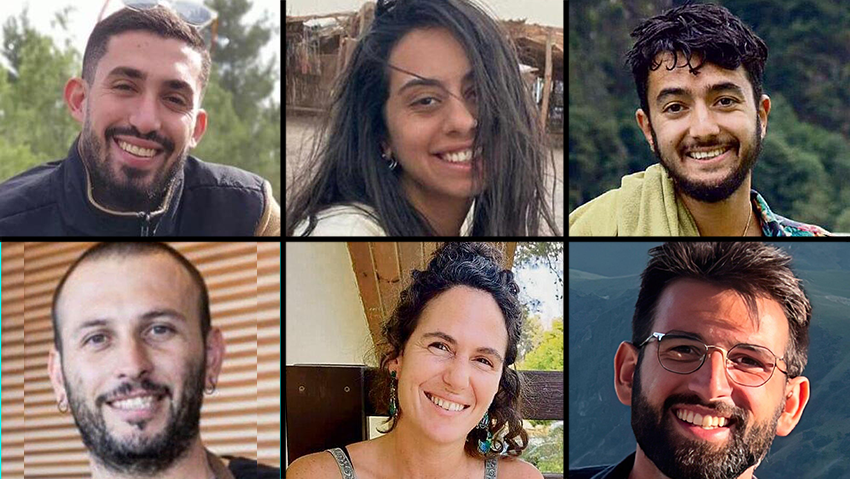
From top left: Ori Danino, Eden Yerushalmi, Hersh Goldberg-Polin, Alex Lobanov, Carmel Gat and Almog Sarusi
Since October 7, their parental status changes constantly and with cruelty characteristic of the Gazan terror organization that held their son and is responsible for his death. From an average family of parents to three, they became parents to two daughters, Libby and Orly, and to the kidnapped son, Hersh, whose hand was amputated and documented during his kidnapping to Gaza. Rachel suddenly became the mother of a hostage who gave a powerful and inspiring speech at the UN assembly two weeks after the kidnapping. Suddenly, they became parents to two and to a hostage, from whom signs of life arrived, and who was filmed by Hamas begging "stay strong for me."
And finally, why are they parents to two daughters and a son, who was one of six hostages murdered a year ago: "We also try to remember that we're in a completely different place now," says Rachel, "that we're 'next to' hostage families, because, yes, we got our hostage back. Not as we prayed and hoped and yearned and worked for him, but we have Hersh. We have a place where we were able to bury him, which we can go to. We want everyone alive to return home. And for the beloved souls who are not alive, that their families will have the place we have, which is a terrible and sickening thing; it doesn't make you feel better, but it's something."
With no small part of the hostage families, they're still in contact, seeing up close the continuation of the nightmare as reflected in the bitter fate of others: "Their pain is so tormenting, like skin that's been torn off. Every parent who lost their child is in another kind of torture, but the torture that these parents, whose children are still there for another year, go through, and families like Rom's, Avitar's, and Matan's, who recently saw photos of their children suffering so terribly, we never had that. We imagined it. So you know, our heart is on the floor for them."

Hersh next to his sisters and parents
Tens of thousands of reserve duty orders were sent this week to reserve soldiers ahead of the conquest of Gaza, and the plans have already been approved despite opposition from the Chief of Staff. Currently it appears that on September 4 the conquest of Gaza will begin, and despite the military's reservations and the people's opposition, the government continues as if nothing has changed from a year ago.
Jon: "A year ago, the story was Rafah, now the story is Gaza City, and as Rachel tends to say - and this was relevant a year ago and today too, at the beginning of Elul - 'This is the time to look inside ourselves as individuals and as a people and ask, what can we do differently? What can we do better? How can we learn from things we did wrong?' We know what happened in the tunnel, in Rafah, to six beautiful people;;e, we have an opportunity now to do something different. Will we do it?"
Jon's question doesn't remain in the air; Rachel catches it quickly: "Rambam says this is the true essence of repentance, to put yourself in the same situation and choose the choice you missed the previous time. 'Sin' means to miss the target, okay? It's very human to miss, but when we're put in the same situation, we have the ability and opportunity to correct. So now this is our real opportunity to choose what we missed a year ago."
But 688 days that the government doesn't make the right choice, and it seems the only act is preferring military force over negotiation and diplomatic moves. It seems, at least currently, they don't really connect to ideas like repentance and soul-searching.
"I think we learned that there are always conversations taking place," says Rachel, "we don't always know what's happening, and we learned a lot about the essence precisely through how it's presented in the media. When there's a lot of choreography and theatrics and drama in the media, it doesn't always indicate that things are happening behind closed doors, and vice versa. Sometimes we were told things whose natural response would be to say: 'What, dear Go, ', and we learned to tell ourselves, 'Wait, take a breath, what's actually happening he. ' Because we were in many of those rooms with other hostage families and heard one thing, left the room, and within minutes saw something else printed, and we had to understand for ourselves what was really happening. Unfortunately, we're not always in on the secret, not always given the precise truth, and that's something we didn't know in real time. It's part of our awakening."
So how are family members of a hostage supposed to know where the truth is? According to investigations, including in the New York Times, more than once, Netanyahu torpedoed a hostage deal because he preferred hardening positions and military action for his own reasons.
"As parents, we don't know what decision-makers are really doing," says Jon, "but we can demand they pull our forces back, and remind everyone that even before we entered and began military pressure, we said it's not the final goal, it's a tool to weaken Hamas and prevent it from becoming a ruling power. 688 days in - I'll just remind, when we think about military pressure, to ask whether it achieves these two goals - or have we lost our way?"
Interestingly, the people in government who would argue with you about Zionists are precisely religious Zionists like you who define themselves as religious Zionists. With the ultra-Orthodox, it's easier on this matter, because they've already announced they'll vote for any hostage deal brought before them. When Rachel talks about Torah prohibition, they're aware of this, and yet apparently won't agree with you.
Jon: "We all make assumptions based on external appearance. Does the man wear a kippah? What color? What size? I know wearers of large black kippahs with black hats on them, and they're wonderful, and I know some who are less wonderful. And I know people who don't wear kippahs, and they're wonderful, and some are less wonderful. I understand that. We want to talk about the thousands of ultra-Orthodox and secular, and religious, and Arabs who came to Hersh's funeral."
And Rachel adds: "Jon specifically is a Zionist and religious, wears a kippah, prays three times a day, washes hands before eating bread and says grace after meals, and all the things that on the surface make people think you're religious, despite us knowing well the recommendation 'don't look at the jug but at what's in it'. This is no small challenge for us. We don't want to make this about what Kippahs Waboutut people's views on redeeming captives, for example. One of the things that became very clear to me during the struggle to return Hersh and the other hostages is that we live in a world where you are not what you say, and you are not what you think, and you're not even what you believe in. In this world, we are what we do, period, end of sentence, that's it.

(Photo: Nachum Segal)
"Years ago, I worked as a student on a hotline for women who suffered violence from their partner and called to ask for help and support. We tried to help them leave, and they didn't want to. They said things like 'but he loves me. He tells me he loves me. I answered, 'Okay, he told you. '. 'And then she said, 'No. I know he loves me. I answered: 'Okay, you know he loves you, you think and believe he loves you, but he hits you and that's all that matters'. We witnessed this dozens of times in closed rooms, when families cry with us, and they tell us they believe redeeming captives is most important. Don't tell me what you believe, unless you're going to act on it. Actions, actions. If you don't do it, it doesn't count. We are what we do, so I think we need to be very careful because our children see this. The state sees it, the world sees it, and God sees it; we need to be very careful about what we choose to do. They're watching us. And what we do with this is what they'll remember."
Jerusalemites knew Hersh long before he was kidnapped to Gaza. He created rare friendships based on love for his team, Hapoel Jerusalem, met people at colorful nature parties, collected friends from social and community activity - from demonstrations for LGBT rights to graffiti in favor of refugees, and kept soul friends from the religious high school Himmelfarb, where he studied.
Initially, as part of the struggle for his release and later on the path to commemorating him, the public in Israel and even in the world also learned to know the living, laughing, "tactless" Hers, as his friends told at the memorial, and full of life that we will no longer get to know. They were all there last week at the square of "Shevet Metzada" in the Crossroads Valley, young people with kippahs alongside cap wearers, adults in kippahs alongside bareheaded secular people, women wrapped in shawls alongside women dressed in pants, soldiers in uniform and weapons alongside ultra-Orthodox scholars, and the religious scout members, Hersh's friends, who surrounded Rachel, Jon and the girls and sang: "Who is the man who desires life, loves days to see good," in a clear Jerusalem twilight hour. But before he belonged to everyone, Hersh Goldberg-Polin belonged to his parents and sisters, and they are the ones who carry the weight of longing for him, remember the daily greatness of soul, and the talent for not hurting his loved ones even when he insisted on going his special way.

(Photo: sina Schuldt)
Like then, when he came to tell them about his relationship with religion: "Hersh was religious until high school," says Rachel, "and when he was in the army, he told us, 'I'm not going to keep Shabbat like you', and it was very painful to hear. I didn't grow up religious, and as a parent, you choose a path that is so meaningful and valuable and dear to you, and you try to give it to your children, and when they say, 'You know, no mom, this doesn't speak to me, 'it's very hard. But in the sambreathea, he said, 'But I will always be respectful and behave respectfully. 'On I asked him, 'How will this work?' We're a family that goes together to synagogue both Friday evening and Saturday morning. And he continued to always come with us."
Hersh continued the tradition he promised his parents, even when he enlisted in armor. "It's not easy. Tash [armor training] is no joke," she laughs, "you come home once every three weeks, and finally can see your friends. Hersh would come with us on Friday evening to the synagogue, and the morning is harder. We hear him coming in at four or five in the morning from his friends, and I say to Jon, 'Yeah, right. Come on, Dinak, do you think he'll go with us to synagogue?' After several years, I asked him how he continues to come with us to synagogue, because I felt how tired he was. And he answered: 'You know, Mom, Dad, I come because I don't want Dad to sit alone in synagogue'. When I told this to a rabbi we know, he said about Hersh: 'He's the most religious person I know', because to do this for 'honor your father and mother', so that his father won't be alone at a time when he doesn't want to go at all, this is the place where you show who you really are. Maybe he didn't keep commandments like others, but the way he did it was such that it continued to show us respect."
You talked at the memorial about this small ritual between you, when he would offer to carry your bag.
"I miss and love him; he was my son. I admired him, and I still admire him, because these things don't stop, admiration doesn't stop, love doesn't stop. I love him more now than I loved him this morning. It's like bamboo, it continues to grow and doesn't stop. He was always very careful with me, very gentle," she suddenly smiles. "I would tell him he approaches me like Fred Astaire, in a kind of inviting hand movement. No matter what bag I had - on Shabbat it's a really small bag, just with a key and tissue or lipstick, really nothing - he wouldn't give up. It was a symbol of his desire to help me."
On protest day last Monday,y they were photographed when Joliftedts her on his shoulders, and Rachstuckcks a sticker for releasing hostages on a billboard in Tel Aviv. Active participants above the Israeli average, but also much less on the media radar. Their position is clearer than ever, especially toward another protest day in the middle of the week, but they're not ready to judge those who oppose the protest, not from the public and certainly not from hostage families.
"Everyone should do what they think can work and what they feel comfortable doing," says Jon, "for some it's protesting, for others it's deep, serious, focused prayer; for others it's committing to do some act in an attempt to bring hostages home, for others it's speaking quietly behind the scenes with leaders. Do what you feel comfortable doing and what you think might have an impact, but if you care about the 50, if you really worry about the 50 hostages and you really believe that we as a people need to bring home these 50, don't sit quietly doing nothing."

Hersh's family
(Photo: Shalev Shalom)
The spontaneous protest that ignited on the evening of September 1, 2024, the day the murder of the six by their captors was published, proved to them that the Israeli public is attentive and sensitive toward them much more than the government is capable of. "I feel that their murder slowed things down," says Rachel, "and showed that when we were too confident in ourselves and felt we could just continue with military moves, it created a situation that caused these six beautiful people to be killed. Our understanding, even without being military tacticians, is that everything stopped with screeching brakes after the six were killed. We saw this very clearly. We may have talked much more than we do, but the way the military has maneuvered since has completely changed.
"I think the death of the six was the greatest nightmare realization for soldiers and commanders - and it doesn't matter who decided to enter the area where they were held. When it became known that Farhan emerged from there 36 hours before, then it was clear there were hostages there. Since then, the military's conduct has been like on tiptoe, quiet, slow, careful, and I think the military is trying to do everything so they never again return more people who were alive in bags."
Did you hear the parents of hostages, Avinatan Or's mother and Eitan Mor's father? They spoke a lot this week about protest versus military force, and said basically the opposite of what we're saying here, and I believe them that they believe in this - that this is the way to save their children. Do you have any answer for them or for people who say: "Netanyahu is working correctly, we need to conquer Gaza and apply military pressure to release hostages?"
"I don't want to get into politics," says Jon, "I'll just talk about facts. Here's one: 42 of our brothers and sisters and children entered Gaza alive and were killed in Gaza. We're on day 688 of their kidnapping, we tried a lot of military pressure, and we still have 50 hostages. We brought home about two hundred hostages - some alive, some not, but ultimately we brought them through deals. Through the military force, we brought eight in 688 days. Others might see things differently. Military pressure should be a tool and not the final goal because when military pressure becomes what drives us, we know it killed many more hostages than it brought home."
And when in the past four days you hear Netanyahu say, "Yes, we'll send a new delegation and conduct new negotiations," at this point, do you believe him? Because it's become complex to follow. One day, he wants to conquer Gaza, and the ne,xt h talks about a new negotiation team.
Jon: "I don't want to talk about Bibi specifically or anyone else. I want to talk about the results. What's happening? Nothing. Nothing has been happening for a long time."
Liri Albag's father, Eli, said in an interview that he planned to take 20 cars and set them on fire as a protest, to cause intentional chaos to pressure Israeli leadership that didn't hurry to a deal. Many Israelis understand that the ongoing protest isn't effective enough; the fact is that a military operation is being prepared while 75 percent of the public supports a deal and ending the war.
"I don't know," Jon answers, "after 688 days, it's so hard to know what can really work. I don't remove responsibility from Hama; we'll never forget that they entered at 6:29 in the morning on October 7 and did what they did, and documented it and enjoyed doing it. I don't give the Israeli government a pass for not achieving the goal after 688 days and not bringing everyone home, and if you don't like the deals being offered, then propose your own proposal. I don't like that we're just sitting and waiting for a deal. Additionally, there's a complete global failure here, a diplomatic failure. There were hostages from 30-something countries, we're 688 days into this, and instead of leaders of these countries whose citizens were kidnapped standing together and demanding the release of hostages, they're doing nothing."
Is this classic antisemitism, or political opposition to Israel's policy in Gaza?
Jon: "I don't know how much Israel's policies and actions are really what causes the world not to like us, but what I can say is we're not helping ourselves."
And what do you think is the explanation for hatred toward us in liberal strongholds in the United States? From the first days of the war, there were anti-Israeli manifestations on the most sought-after campuses in America. When you were students there, did you feel this?
Jon: "For 38 years, before I came to live in Israel, I could count on one hand the times I felt like a victim or recipient of antisemitism. These were small comments. When I was 2,0, someone drove next to me on the street, saw my kippah, ah and said, 'Get out of Palest.neComments. ' nts like that, but rarely. The best years of my life were at university in the United,. Enjoy living life and being active around Israel, and we always wear a kippa.s, I never felt threatened, never felt fear. I'm so sad for my nieces and nephews and for children in America today who don't know this reality, who can't feel safe putting a mezuzah on their university door. I think something was brewing there under the surface for a long time, and now people feel they got permission to behave like this toward Jews."
First published: 18:03, 09.02.25