


High school studies in STEM — science, technology, engineering and mathematics — are one of the main gateways to prestigious positions in the military and the job market and to future economic success. Yet despite widespread recognition of their importance, most students who choose these subjects and remain on the track are boys.
The data show that the gap is not about ability. Overall eligibility rates for Israel’s matriculation certificate, known as the Bagrut, are nearly identical: 76.4% among boys and 76.1% among girls. But when it comes to advanced STEM subjects, the picture changes. Only 15.4% of girls take the highest-level, five-unit mathematics matriculation exam, compared with 19% of boys. In physics, the gap is even wider: 5.7% of girls compared with 12.5% of boys.

And even when girls do take five-unit mathematics, most do not choose the “high-tech” track, which combines advanced mathematics with higher-level computer science or physics. In 2024, for example, girls accounted for only about 34.5% of students taking the five-unit computer science exam.
Behind those figures is a process that begins long before students choose their high school concentrations. Gender stereotypes, adults’ expectations, confidence in one’s abilities and fear of failure accumulate over the years, influencing decisions that can later determine access to technological units in the IDF, university programs and the high-tech industry.
‘A gap in opportunity’
“This isn’t a gap in ability, but a gap in opportunity,” said Prof. Irit Sasson, a senior lecturer at the Tel-Hai University of Kiryat Shmona in the Galilee. She noted that results from the international PISA assessments show almost no difference between boys’ and girls’ performance in science and only a relatively small advantage for boys in mathematics.
Despite that, too few girls choose to pursue those fields. Women account for about 38% of graduates of academic STEM programs worldwide and about 37% in countries belonging to the Organization for Economic Cooperation and Development. The disparity widens further when graduates enter the workforce.
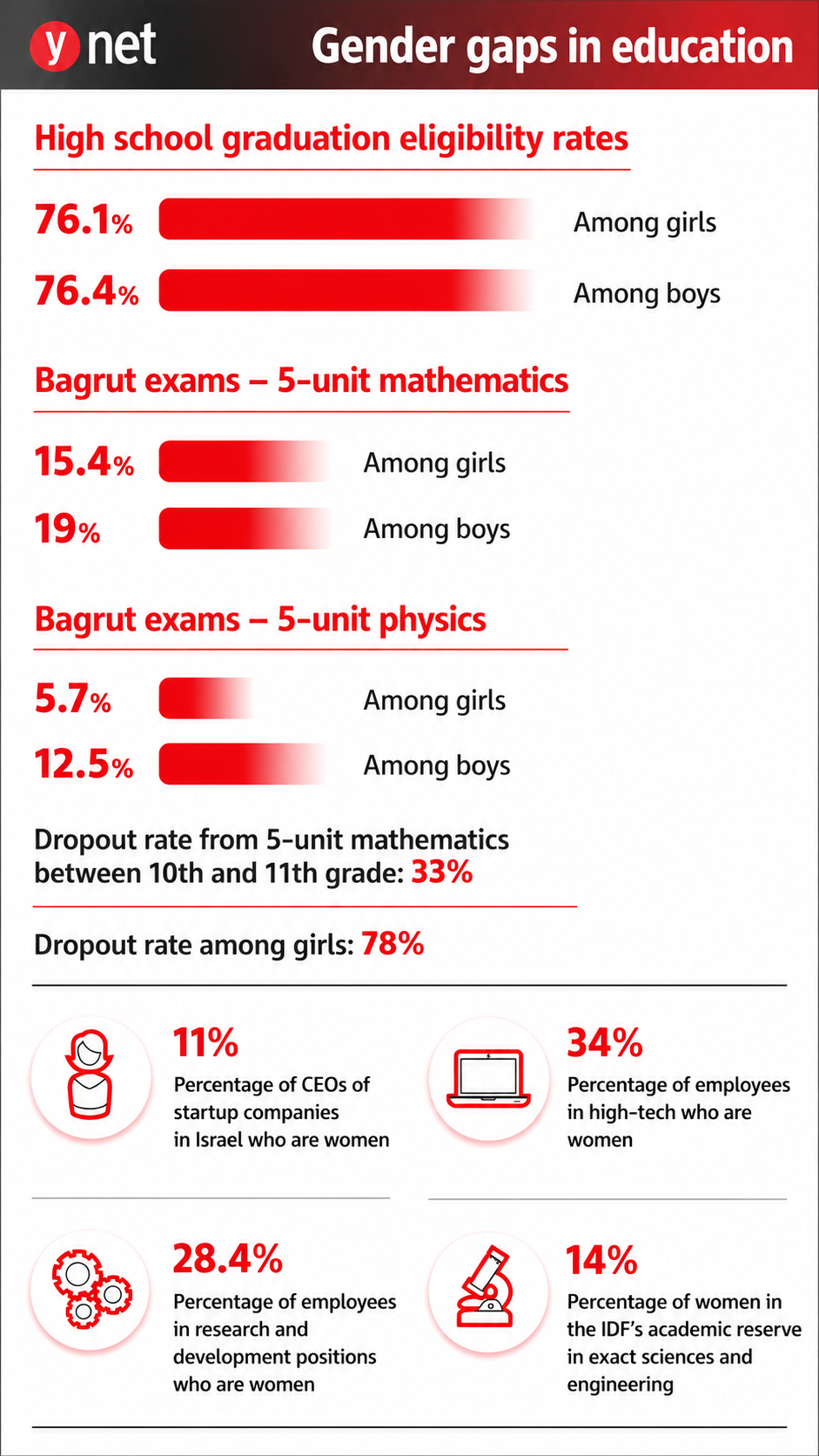
In Israel during the 2024-25 academic year, women made up about 34% of students in fields associated with high-tech. In 2025, they accounted for about 34% of high-tech employees but only about 28.4% of those working in research and development positions.
The gap is also evident in the military, where women account for about 40% of personnel in technological roles that do not require an academic degree but only about 14% of those in research and development positions requiring higher education.
A similar pattern can be seen in the IDF’s Academic Atuda program, which allows selected recruits to complete university studies before beginning their military service. Women account for just 14% of participants studying exact sciences and engineering.
“This is a mechanism that could perpetuate economic and social disparities and reduce mobility and access to positions of power and decision-making,” Sasson said.
She said the gap results from a combination of personal, social and institutional factors, including gender stereotypes, expectations from families and society, a shortage of female role models and teaching methods and curricula that can explicitly or implicitly convey the message that certain fields are “masculine.”
“Studies conducted in Israel have found that even when abilities are similar, boys and girls make different decisions about advanced academic tracks,” Sasson said. “For example, girls assess their abilities in physics as lower and are less likely to associate technological studies with future opportunities in the military and the job market.”
What could change the picture?
“Collaborative and interactive learning environments that incorporate discussion, active experimentation and opportunities to express ideas, alongside less emphasis on competition, may help increase girls’ participation and strengthen their confidence in their scientific abilities,” Sasson said.
 Prof. Irit Sasson Photo: Tel-Hai University of Kiryat Shmona in the Galilee
“Programs aimed at increasing participation in STEM therefore cannot settle for simply increasing exposure to these fields. They must also adapt teaching methods and systematically assess their impact on girls and boys.”
Sasson said efforts should begin at a young age. They should include making science and programming extracurricular programs and advanced classes more accessible to girls, actively encouraging female students and informing parents and teachers about future opportunities.
She also called for more girls to be invited to screening and selection processes for technological positions in the military, greater exposure to female role models and mentoring programs and, above all, inclusive teaching methods that strengthen students’ confidence in their abilities.
Those efforts, she said, should be accompanied by teacher training and systematic monitoring of gender disparities at every stage of the educational and professional pipeline.
‘We’ve been taught that boys are better suited to these fields’
Yuval Shulman, who is entering 12th grade at Beit Eliezer High School in Hadera, is pursuing an advanced track combining five-unit mathematics, physics, biology and English.
“There are still stereotypes surrounding these fields, and I think many girls are simply afraid to enter them, especially because boys are the majority,” she said. “I believe any girl can succeed in science if she wants to. You shouldn’t be afraid to choose a less conventional path. There’s no reason girls shouldn’t be there just as much as boys.”

Yuval Shulman and Esti Rabaev
(Photo: Elad Gershgorn)
Shulman said she chose the track because she enjoys challenges and is curious to learn and develop.
“I knew this choice would open doors for me in the future,” she said. “My dream is to work at a high-tech company one day, and it was important for me to choose a track that would give me as many options as possible. The studies are challenging, but they give me a great sense of accomplishment and confidence in my abilities.”
Her classmate, Esti Rabaev, said the path is not easy.
“The studies require investment, commitment and a lot of time. But for me, it is absolutely worth it,” she said. “I feel this choice will broaden my horizons and create many opportunities in the future.”
“For years, society has conditioned us to think that boys are better suited to these subjects and to the high-tech world,” Rabaev added. “I think more girls need to be exposed to the opportunities available to them through lectures, personal examples and showing them what their future could look like. Girls can succeed in these fields just as much as boys. If you have the determination, the sky’s the limit.”
Ruth Shoham, CEO of the Davidson Institute of Science Education, said women account for slightly more than a quarter of employees in development positions in Israel’s high-tech industry. Just 11% of Israeli startup CEOs are women, she said, while women-led companies receive only 4.5% of total investment in the sector.
“In the coming years, Israel will need to increase the size of its combat forces while preserving and even expanding its technological advantage,” Shoham said. “That creates an opportunity to expand women’s participation in technological professions in the IDF, intelligence, cyber, research and development.”
Expanding the number of women entering those fields, she said, is “a strategic move that can increase the pool of human capital on which Israel will depend in the coming decades.”
‘Girls are perfectionists. Boys keep going even after failing’
Meirav Zarbiv, a deputy director-general at the Education Ministry and head of its Innovation and Technology Administration, said the ministry is working to strengthen female students’ confidence in their abilities while holding workshops and awareness programs aimed at changing perceptions among teachers and principals.
The ministry also provides financial incentives to schools that open prestigious “Bagrut-Tech” classes, an advanced high school track geared toward technology studies. School principals have been instructed to ensure that girls make up 50% of such classes as a condition for approval.
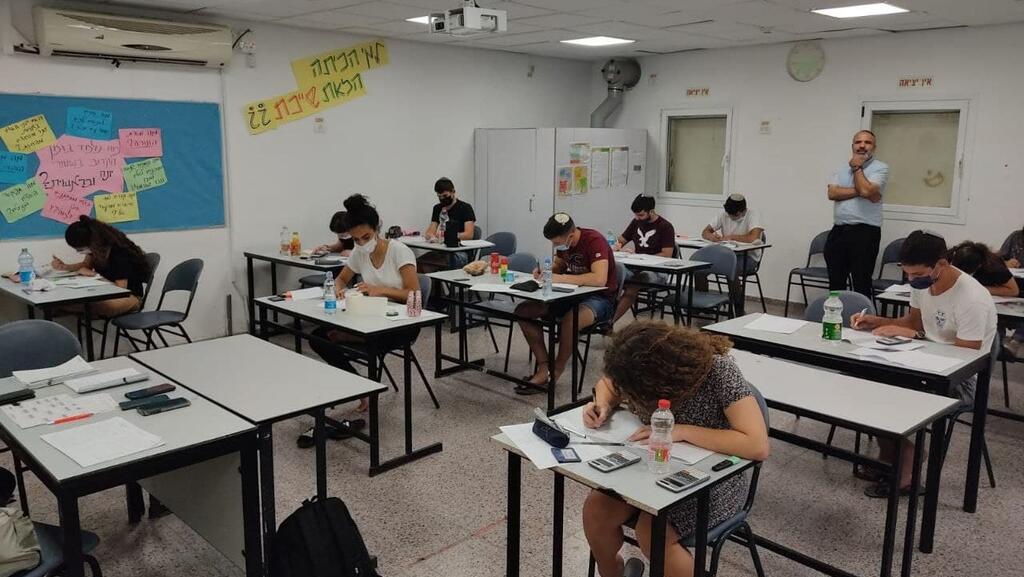
A Bagrut exam in Gan Yavne
(Photo: Education Ministry)
“We are also investing efforts to reduce dropout rates among girls as much as possible,” Zarbiv said. “Under the procedure, only a principal may approve a student dropping out, after every effort has been made to strengthen and keep her in five-unit studies in the sciences.”
In practice, however, that does not always happen. Girls who struggle are often encouraged by the education system to move to less demanding tracks.
Zarbiv stressed that the process shaping students’ choices does not begin when they select high school concentrations in ninth grade.
“It starts in kindergarten, with the image that boys belong in the world of Lego and robots and girls with dolls,” she said. “It continues at home, in the early grades and in the guidance students receive when choosing high school tracks.”
There is another factor, she said.
“Girls are perfectionists, and if they fail, they say, ‘This isn’t for me.’ Boys will keep going even if they fail three or four times,” Zarbiv said.
The result, she said, is that about 33% of students enrolled in five-unit mathematics drop out of the advanced track between 10th and 11th grades. Of those who leave, 78% are girls and 22% are boys.
A survey by the Trump Foundation for Education and the Geocartography Institute supports that assessment. According to the survey, about 9% of girls describe the high-tech matriculation track as difficult, compared with 30% of boys. About 10% of girls say it is “not suitable for people like me,” compared with 7% of boys, while 10% of girls describe the track as intimidating or frightening, compared with 8% of boys.
Eli Hurvitz, CEO of the Trump Foundation for Education, said the next objective is clear.
“After female students became equals among equals in five-unit mathematics, the next step is true equality in the high-tech matriculation track — meaning physics and computer science as well,” he said.
“When they are there in equal numbers, the question will shift to the IDF’s technological units and the Israeli high-tech industry: Why are women still not equally represented there?”