


The parliamentary election, which ended Tuesday at 10 p.m. when polling stations closed, revealed several unexpected developments: high overall voter turnout, exceptionally strong participation among Arab voters and liberal strongholds where turnout approached its potential maximum but still failed to bring about a change in government.
Prime Minister Benjamin Netanyahu survived the election campaign but did not win a clear victory, leaving him at the center of a political deadlock.
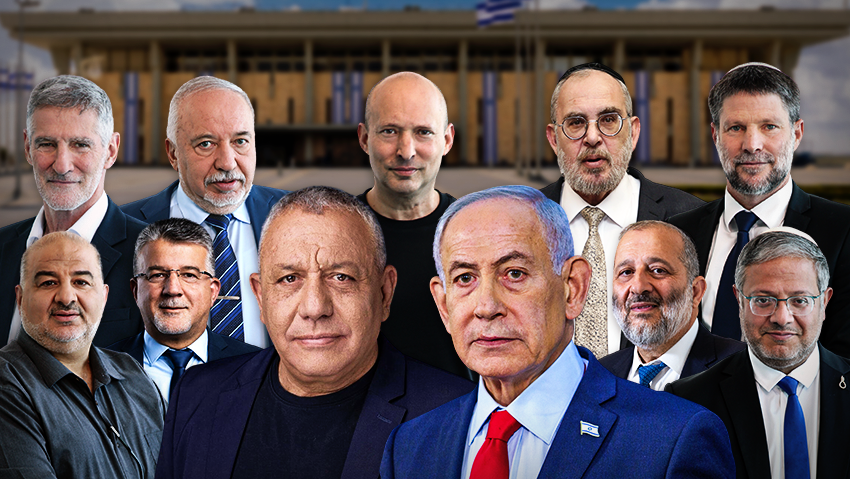
Since addressing their supporters Tuesday evening, the political party leaders have largely disappeared from public view.
Netanyahu broke with his usual practice of calling the leaders of his political bloc on election night after the exit polls were released. He also spent Wednesday dealing with matters unrelated to his coalition partners.
The prime minister issued no statements to the media apart from two social media posts, one of which was addressed to the general public and simply read: "Thank you very much."
However, the office of United Torah Judaism Chairman Yaakov Asher said it had received a message from Netanyahu's representatives.
"In response to journalists' inquiries, we wish to clarify that there have been no approaches from party leaders, apart from a message conveyed by people close to Prime Minister Netanyahu indicating that he intends to keep the coalition parties together," Asher's office said.
But Netanyahu's unusual silence toward his political allies is not the only development attracting attention. The leaders of the rival pro-change bloc have also largely remained silent.
Apart from Joint List Chairman Yousef Jabareen, who called Wednesday morning on the pro-change parties not to ignore the Arab parties, none of the main political figures has appeared publicly to assess the election results, outline their next steps or explain how they intend to proceed.
Democrats Chairman Yair Golan limited his response to a post on social media.
"There is an opportunity to form a government in partnership with the Arabs. Netanyahu has no business lecturing anyone about Zionism," he wrote.
The silence may partly reflect the fact that the official election results have yet to be finalized.
But senior political figures believe it also reflects shock and disappointment on both sides over the realization that virtually any scenario other than another election would require at least one major political player to break a fundamental campaign promise.
For the pro-change bloc, that could mean considering a unity government with Netanyahu despite pledges not to serve under him.
For Netanyahu, it could mean abandoning some of his longstanding political allies, despite promising that all would remain part of his governing bloc.
For now, it remains unclear which direction Israel's political leaders intend to take or which options they consider realistic.
Most are holding closed-door consultations, weighing their public messages and, above all, developing strategies for the next stage.
In Eisenkot's Yashar! party, for example, members of the electoral list met and thanked the hundreds of thousands of voters who supported them, along with thousands of campaign activists, local campaign leaders and field organizers.
Hundreds of thousands of ballots could change the outcome
As of the latest count, 93% of polling stations had been tallied, representing 85.6% of all votes cast.
Netanyahu's right-wing and religious bloc was projected to win 53 seats in the 120-member Knesset, compared with 48 for the pro-change bloc and 19 for the predominantly Arab parties.
Neither major bloc had reached the 61 seats required for a parliamentary majority.
The results could still change significantly, however, with an estimated 430,000 to 480,000 so-called double-envelope ballots yet to be counted.
These ballots are cast by soldiers, reservists and other eligible voters who vote outside their regular polling stations. Counting was expected to begin Wednesday evening.
Under the current circumstances, the only electoral list still below the 3.25% threshold for entering the Knesset that appears to have a possible path into parliament is the joint Reservists-Economic Party list led by Yoaz Hendel and Yaron Zelekha.
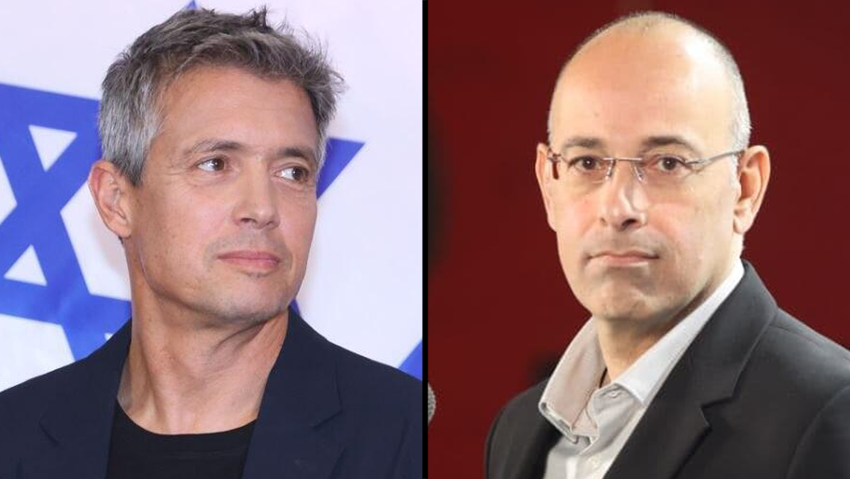
Yoaz Hendel and Yaron Zelekha
(Photo: Moti Kimchi)
With 85.6% of votes counted, nearly 128,000 ballots had been cast for the list, which runs under the Hebrew ballot letters Dalet-Yod.
That means the alliance needs approximately 57,500 additional votes to cross the electoral threshold, estimated at around 185,000 votes.
If the joint list manages to overcome the odds and enter the Knesset, the consequences could extend well beyond its own parliamentary representation.
Based on the count of 93% of regular polling stations, before the double-envelope ballots are included, the parties currently positioned to lose seats would be Shas, Beyachad, the Joint List and Yashar!.
Politically, that would reduce Eisenkot's pro-change bloc to 46 seats and Netanyahu's bloc to 52.
The Arab parties would hold 18 seats, although that figure could decline further depending on the distribution of the outstanding double-envelope ballots.
Such an outcome would further complicate coalition negotiations and potentially give Hendel and Zelekha a significant role in determining the composition of Israel's next government.
Likud alleges Arab parties 'stole the election'
While Netanyahu himself has remained relatively quiet, his Likud party has already approached the Central Elections Committee with allegations of widespread election fraud involving Arab political parties.
Likud claimed that "the elections were stolen by Arab parties that support terrorism and the destruction of the Jewish state through serious criminal offenses involving bribery, threats, violence, forgery and the use of prohibited voter-mobilization software."
In its statement, Likud said it had submitted hundreds of testimonies and pieces of evidence to the Israel Police and Shin Bet domestic security agency concerning alleged irregularities at numerous polling stations in Arab communities.
The party cited "thousands of envelopes containing cash and Ra'am ballot slips, threats and violence against polling station officials, multiple voters behind voting booth curtains, voting under duplicate identities, discrepancies between the number of envelopes and the number of voters, the use of prohibited voter-mobilization software and more."
Ra'am is an Islamist party led by Mansour Abbas that draws much of its support from Israel's Arab population.
The allegations come after unusually high Arab voter turnout helped the predominantly Arab parties make substantial electoral gains, with their combined representation projected at 19 seats in the latest count.
That increase has become particularly significant because neither Netanyahu's bloc nor the rival pro-change bloc appears capable of securing a parliamentary majority on its own.
Likud demanded a thorough investigation into the alleged irregularities.
With the final vote count still underway, Israel's political leaders face an uncertain parliamentary landscape in which forming a government may require difficult compromises, broken campaign promises or another election.