

What began as one of the coalition’s most ambitious ideas has effectively run into a dead end: despite more than a year of political declarations, government discussions and efforts to find host countries, no state has agreed to receive Palestinians leaving the Gaza Strip.
The idea of encouraging what officials termed “voluntary migration” from Gaza was championed by far-right ministers Itamar Ben Gvir and Bezalel Smotrich and later embraced publicly by U.S. President Donald Trump. More recently, former IDF general Ofer Winter, who launched the new Amcha Israel party, presented transfer from Gaza as his preferred solution.
Gallery

(Photo: Alex Kolomoisky, Yariv Katz, Chaim Goldberg/Flash90, Brendan Smialowski/AFP, Reuters/Dawoud Abu Alkas)
But the plan failed to gain international traction, and Trump himself later moved away from it. His 20-point Gaza plan, published more than seven months after he first spoke publicly about encouraging Gazans to leave, explicitly called for residents to remain in the territory rather than be encouraged to emigrate. Israel adopted that framework.
The Cabinet had already approved preparations in March 2025 for Palestinians who wished to leave Gaza. Defense Minister Israel Katz ordered the creation of a Defense Ministry directorate to deal with voluntary migration, while the Mossad was tasked with identifying countries willing to receive Gazans. The effort was accompanied by repeated public statements, but ultimately produced no agreement with a receiving country.
The documents behind the effort
On February 6, 2025, Katz announced that he had instructed the IDF “to prepare a plan that would allow any resident of Gaza who wishes to do so to leave for any place in the world willing to receive them.”
The Movement for Freedom of Information later asked the military for copies of any plans prepared on the subject and for a list of IDF discussions held to formulate them. The IDF responded that it had no information responsive to the request.
More than a year later, on May 27, 2026, Katz continued to insist publicly that the policy remained alive.
“We promised that Hamas would not rule Gaza militarily or civically, and that is how it will be,” he said. “The voluntary migration plan from Gaza will also be implemented, all at the right time and in the right way.”
His comments indicated that even by then, more than a year after Trump and Prime Minister Benjamin Netanyahu first promoted the concept publicly, the plan had still not been implemented.
In June, National Security Council chief Shmuel Ben Ezra convened an interagency meeting on advancing voluntary migration. Representatives of the IDF, Defense Ministry, Mossad and Shin Bet were invited. According to information presented at that meeting, Mossad representatives said no countries had been found that were willing to receive Gazans.
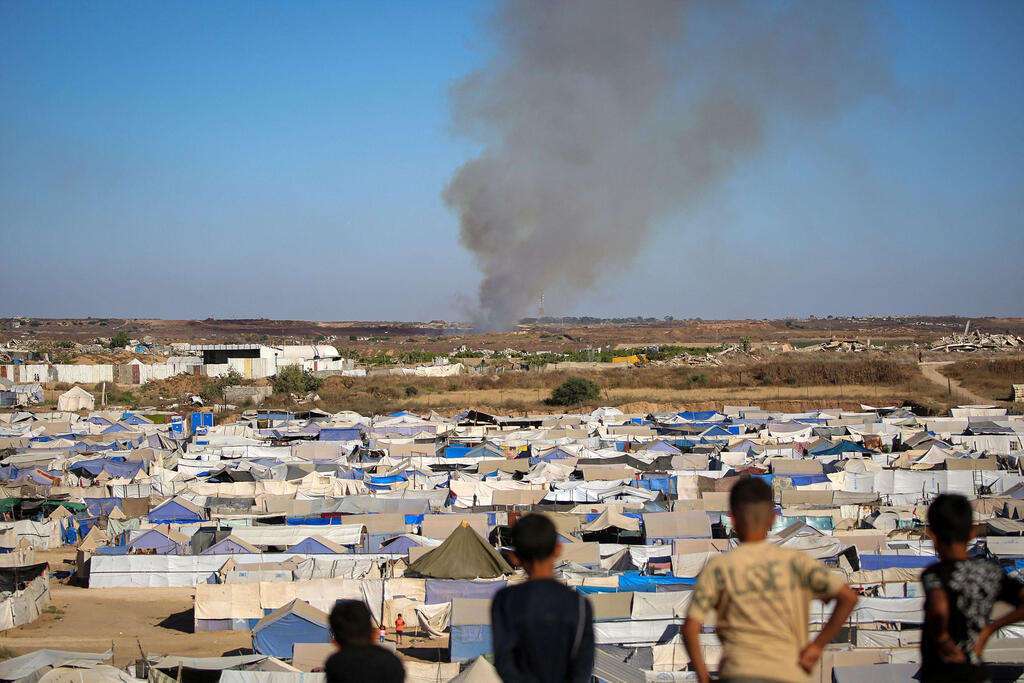
Refugee camps in Gaza
(Photo: Eyad Baba / AFP)
Netanyahu’s adviser Caroline Glick was also tasked by the Prime Minister’s Office with advancing the issue.
The Defense Ministry told the Movement for Freedom of Information that the directorate was headed by retired Col. Yaakov “Kobi” Blitstein, a deputy director general at the ministry, in addition to his existing duties. No dedicated staff positions were created for the project, though outside service providers were employed. The ministry declined to disclose the substance of the directorate’s work, citing security considerations.
The information requests also sought data on how many Gazans had left through the directorate, their departure points, destination countries and other details, as well as copies of the ministry’s plans and contracting records. The Defense Ministry declined to provide much of that information.
Attorney Hidi Negev, executive director of the Movement for Freedom of Information, criticized the lack of transparency.
“It is infuriating to discover that only after court petitions do the IDF and Defense Ministry tell the truth about the voluntary migration directorate,” he said. “Once again we discover there was nothing, and apparently there will be nothing.”
Why no country agreed
Officials now largely acknowledge that the plan has little political or international feasibility.
Netanyahu nevertheless held repeated discussions on voluntary migration and allocated responsibilities among officials. The issue also played a role in his efforts to keep Ben Gvir inside the coalition, and Netanyahu instructed officials to accelerate contacts with countries that might agree to accept Palestinians.
At one stage, reports said understandings had been reached with five possible destination countries, including Ethiopia, Libya and Indonesia. Then-Mossad chief David Barnea also raised the issue with U.S. envoy Steve Witkoff and other American officials, seeking Washington’s help in persuading those countries.
In the end, none agreed to accept Gazans.
The resistance was hardly unexpected. Arab and other governments have repeatedly opposed any move they believe could become permanent displacement of Palestinians from Gaza. For Arab states in particular, accepting large numbers of Gazans is widely viewed as risking what they describe as a “second Nakba,” a reference to the mass displacement of Palestinians during the 1948 war.
Governments also fear that taking in hundreds of thousands of Palestinians would shift responsibility for Gaza away from Israel while weakening Palestinian claims to the territory. Security concerns are another factor, with some states worried that large-scale arrivals from Gaza could include Hamas members or other Islamist militants.
There is also the economic burden of absorbing large numbers of people requiring housing, jobs, schools, health care and other infrastructure. Together, those concerns have left the government without a willing partner for the plan.
Winter brings the idea back
That has not stopped the issue from returning to domestic politics.

Former IDF general Ofer Winter
(Photo: Shalev Shalom)
At the launch of his new Amcha Israel party this week, Winter declared that transfer was the only solution for Gaza. He did not explain how he would persuade foreign countries to accept Palestinians when the current government, despite extensive diplomatic and intelligence efforts, was unable to find a single country willing to do so.
More than two million Palestinians remain in the Gaza Strip. For now, whatever political appeal the migration idea retains on the right, the central obstacle remains unchanged: there is nowhere for them to go.