

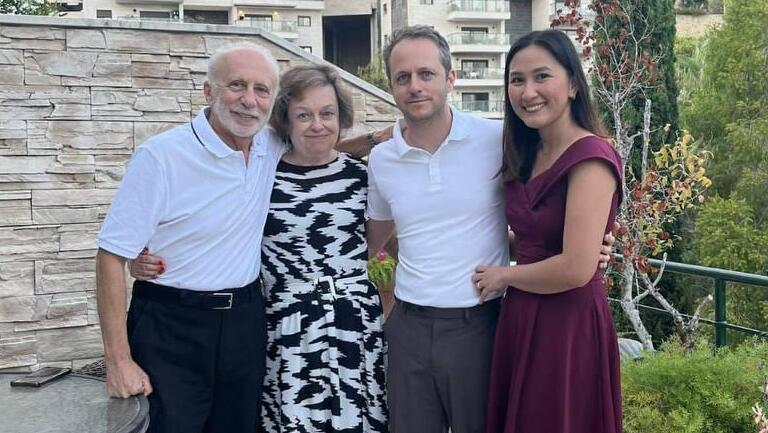
Four members of the Gershovitz family — Lena, 68, her husband Vladimir, 73, their son Dima, 42, and his wife Lucille-Jane, 29 — were killed in a direct hit by an Iranian missile in Haifa. IDF Spokesperson Brig. Gen. Effie Defrin said Monday that “interception attempts were made, but unfortunately they failed. Our air defenses are very strong, but not hermetic.”
At a press briefing, Defrin said the incident remains under investigation. The family had sought shelter in the stairwell, fearing the elderly parents — including Vladimir, who had been released from a prolonged hospital stay just hours earlier — would not reach a protected shelter in time. He urged Israelis to “continue to act responsibly and follow instructions. We know many people struggle to reach protected spaces — help those who need it.”
The scene in Haifa after the Iranian missile strike
(Video: Ido Erez)


Military analyst Ron Ben-Yishai noted the Iranian missile broke apart midair, preventing interception — a problem seen 35 years ago during the Gulf War. In retaliation for the U.S.-led invasion of Iraq, Saddam Hussein launched surface-to-surface missiles at Israel. These were Soviet-made Scud B missiles, with warheads weighing hundreds of kilograms and a range of about 300 kilometers.
Saddam, who had planned to strike Israel, extended their range by enlarging the liquid fuel tanks with the help of German engineers. The missiles were cut and modified to add larger fuel tanks and renamed Al Hussein missiles. It was the first time Israel faced heavy surface-to-surface missiles. At the time, Israel lacked a multilayered defense system capable of intercepting them. Iraq fired 41 missiles, causing significant damage, particularly in Ramat Gan. Then-Prime Minister Yitzhak Shamir threatened to send forces into the Iraqi desert to stop the launches.
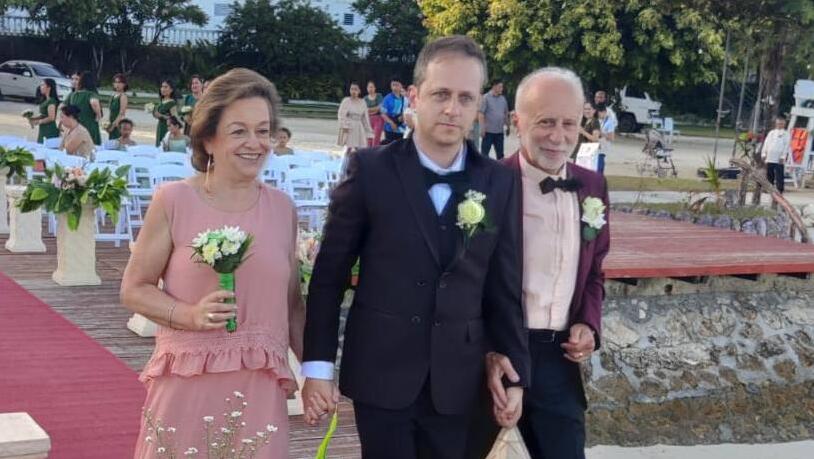
Dima and his parents at his wedding
U.S. President George H.W. Bush, concerned that Arab members of the coalition might withdraw if Israel entered the war, deployed Patriot missile batteries and American crews to Israel. However, the older PAC-2 systems failed to intercept the missiles, in part because the modified Iraqi missiles broke apart upon reentry, and the radar could not distinguish between debris and the warhead, causing interceptors to detonate ineffectively.
In one instance, a Patriot missile mistakenly struck a home in Ramat Gan, killing a resident. Following the failure, the U.S. upgraded the system. The newer PAC-3 can intercept ballistic missiles, but not those that break apart midair. It appears that in the Haifa strike, Israel’s advanced air defense systems also failed to overcome this “longstanding” problem.
‘A legendary teacher, a beloved caregiver’
The Haifa strike killed four members of the Gershovitz family. Hours before the attack, Vladimir had been discharged from a lengthy stay in an underground ward at Rambam Medical Center. Their son Dima, who lived with his wife Lucille in Herzliya, had brought him back to the family home in Haifa after his condition improved.
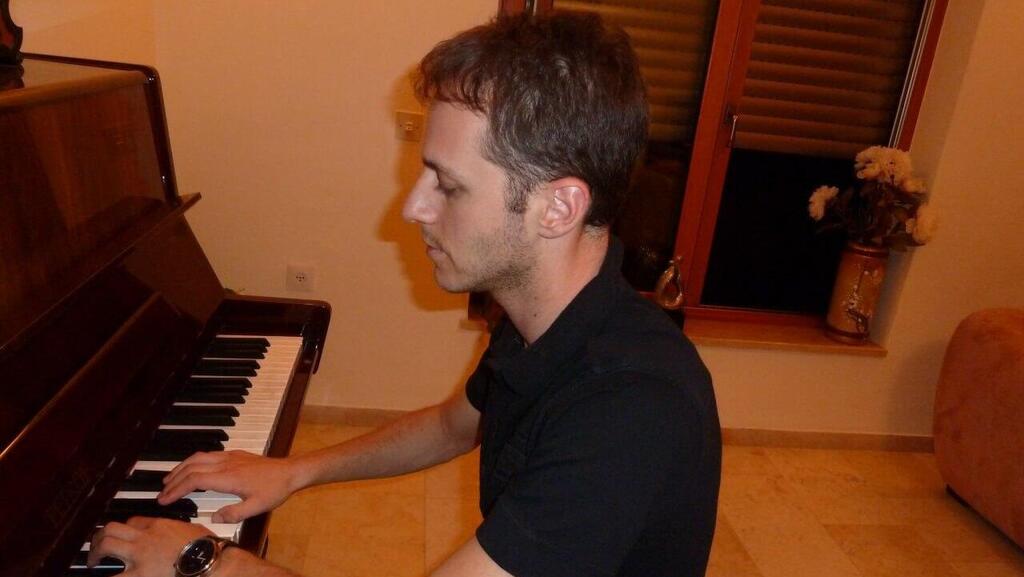
Dima Gershovich
(Photo: Facebook)

Dima and his wife Lucille-Jane
Vladimir was retired. His wife Lena, née Ostrovsky, taught voice development at the Nissan Nativ Acting Studio. The Israeli Actors Association said she “mentored generations of actors with dedication, professionalism and deep love for her craft and students.” Among those who paid tribute were actors Lior Raz, Guy Amir, Hanan Savyon and Liat Har-Lev.
Dima had worked for the past nine years as a software engineer at JFrog. He studied at the Technion in Haifa and later at Reichman University in Herzliya. “Dima was an exceptional person — even as a child he stood out as gifted, a prodigy who studied in advanced classes, played piano and continued on an academic track,” a family friend said.
Dima met Lucille, a native of the Philippines, during a trip there. She worked as a caregiver at a WIZO daycare center in Tel Aviv. Shachaf Levy, whose daughter attended the daycare, said: “She always had a smile, loved the children as if they were her own. At Purim, she was fully part of the celebration, even dressing up with them. She loved Israel so much that she attended Hebrew classes twice a week. This is a heavy loss for our children and us.”
Indira Rabi, the daycare director, said: “Dear Lucille was a beloved caregiver and educator. She was a valued member of the staff, caring for children with dedication, warmth and genuine love, giving each child a sense of security and joy. She joined us in December and quickly became an integral part of the team. In our last conversation, she shared how much she missed the children and looked forward to returning to routine. Those words remain with us and reflect the depth of her connection and her big heart.”