


Yisrael Beytenu leader Avigdor Liberman's announcement Friday that he is willing to form a government with ultra-Orthodox parties and compromise on military conscription represents a complete reversal of positions he has repeatedly and emphatically defended over the past eight years.
"We will show flexibility and compromise, including on the conscription issue," Liberman declared Friday, signaling his willingness to negotiate with the same ultra-Orthodox political parties he previously vowed never to join in government.
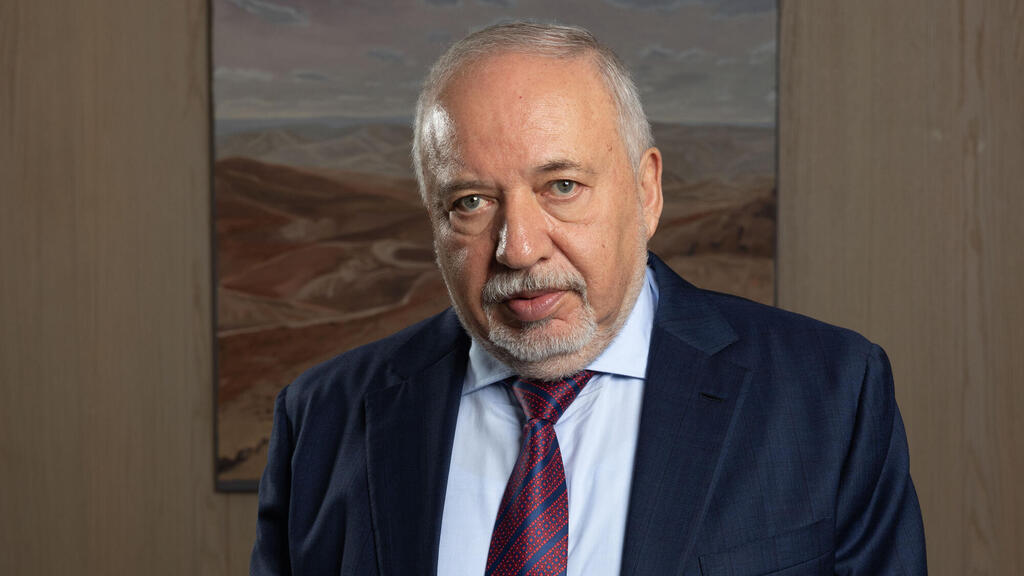
The change comes as the anti-Netanyahu bloc seeks to assemble a governing coalition following the 2026 Knesset election. Liberman, who has made opposition to ultra-Orthodox military exemptions a defining feature of his political identity, now appears prepared to set aside that principle to end Prime Minister Benjamin Netanyahu's tenure.
Liberman was once a close political ally of ultra-Orthodox leaders, particularly Shas chairman Aryeh Deri. But relations deteriorated sharply in recent years, and Liberman became one of the most reviled figures in ultra-Orthodox media.
His latest declaration marks a return to potential cooperation with those parties, despite years of explicit promises to voters that he would not compromise on conscription or join a government with ultra-Orthodox factions.
2018: 'This law is a betrayal of soldiers'
The rupture between Liberman and the ultra-Orthodox parties began in 2018 amid disputes over legislation granting military service exemptions to ultra-Orthodox men.
Liberman, then serving as defense minister, threatened to resign over the proposed legislation.
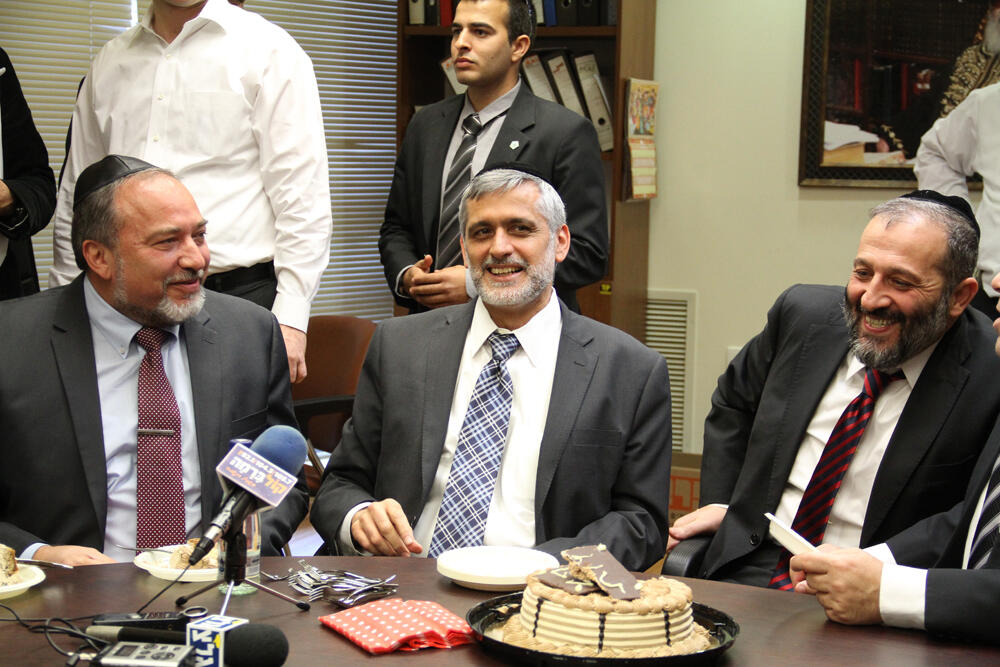
Liberman (left) and Shas chairman Aryeh Deri (right)
(Photo: Akiva Novik)
"This is a fake law," he said at the time. "All of us, including Minister Sofa Landver, will vote against the proposed law."
He went further, declaring: "This law is a betrayal of soldiers."
The dispute marked the beginning of a prolonged political confrontation over the exemption of ultra-Orthodox yeshiva students from military service, which is compulsory for most Jewish Israelis.
2019: 'Not a single comma or period'
By 2019, Liberman had made his refusal to govern alongside ultra-Orthodox parties a central political commitment.
"Yisrael Beytenu will not join any government with the ultra-Orthodox and the messianists," he declared. "Not Shas, not United Torah Judaism and not the Smotriches," referring to the religious Zionist political camp associated with Finance Minister Bezalel Smotrich.
At the time, Liberman advocated a government comprising Yisrael Beytenu, Netanyahu's Likud and the centrist Blue and White party as an alternative to a right-wing coalition dependent on ultra-Orthodox factions.
His stated goals included preventing additional government funding for the ultra-Orthodox sector and requiring yeshiva students to serve in the military.
During the coalition crisis that year, Liberman insisted that he would not compromise on the conscription law, even if his position forced Israel into another election.
"Even at the cost of going to another election, Yisrael Beytenu will make no concessions whatsoever on the conscription of yeshiva students," he said.
"We will not give up a single comma or period. We will demand that it pass its second and third readings in exactly the same wording."
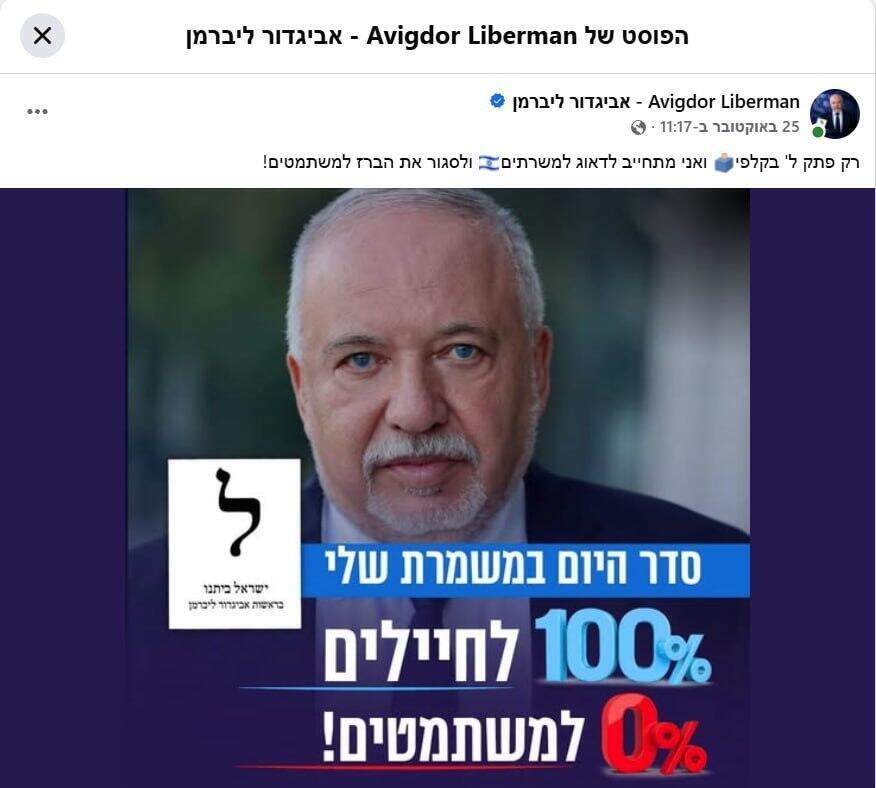
Liberman declares '100% for soldiers, 0% for draft dodgers' in a Facebook post published just two days before the election
(Photo: Screengrab)
He emphasized that his position was not motivated by hostility toward religious Jews. "This is not against Jewish law or against the ultra-Orthodox. It is in favor of the IDF," he said.
On another occasion, he described a proposed compromise on the issue as "an instrument of surrender to extortion."
He also rejected suggestions that he might abandon his principles in exchange for political appointments. "Anyone who thinks we will give up our principles in return for tempting ministerial positions — that will not happen," Liberman said.
2021: 'Even if the Messiah arrives tomorrow'
Liberman's position became even more categorical in 2021, when he was asked whether he would consider forming a government with ultra-Orthodox parties if Netanyahu were excluded.
"Absolutely no chance," he replied. "Even if the Messiah lands here tomorrow, we will not enter any government with the ultra-Orthodox."
Liberman argued that politicians needed firm principles, regardless of the opportunities available to them. "I wasn't born a defense minister, finance minister or foreign minister," he said. "There is a coherent worldview, and there must be red lines."
"Politics is the art of the possible, but there must be red lines. Politicians who don't have them are the most dangerous."
During the same interview, Liberman called for eliminating military exemptions for yeshiva students altogether and sharply reducing child benefits for large families.
"Secular Israelis are suckers," he said. "Child benefits must be cut dramatically. There is no reason to pay from the fifth child onward."
He argued that existing government policies encouraged economic inactivity and high birthrates among ultra-Orthodox Jews and Bedouin communities.
"Today, we encourage idleness and childbirth among Bedouins and ultra-Orthodox Jews, and we must abolish the concept of 'torato umanuto,'" he said.
The Hebrew phrase torato umanuto, meaning that Torah study is a person's occupation, has historically been used to justify military service deferments for full-time yeshiva students.
2022: Military service, education and employment as conditions
In a 2022 interview with ynet, Liberman sought to distinguish between his opposition to ultra-Orthodox political demands and his attitude toward ultra-Orthodox individuals.
He insisted that he did not reject religious Jews personally but maintained that any political cooperation would require fundamental changes in their parties' positions.
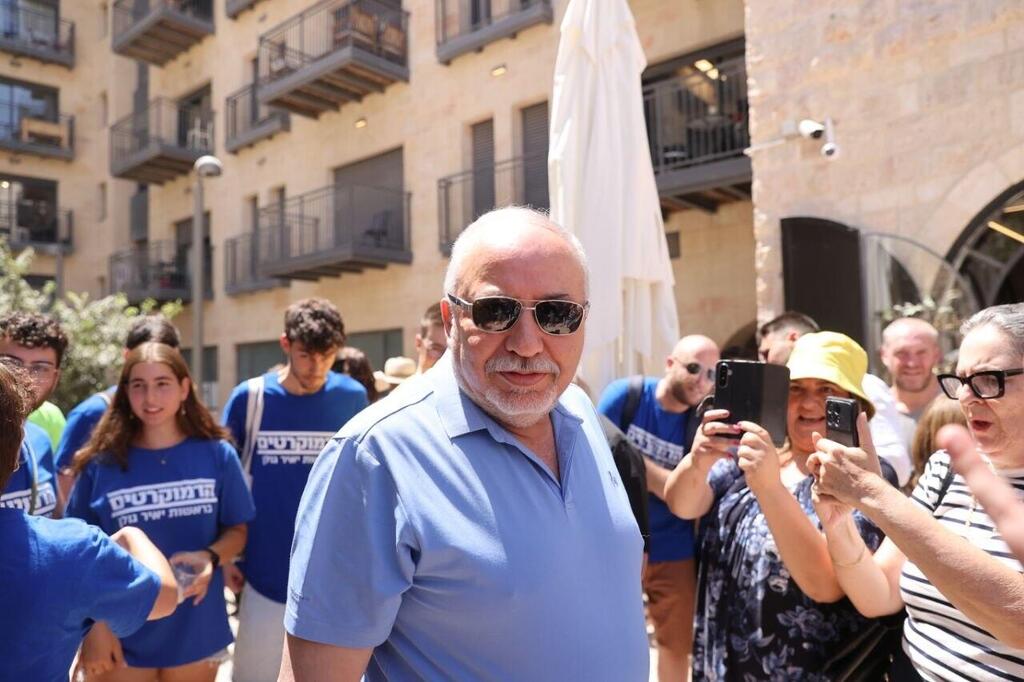
Liberman
(Photo: Alex Kolomoisky)
"As long as there is no agreement on conscripting yeshiva students, core curriculum studies and entering the workforce, there is nothing to discuss," he said.
Core curriculum studies refer to subjects such as mathematics, English and science, which are not taught to the same extent in many ultra-Orthodox educational institutions.
Liberman noted that he had previously served in governments alongside ultra-Orthodox representatives and had attempted to reach agreements with them.
But he said he would not accept arrangements that exempted the community from obligations imposed on other Israelis.
"I am not prepared to accept that people do not work and do not study core curriculum subjects, unlike all other sectors," he said.
2024: 'One people, one draft'
Following the Hamas-led Oct. 7, 2023, attack on Israel and the subsequent war, Liberman became one of the most vocal advocates of universal military conscription.
His demands intensified amid a severe shortage of combat soldiers and mounting pressure on reservists, many of whom were repeatedly called up for extended periods of military service.
In an October 2024 interview with ynet, Liberman demanded an end to all exemptions for ultra-Orthodox yeshiva students.
"No more quotas, no more targets. One people, one draft," he declared. "No more exemptions, no more 'torato umanuto.' Not a single person should receive an exemption. Everyone must enlist."
He criticized the low turnout among ultra-Orthodox men who had received military induction orders, describing the situation as "madness" and "an attack on the unity of the people."
Liberman argued that religious study and military service were not mutually exclusive, pointing to students at religious Zionist yeshivas who combine Torah study with military service and reserve duty.
"There is absolutely no reason for anyone here to be an exception. There is no reason for anyone to enjoy special privileges," he said.
He also called on the military and defense establishment to enforce conscription laws uniformly, accusing the IDF of selectively issuing draft notices.
Liberman subsequently proposed sweeping financial and employment sanctions against those who evaded military service.
Under his proposals, draft evaders would lose access to government benefits, discounts, housing assistance and subsidized daycare.
They would also be barred from employment in the civil service and local government, while the yeshivas in which they studied would lose state funding allocated on their behalf.
"When all these sanctions are enshrined in law, you will see a line of ultra-Orthodox men waiting to enlist," he said.
August 2026: 'There will be no exemption'
Liberman maintained his hard line even in the months leading up to the 2026 election.
In August, he sought to establish firm conditions for Yashar! leader Gadi Eisenkot, who was emerging as a leading candidate to head an alternative government.
"I will not join a minority government. There will be no exemption for the ultra-Orthodox," Liberman declared.
The statement appeared intended to prevent potential coalition partners from negotiating concessions on conscription in exchange for ultra-Orthodox political support.
Yet on Friday, just months later, Liberman explicitly included the conscription law among the issues on which he was prepared to compromise.
His reversal comes as Eisenkot and other anti-Netanyahu leaders seek a parliamentary majority that could require cooperation with ultra-Orthodox parties.
Liberman has said that ending Netanyahu's premiership and avoiding another election must now take precedence over other political considerations.
The shift also raises questions about the positions of other opposition leaders, including Eisenkot, former prime ministers Naftali Bennett and Yair Lapid, and Democrats leader Yair Golan.
All have previously made statements opposing military exemptions or government benefits for ultra-Orthodox men.
Whether they, too, will soften their positions as coalition negotiations progress remains to be seen.
For Liberman, however, the contradiction is already apparent: A politician who once declared that he would not compromise on "a single comma or period" of the conscription law, even at the cost of another election, is now openly advocating compromise on that same issue to prevent Netanyahu from remaining in power.