


The timing of a possible return to war with Iran remains unclear after U.S. President Donald Trump postponed an attack at the last minute but left in place the threat of an immediate strike if talks fail, while Tehran insists on keeping highly enriched uranium.
Meanwhile, analysis of satellite images published by Soar shows damage to several IDF bases across Israel from the latest round of fighting, before the ceasefire began last month. This report is being published with the approval of the military censor.

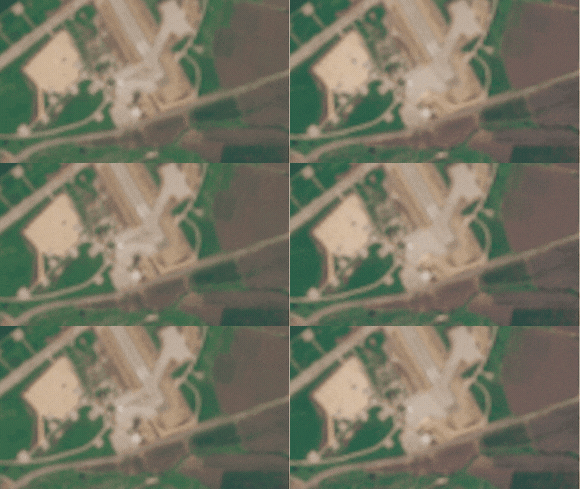
Images from the Sentinel-2 satellite show that the Ramat David Air Base was hit in two areas during the war with Iran. According to the analysis, one of the damaged areas was apparently used for support vehicles and equipment, while the second served as a refueling and service point for fighter jets.
The images also point to a sudden change on the ground in March, near a structure inside the IDF’s Mishar base, a Unit 8200 facility near Safed. According to Soar’s analysis, the change indicates a possible strike on the base between March 5 and March 10.
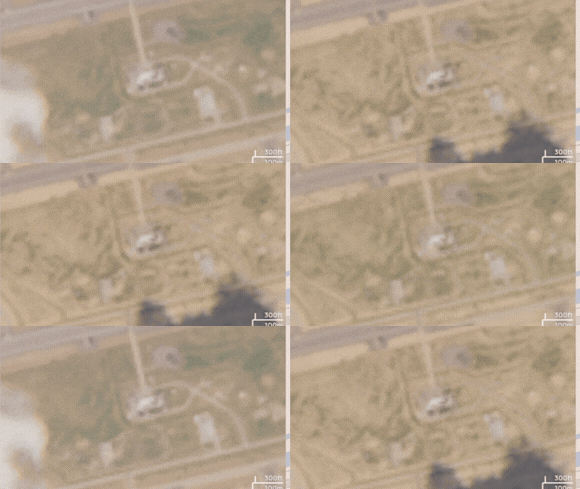
The damage at Nevatim
(Photo: Sentinel-2)
Additional satellite images show damage to a defensive position at the Nevatim Air Base. According to the image analysis, the damage was clearly visible on March 25 at a small defensive position inside the base.
Other images published by Soar point to a major fire that broke out at Camp Shimshon beginning on March 10, the same day Hezbollah said it attacked the site with a swarm of drones. According to the analysis, the fire burned for several days and spread across an area of about 200 meters inside the base.
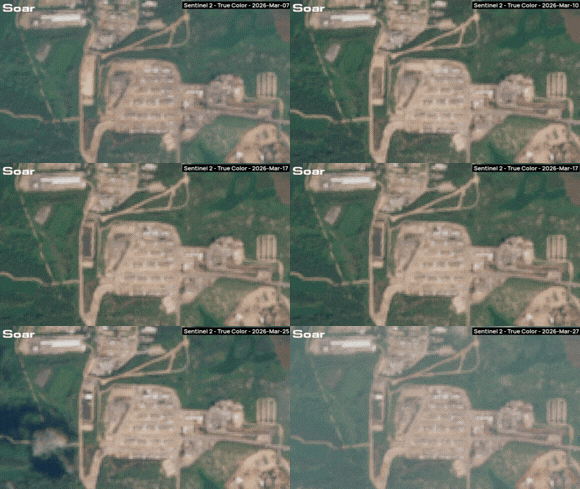
A fire burned for days at Camp Shimshon
(Photo: Sentinel-2)
The latest image analysis also examined older high-resolution images published by Google Earth Pro and World Imagery Wayback from 2016, 2024 and 2025. Those images showed that the large area damaged at the base had consistently been used for various operational purposes, including the placement of military vehicles and logistical preparations.
The analysis said comparisons with past images did not show significant vegetation in the area, indicating that the fire was caused by a strike on a significant area inside the base rather than by burning vegetation.
Against the backdrop of these and other strikes, Israel’s defense establishment is especially concerned that ballistic missiles are not at the center of negotiations with Iran. Israeli assessments before the war held that Iran possessed more than 2,000 ballistic missiles. Today, after the launches it carried out and the strikes it sustained, Israel estimates that roughly half that number remains.
(Photo: Sentinel-2)
Israeli officials say that contrary to various reports, including one published by CNN on Friday, Iran cannot quickly rebuild its missile stockpile on a large scale, especially after heavy launch trucks and production systems were also damaged. In any case, since the end of the latest campaign, Iran has been working to reopen missile tunnels that the IDF struck and sealed in aerial attacks.
On Thursday night, the Iranian Tasnim news agency, which is close to the regime, reported that the United States had delivered a new proposal to Tehran.
“They delivered a new text to Iran through Pakistan,” a source close to the negotiations said. “Iran is now studying the text and has not yet responded. Pakistan is working to bridge the gaps, but these efforts have not yet produced final results.”
Trump on Iran
(Video: The White House)


Trump later said he may wait “a few days” for Iran’s answer.
“We need to get the right answers,” he said.
Secretary of State Marco Rubio said Friday that there were “good signs” that an agreement could be reached. Both Trump and Rubio stressed that the enriched uranium must be removed from Iran and that Tehran would not be allowed to collect fees for passage through the Strait of Hormuz.
Israel prepares: ‘This will not be the last round’
Israel is preparing for the possibility of renewed war with Iran. IDF Chief of Staff Lt. Gen. Eyal Zamir has held a series of discussions and briefings in recent weeks with the defense establishment, Military Intelligence, the Operations Directorate and the Air Force ahead of a possible additional round, this time in full cooperation with the Americans.
But the defense establishment also wants to prepare the Israeli public for a new reality: the campaign against Iran is not expected to end with a single blow.
“We need to coordinate expectations with the public,” a very senior defense official told ynet and Yedioth Ahronoth. “The war against Iran is a long one. As long as this regime does not fall, we are expected to enter repeated rounds of fighting, perhaps every year and possibly even more frequently, to ensure that the nuclear and ballistic missile threats do not endanger the existence of the State of Israel.”
According to the official, the gaps between Washington and Tehran remain very deep.
(Photo: AFP - SOURCE: UGC / UNKNOWN, REUTERS/Jessica Koscielniak/Stringer, Oliver CONTRERAS/AFP)
“The people making the decisions in Iran are the Revolutionary Guards, and their interests do not meet the American demands,” the official said. “The American minimum does not meet the Iranian maximum. Therefore, in our assessment, Trump will ultimately have no choice but to launch another round against Iran.”
Even if another strike eventually takes place, Israel does not view it as a move that would end the threat.
“From Israel’s perspective, this will not be the last round as long as this regime remains standing,” the official said. “It will be possible to hit the Iranians very hard, strike economic and military targets and symbols of government, and it will look like a clear victory through Western eyes. But from the Iranian perspective, as long as the regime survives, they will rebuild their military capabilities. That is why Israel will have to maintain intelligence and operational readiness for another return to combat.”
“Even if we assume, in the most optimistic scenario, that the nuclear issue is resolved, and the chances of that are low, Iran will accelerate its arms race mainly in the missile field,” the official said. “There is a certain threshold for which no full air defense can be provided. That is why we will have no choice but to strike again.”
At the same time, the defense establishment says Operation Roaring Lion has already inflicted deep damage on the Iranian regime. Military industries were severely hit, senior figures who formed pillars of the regime were eliminated, ballistic missile production capabilities were significantly damaged and the sense of immunity among Tehran’s leadership was shaken.