


As tensions mount between the ultra-Orthodox parties and the government over proposed changes to military draft legislation, the spotlight has shifted to Aryeh Deri, leader of the Sephardic Shas party and one of Prime Minister Benjamin Netanyahu’s closest political allies.
The crisis erupted after United Torah Judaism, representing the Ashkenazi Haredi community, submitted resignation letters from all of its government and Knesset posts. The move followed what the party called unauthorized changes made by Knesset Foreign Affairs and Defense Committee Chairman Yuli Edelstein to a long-sought exemption law for yeshiva students.
Gallery

Aryeh Deri, leader of the Sephardic Shas party and one of Prime Minister Benjamin Netanyahu’s closest political allies.
(Photo: Alex Kolomoisky)
Deri has not followed suit but is widely seen as the decisive figure in whether the ultra-Orthodox bloc remains in Netanyahu’s fragile coalition. Shas is awaiting guidance from its Council of Torah Sages, expected to meet later Tuesday. Meanwhile, quiet coordination is underway between Shas and the Degel HaTorah faction of United Torah Judaism, including consultations with Rabbi Dov Landau, one of the community’s senior spiritual leaders.
Deri, a longtime political heavyweight, holds senior cabinet posts and is part of Netanyahu’s innermost security forums. He was reportedly briefed ahead of Israel’s recent military operation against Iran and helped mediate between coalition partners in the tense days leading up to the strike. But sources close to Deri now say his patience has worn thin.
“The sense is that Deri feels Yuli deceived him,” said Israel Cohen, a political commentator with close ties to the Haredi community. According to Cohen and other Haredi sources, Edelstein had promised to finalize a version of the exemption bill acceptable to both Shas and United Torah Judaism in talks with former minister Ariel Atias. Deri reportedly pushed his party to support the compromise. But after the Iranian operation and a subsequent cease-fire, Edelstein allegedly backtracked and refused to share a draft version, leaving the Haredi parties fuming.
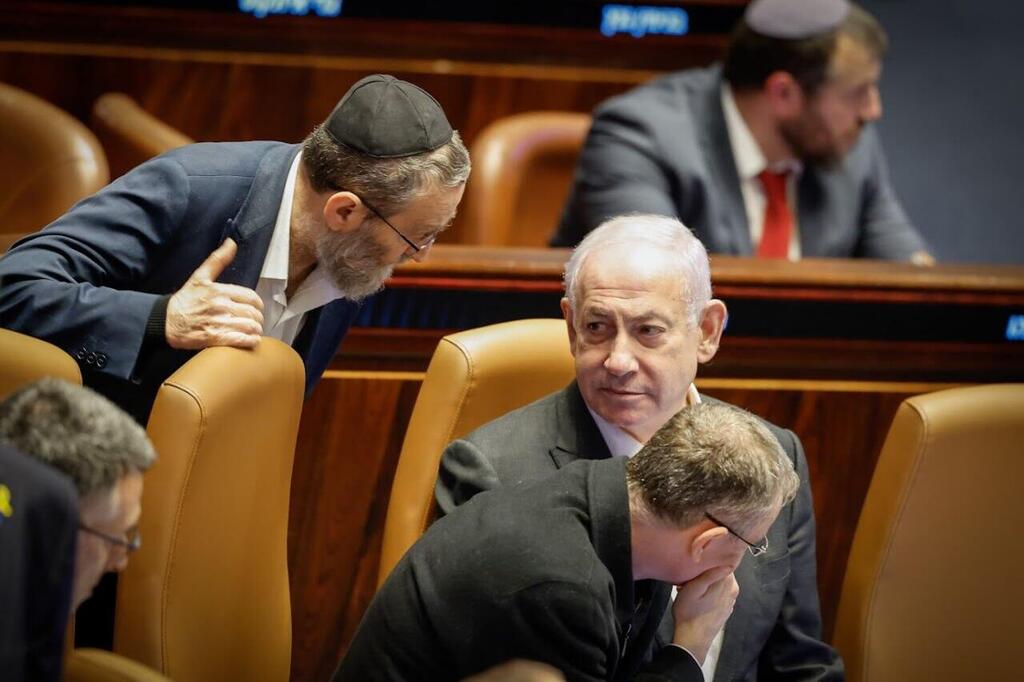
Prime Minister Benjamin Netanyahu speaks with MK Moshe Gafni in the Knesset plenary
(Photo: Danny Shem-Tov)
“He misled us. He lied. They changed the principles,” Atias said in an interview with the Haredi radio station Kol Chai. “Once we gave up the basic principle — that those who want to sit and learn Torah can do so — I believe the intention from the start was for there to be no law at all.”
The dispute centers on proposed legislation that would codify the exemption of yeshiva students from mandatory military service — a longstanding demand of Haredi parties. The government, facing legal pressure from Israel’s High Court, must act soon to either pass a new law or begin drafting Haredi men, a move expected to ignite mass opposition.
Netanyahu has publicly called for passing a law but has also urged his coalition partners to avoid “provocations.” Still, growing distrust among Haredi leaders could threaten his ability to hold the government together.
Get the Ynetnews app on your smartphone: Google Play: https://bit.ly/4eJ37pE | Apple App Store: https://bit.ly/3ZL7iNv
Adding to the tension, rabbis affiliated with Shas have spoken out against any law that includes penalties or sanctions against those studying Torah full time. Some warn that such legislation would spark backlash among core voters and open the party to accusations of betrayal from more extreme Haredi factions.
Shas, traditionally a party representing working-class Sephardic and Mizrahi Jews, has in recent years attracted a growing yeshiva-oriented base. Influential rabbis such as Rabbi Avraham Salim — a Sephardic figure closely aligned with the Lithuanian Haredi community — are shaping expectations that the party will take a principled stand rather than merely preserve political alliances.
As the political maneuvering continues, Deri's next steps could determine not only the fate of the exemption bill, but also the future of Netanyahu’s governing coalition.