

Hours before Iran attacked tankers in the Strait of Hormuz overnight between Monday and Tuesday, triggering another round of exchanges of fire with the U.S. military, participants in the funeral ceremonies for former supreme leader Ali Khamenei in Tehran offered a glimpse into the deep internal tensions inside the regime, against the backdrop of the memorandum of understanding and stalled negotiations with the United States.
In footage from the Iranian capital obtained by the opposition channel Iran International on Monday, many participants in a mass procession were seen verbally attacking President Masoud Pezeshkian and Foreign Minister Abbas Araghchi. In the background are reports of camps forming within the country’s leadership, with The New York Times describing two groups of conservatives: the “pragmatists” and the hard-line conservatives.
Iran hard-liners mob president, foreign minister at Khamenei funeral


According to Iran International, one video shows many regime supporters, who oppose negotiations with the United States, surrounding President Pezeshkian and chanting “death to the compromiser” as he attended the funeral of the leader killed by Israel in the opening strike of the war on February 28. In another video published by the Iranian opposition channel, participants were documented shouting “death to the traitor” and “shameless” at Araghchi as he walked through the streets of Tehran.
Araghchi leads the negotiations with the United States as part of the team headed by parliament speaker Mohammad Bagher Ghalibaf. Since the war, Iranian state television, which is identified with the Revolutionary Guards, has intensified its attacks on the negotiating team, including Araghchi, who is viewed as “appeasing.” According to The New York Times, the “pragmatist” camp also includes senior Revolutionary Guards generals whose names were not published, alongside Ghalibaf, Pezeshkian and the head of the Supreme National Security Council, Mohammad Bagher Zolqadr. Facing them are senior Revolutionary Guards generals who have consolidated their power since the war.
Gallery
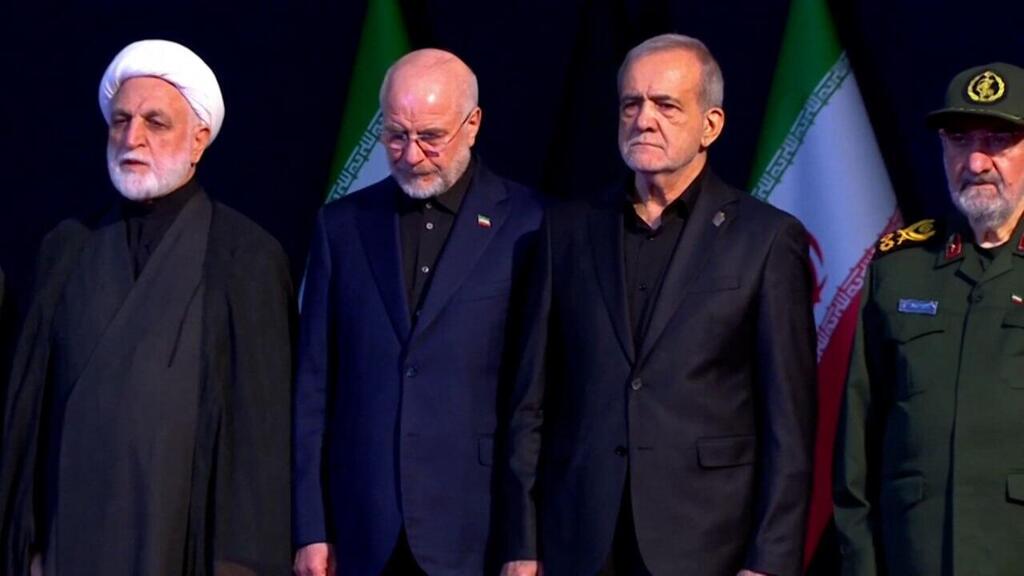
Iran’s president and senior regime officials weep before Ali Khamenei’s coffin at the start of the funeral ceremonies
(Photo: Reuters)
Despite criticism from the hard-line camp, the “pragmatists” appear to have achieved their goal with the current supreme leader, Mojtaba Khamenei, who has not yet appeared in public and was also not seen at his father’s funeral ceremonies. His father is expected to be buried today in the city of Mashhad. They managed to advance the memorandum of understanding and the negotiations with the United States, which, at least according to the plan, are meant to lead to a broad agreement that would end the war and help Iran recover economically.
Beyond the public calls for the deaths of Pezeshkian and Araghchi, another example of the internal confrontation came when a television interview with Ghalibaf was cut off while he was detailing the memorandum of understanding with the United States.
According to The Times, the incident sparked a public storm in Iran, including calls to dismiss the head of the state broadcasting authority, who was appointed by Ali Khamenei and belongs to the hard-line conservative camp. The public split, according to the report, only scratches the surface of deeper fractures. Four senior Iranian officials and two members of the Revolutionary Guards told The Times that the two sides are engaged in a ruthless battle for the ayatollah’s support, a move that could give the winning side control over Iran’s future. In practice, it was claimed, the country has been run in the months since the war by Revolutionary Guards generals, even though Ghalibaf and Araghchi, together with Pezeshkian, pushed the agreement forward.
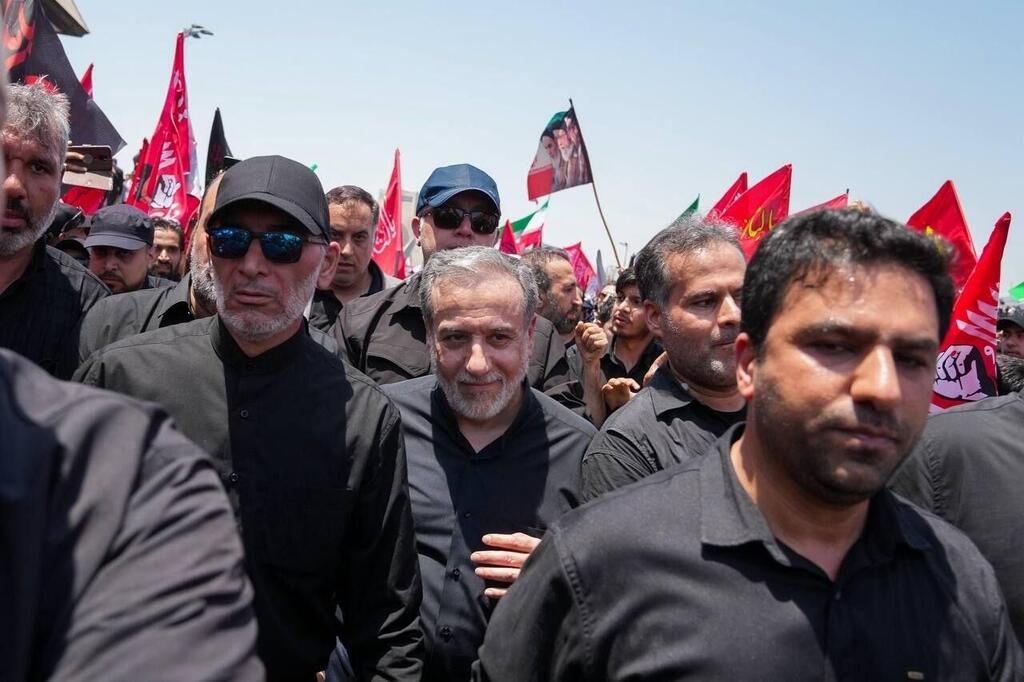
Iranian Foreign Minister Abbas Araghchi at the funeral in Tehran
A sign that the decision-making process in Iran has changed came when Iran’s vice president, Mohammad Jafar Ghaempanah, made remarks that could be interpreted as saying the supreme leader no longer has the final word. “If the intention is that we implement everything the leader says as his opinion, then there is no longer any need for any other institution,” he said in a speech. “The parliament and the Supreme National Security Council also lose their meaning. The leader expresses a position, and his position undergoes professional review.” Under Ali Khamenei, such a statement would not have passed.
According to The New York Times, political circles in Iran are already questioning whether Mojtaba can continue to rule “in his absence,” as four senior Iranian officials quoted in the report put it. When the younger Khamenei hesitated over the memorandum of understanding, President Pezeshkian visited him and, according to the four sources, threatened to resign. He told him the economic situation was dire and that the American naval blockade was paralyzing Iran. The central bank governor warned Khamenei that the country was facing a severe financial crisis and that food and medicine supplies would run out by the end of August if the naval blockade continued.
These appeals, according to the four sources, were decisive in Khamenei’s final decision to back the agreement. In the written statement he published, he noted that he opposed the deal “in principle,” but instructed the president to move forward if he had the backing of the Supreme National Security Council. There, Pezeshkian received the green light.
According to another New York Times report, the younger Khamenei asked senior officials to attend his father’s burial ceremony, scheduled for today at the Imam Reza shrine in Mashhad, his father’s birthplace. But according to Revolutionary Guards sources quoted by the American newspaper, Iranian security officials rejected the idea. The reason was concern that Israel would try to assassinate him or track his movements back to his hiding place.