


Israel has seen a downward trend in the number of Israeli academics returning to the country since 2022, and since 2023 a rise in the number of Israeli academics residing abroad, according to data published by the Central Bureau of Statistics. From 2023 onward, and for the first time in many years, the number leaving has exceeded the number returning.
The CBS data show a sustained decline over recent years in the number of academics who left Israel and lived abroad for more than three years. In 2023, however, that trend reversed and the number rose, albeit moderately. At the same time, there has been a decline in the number of academics returning to Israel. In 2023 the drop was sharp, and while the decline continued in 2024, it was more moderate.
According to 2024 figures, 54,778 graduates of Israeli higher education institutions had been living abroad for three years or more. The data refer to degree recipients from 1990 to 2018. Those residing abroad account for 11.9% of PhD holders, 8.1% of medical master’s degree holders, 5% of master’s degree holders and 6.4% of bachelor’s degree holders.
Most degree holders living abroad come from affluent localities, led by Ramat Hasharon, Omer, Even Yehuda, Tel Aviv, Zichron Yaakov, Herzliya, Raanana, Haifa, Kfar Saba, Kochav Yair, Karmiel and Hod Hasharon.
The data indicate that the share of those living abroad for three years or more is particularly high among graduates in STEM fields, including mathematics, statistics, sciences and architecture, compared with other disciplines: 1.6 times higher at the bachelor’s level, 2.4 times higher at the master’s level and 2.5 times higher at the doctoral level.
The report also shows that, among bachelor’s degree holders, especially high rates of residence abroad were recorded among graduates in music, at 25.8%, English language and literature, at 19.9%, and mathematics, at 14.2%. Among medical master’s degree holders, the proportion living abroad remained relatively high at 8.4%, similar to previous years. At the master’s level overall, high rates were also recorded among graduates in music, at 21.8%, and international relations, at 15.3%.
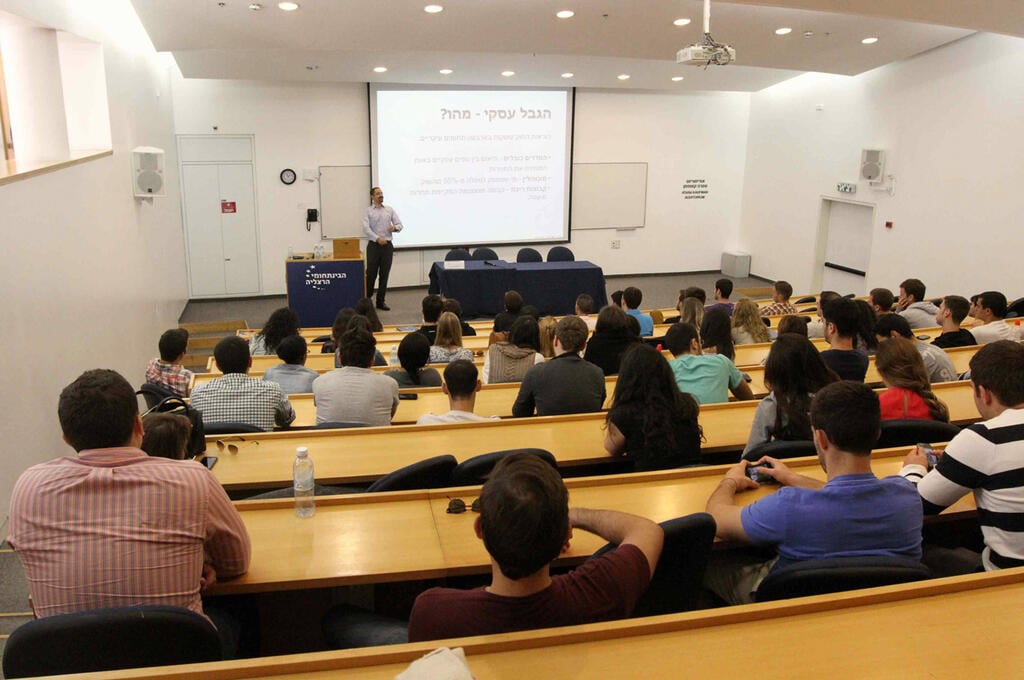
'Israeli academia invests extensive resources in training the brightest minds, and the country loses them at the critical moment'
(Photo: Ido Erez)
Most Israelis living abroad are university graduates at the bachelor’s level, at 7.8%, a significantly higher share than among graduates of academic colleges, at 5.6%, the Open University, at 5.2%, and academic colleges of education, at 2.2%.
The report’s authors noted that as of 2024 there has been an increase in new departures from Israel and a decline in the number returning after extended stays abroad. A breakdown of the findings shows that the proportion of Jews living abroad is higher than that of Arabs, 6.2% compared with 2.3%, and that the share of men is higher than women, 7.6% versus 5.2%.
At the same time, among those living abroad six to nine years after receiving their degree, a moderate downward trend was observed.
The Council of Presidents of Israel’s Research Universities said in response: “The CBS data are a wake-up call and a severe warning sign for decision-makers. When about a quarter of PhD graduates in mathematics and computer science choose to build their future abroad, the State of Israel is steadily losing its comparative advantage. Israeli academia invests extensive resources in training the brightest minds, and the country loses them at the critical moment.
“This is a direct blow to the engines of growth of the Israeli economy, to security, to high-tech and to our national resilience. Without immediate investment in research infrastructure and in creating certainty for young researchers, we will continue supplying the world with the best scientists, instead of having them build our future here,” the council added.