

Until a month ago, no one outside Germany's internal left-wing politics had heard of Vanessa Emde. This week, she became a central figure in German and Berlin politics, with her positions threatening to deny her party, Die Linke (The Left), which won the Berlin elections in late September, the opportunity to form a government. Moreover, the controversy Emde sparked this week threatens to tear Die Linke apart from within, triggering a genuine struggle over the party's fundamental identity. At the heart of the dispute, unsurprisingly, is its attitude toward Israel.
After Die Linke won more than a quarter of the vote in Berlin, it was clear that forming a coalition under its leadership would require negotiations with the Greens and Social Democrats (SPD), its two natural partners in establishing a left-wing government.

However, before agreeing even to enter talks with Die Linke, the leaders of both parties demanded clarification and unequivocal commitments on two main issues: that the party distance itself from any ties to criminal clans in Berlin and, above all, that it commit to combating antisemitism, protecting Jewish lives, acknowledging the October 7 massacre, opposing Hamas and unequivocally recognizing Israel's right to exist.
Die Linke found itself in a trap. Signing such agreements would run counter to a central principle held by its voters, particularly younger voters and immigrant communities. But refusing the conditions would reinforce the public perception that it was an antisemitic party. Without the Greens and SPD, it had no chance of forming a coalition. Die Linke's representatives in Berlin signed the memorandum of understanding on the issue, and the parties agreed to begin talks.
But the agreement began to unravel almost immediately afterward, when Die Linke decided to admit Vanessa Emde to its parliamentary group. Although she had been directly elected in the Neukölln district with nearly 50% of the vote, the SPD and Greens had demanded that she not be admitted to the group. For them, she was a red line.
Emde, a queer feminist activist, rode a wave of political success largely on the strength of her explicitly anti-Israel platform. She belongs to a group called Palestine Solidarity Working Group (AG Palästina-Solidarität), whose members have previously claimed that "the Palestinian struggle will end when Tel Aviv is in Palestinian hands." On election night, she proudly posed for a photograph with Ibrahim Ibrahim, a prominent supporter of the Popular Front for the Liberation of Palestine (PFLP) in Germany who is active in the United Palestinian National Committee, which also includes Hamas supporters.

Emde in a video she posted. 'A legitimate political demand'
(Photo: Vanessa Emde's Instagram account)
She is best remembered for a statement she made in May, when she said she "does not believe in the right of states to exist, only in the right of human beings to exist." Although the statement did not refer directly to Israel, its context was clear. She supports a one-state solution and explained her friendly photograph with Ibrahim by saying she rejects the authority of Germany's domestic intelligence agency to determine who may establish political ties in the country.
Within Die Linke, the Berlin branch is considered the most radical, particularly regarding policy toward Israel. Within the Berlin branch, Neukölln, a district with a large Muslim immigrant population, is regarded as the most radical of all. Die Linke cannot afford to lose its support, either electorally or because of the work local activists do to bring voters to the polls.
Now, the local branch and its voters have demanded that the party not give in. Calls have grown louder to preserve the party's policies and the positions that brought it electoral victory at all costs, particularly on the Israeli-Palestinian conflict, even if that means remaining in opposition.
The grassroots pressure worked. On Thursday, Emde posted a three-minute video on her Instagram account in which she repudiated her signature on the memorandum of understanding with the other two parties and reaffirmed all her previous statements, including her rejection of the right of states to exist.
"The fact that I, as an individual, am being used as a bargaining chip in the talks is, to put it mildly, a democratic scandal that must be investigated," she wrote in the accompanying post.
According to Emde, "The starting point for this madness: A few months ago, I published a video in which I paraphrased a self-evident principle of international law: 'States do not have a right to exist — people have a right to exist.'
"I also said: 'The demand for a democratic one-state solution with equal rights for all people, regardless of their ethnic origin or religion, is a legitimate political demand and must not be criminalized.'"
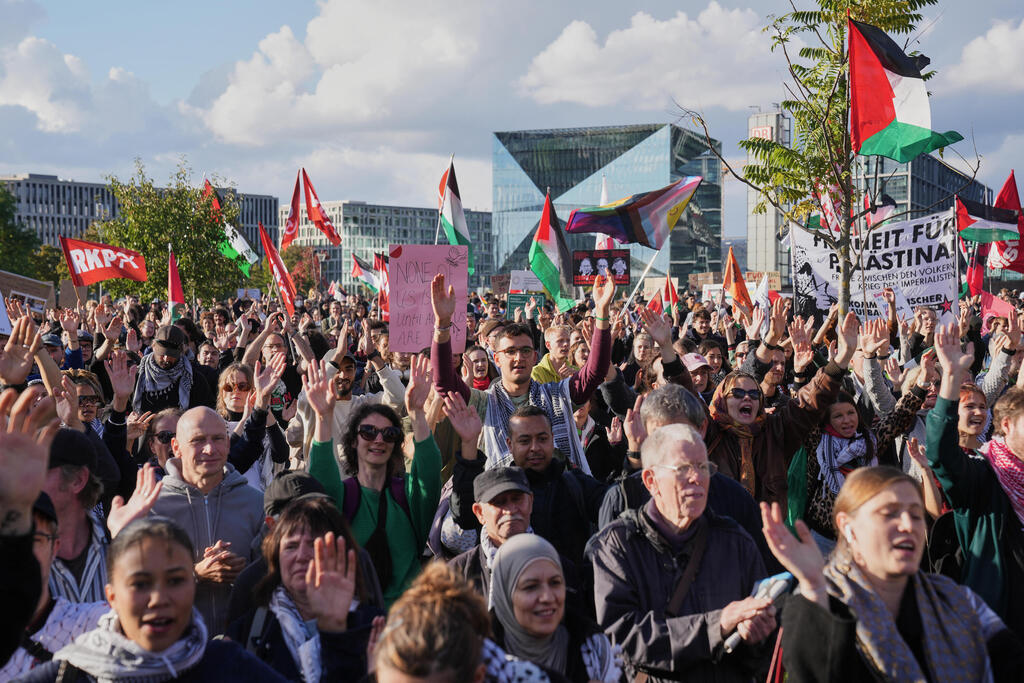
Pro-Palestinian demonstration in Berlin. Will a Die Linke-led government be formed after all?
(Photo: AP Photo/Ebrahim Noroozi)
The SPD and Greens announced the cancellation of coalition talks, saying they suspected Die Linke was conducting two parallel sets of negotiations and signing separate memorandums of understanding: one in coalition negotiations with them and the other in internal party negotiations, with each agreement undermining the other.
Die Linke's leaders have now announced that the parliamentary group distances itself from Emde's remarks and disavows her political positions. Discussions about her future in the group are scheduled to begin Tuesday, with Emde in attendance.
The Palestinian issue and the war in Gaza have dominated Berlin's streets for the three years since October 7 and were an important factor in the city's election campaign. Now, they threaten both the stability of a potential local coalition and the unity of the radical left-wing party, confronting it with a fateful question: Does Die Linke have an identity without its distinctly anti-Israel stance?
It remains to be seen whether the party's argument that its position constitutes criticism of Israeli policy rather than antisemitism will be accepted, and whether it can preserve its unity and its chances of governing without abandoning that position.