


Media outlets across the Arab world circulated footage Thursday evening purportedly showing iPhones floating in the Strait of Hormuz following one of Iran's latest attacks on ships in the strategic trade route.
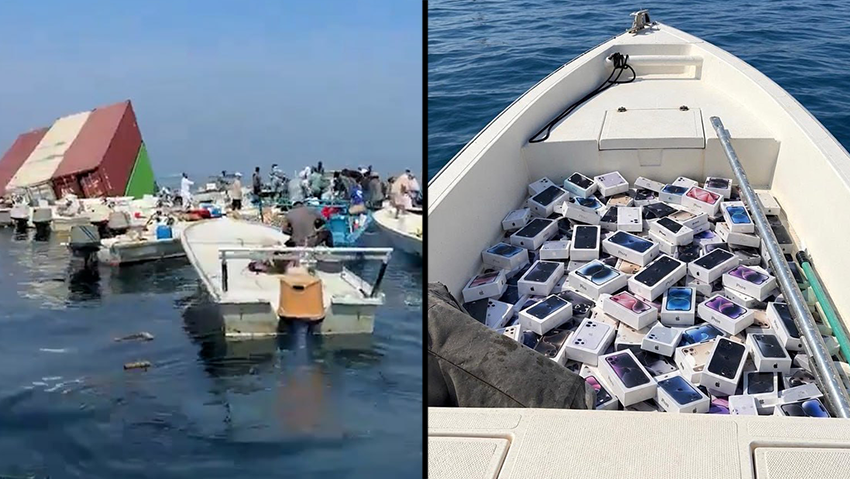
The footage shows shipping containers floating at sea, surrounded by numerous small objects. People aboard small boats, whose identities remain unclear, can be seen collecting the valuable goods scattered in the water. One of the boats appears to be loaded with boxes of iPhones. One report claimed the devices were Apple's latest model, the iPhone 18.
Footage from Hormuz: 'iPhones floating after ship was sunk'


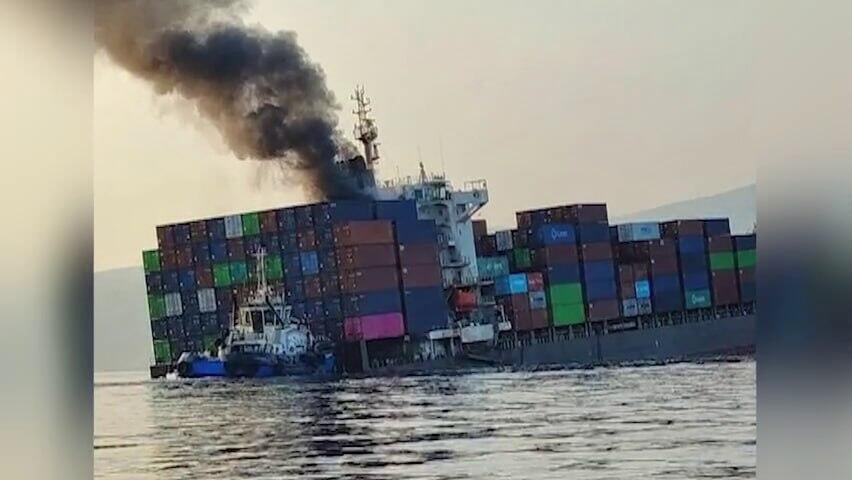
Footage circulated in Iran yesterday, purportedly showing the Singaporean container ship before it sank
Although the origin of the containers scattered across the Strait of Hormuz remains unclear, the footage emerged a day after Iran announced that a vessel carrying 2,500 containers had sunk in the strait after allegedly entering a "dangerous route" without Iranian authorization and striking a mine.
Iranian reports did not identify the ship, but Reuters reported Wednesday, citing maritime industry sources, that the GFS Pride, a small Singapore-flagged container ship with a capacity of 2,824 containers, had sunk after being struck by a projectile. That would indicate the vessel was directly attacked rather than hitting a previously laid mine.
Singapore confirmed that the ship sank after a fire broke out aboard it, adding that all 21 crew members had been safely evacuated without injuries.
The Associated Press reported that two Singaporean cargo ships crossing the Strait of Hormuz were attacked Tuesday and Wednesday, with the second vessel continuing to its destination.
According to Reuters, the GFS Pride was the second ship to sink in the strait within just 24 hours. A third vessel, the Antigua and Barbuda-flagged Cape Dao, also sank after sustaining severe damage in an earlier attack on Sept. 23.
Although Iran has attacked numerous vessels throughout the war in an effort to block the Strait of Hormuz, a vital artery for the global oil trade, ships sinking as a result of these attacks remains extremely rare. Including the two latest vessels, only three ships have sunk since the war began in late February.
The iPhones and other goods seen drifting in the waters of Hormuz most likely came from the GFS Pride, which sank Wednesday. According to a Saudi report Thursday evening, luxury perfumes and other products were also floating in the water.
Footage of the ship that Iran claims 'sank after hitting a mine' in the Strait of Hormuz
In recent days, Iranian attacks on vessels in the Strait of Hormuz have intensified again, in what appears to be an attempt by Tehran to trigger a renewed escalation with the United States just ahead of the U.S. midterm elections.
President Donald Trump has said he will not attack Iran before the elections, scheduled for Nov. 3.
Reuters reported Wednesday that an analysis of maritime security data and reports submitted to the United Kingdom Maritime Trade Operations center (UKMTO) showed that the pace of attacks in recent days had reached its highest level since the war began.
A similar rate of attacks was recorded between Oct. 3 and Oct. 5, but another escalation now appears to be underway.
"There is a tempo increase in strikes, which looks deliberate," a maritime security official told Reuters.
The report quoted two senior Iranian officials who said Tehran had adopted a new strategy of stepping up attacks on ships in the Strait of Hormuz and other parts of the Persian Gulf to keep global oil prices high and influence the outcome of the U.S. midterm elections.
According to the officials, the decision to change strategy was made at the highest levels of Iran's leadership and coordinated among the country's various centers of power.
One official said Iran began employing different methods of attacking vessels about 10 days ago, targeting ships it claims are violating restrictions Tehran has imposed on maritime traffic through the strait.
The objective of the escalation, he said, is "to frustrate efforts by the United States and its allies to bring down global oil prices."
The second official made clear that Tehran would not allow Trump to bring prices down before the November elections.
"Just when they think they are getting close to the point where prices will fall, we will push them away from it," he said, adding: "This is a game of chess."
The renewed attacks come as the Trump administration claims that despite Iranian threats, maritime traffic through the Strait of Hormuz is gradually returning to normal and oil flows have recovered to levels similar to those recorded before the war, when approximately one-fifth of global oil consumption passed through the waterway.
The administration attributes the recovery to a U.S. Navy-led operation to protect shipping in the strait, alongside a continuing blockade of Iranian ports.
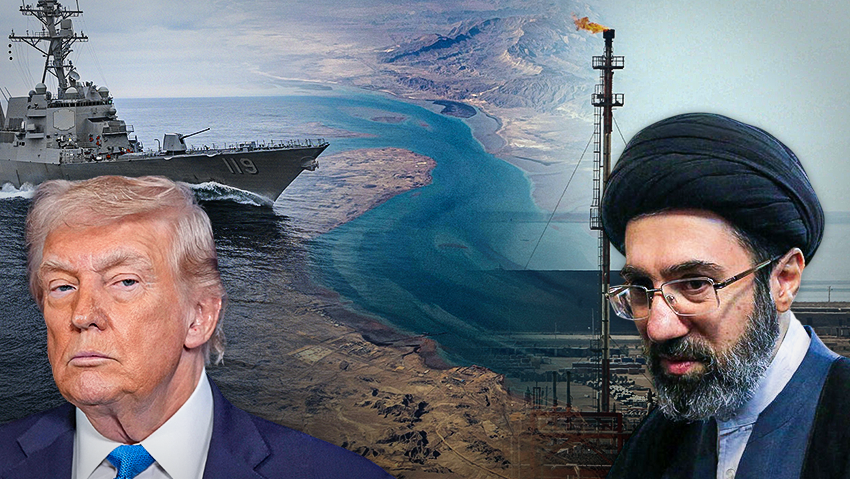
Trump and Iran's reclusive leader Mojtaba Khamenei
(Photo: AP/Alex Brandon, Atta Kenare/AFP, REUTERS/Stringer, Lance Davis/United States Navy/Huntington Ingalls Industries)
Meanwhile, the escalation between Yemen's Houthi rebels and Saudi Arabia is also continuing. Riyadh reported Thursday evening that it had intercepted additional drone attacks launched toward the kingdom by the Yemeni rebels.
The interceptions came hours after Saudi Arabia disclosed that at least 19 people had been killed in Houthi attacks on the kingdom since the beginning of the month and that the international airport in the capital, Riyadh, had been targeted at least 20 times.
At a news conference presenting the figures, Saudi Deputy Foreign Minister Rayed Krimly accused Iran of "encouraging" the Houthis to escalate their attacks and seize territory overlooking the Bab el-Mandeb Strait last month.
The move gave the rebels, and their patrons in Tehran, another powerful bargaining chip against the United States.
"We think the escalation by the Houthis at this later stage of the conflict is encouraged by Iran," Krimly said.
He accused Iran of continuing to arm, train and support the Houthi militia in violation of relevant United Nations Security Council resolutions and its commitments under the Beijing Agreement.
He was referring to the 2023 agreement under which Saudi Arabia and Iran restored diplomatic relations after a seven-year rupture.
Krimly noted that Saudi Arabia continues to maintain direct communication channels with Iran, adding that the foreign ministers of the two countries had spoken by telephone even during one of the waves of attacks on Riyadh's airport.
Smoke rises from the presidential palace in Aden, Yemen, following a Houthi missile attack
Alongside the renewed attacks on Saudi Arabia, the Houthis also launched an unusual missile attack Thursday evening against the Maashiq presidential palace in Aden, southern Yemen.
The palace houses Yemen's internationally recognized government, whose forces are currently engaged in ground battles with the Houthis for control of the Bab el-Mandeb Strait.
Footage circulated from Aden showed smoke rising near the palace. Two Yemeni government officials told Reuters that two security guards were killed in the attack.
Yemen's prime minister and Cabinet ministers were at the palace when the attack occurred, but were reportedly unharmed.
According to reports, five missiles were launched at the compound.
Houthi military spokesperson Yahya Saree claimed that the attack targeted "the military operations headquarters of the Saudi enemy in Aden."