

Uganda has unveiled a memorial to Lt. Col. Yonatan “Yoni” Netanyahu at the Old Entebbe Terminal, the site where the Israeli commando commander was killed during the 1976 hostage-rescue operation, The Kampala Post reported.
The ceremony was led by Uganda’s chief of defense forces, Gen. Muhoozi Kainerugaba, who described the monument as a symbol of courage, sacrifice and the close relationship that has developed between Uganda and Israel.
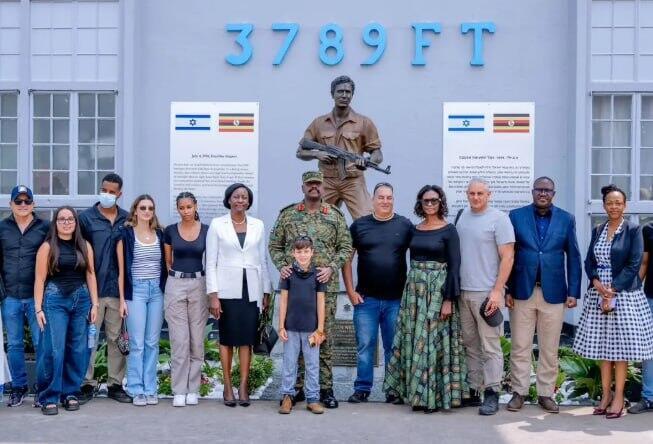
Uganda’s military chief Muhoozi Kainerugaba, the president’s son, unveils a statue of Yoni Netanyahu at Entebbe Airport’s old terminal
(Photo: Kampala Post)
Netanyahu, the older brother of Prime Minister Benjamin Netanyahu, commanded the Israeli force sent to rescue hostages held at Entebbe Airport on July 4, 1976. He was killed during the operation.
Kainerugaba said the memorial honored both Netanyahu’s leadership and the wider values represented by the rescue mission.
“It is a great honor and privilege to join you at this historic site as we unveil this monument to Lieutenant Colonel Yonatan ‘Yoni’ Netanyahu,” he said, according to The Kampala Post.
He described Netanyahu’s actions as an enduring example of “courage, duty and selfless service,” adding that the monument should serve not only as a reminder of one soldier, but also as a lesson for future generations.
“Monuments are more than stone and bronze,” Kainerugaba said. “They preserve memory, teach history and inspire future generations.”
The Ugandan military chief also commemorated the civilians who were killed during the hostage crisis, naming Jean-Jacques Maimoni, Pasco Cohen, Ida Borochovitch and Dora Bloch.
“Their memory remains an important part of this solemn history,” he said.
Kainerugaba also acknowledged the Ugandan soldiers who died during the battle, while distinguishing the Uganda of today from the dictatorship of Idi Amin, whose government was involved in the crisis.
He said the soldiers had fought for what they believed was a justified cause, but added that Amin’s government was a brutal regime that did not represent the Ugandan people.
The events of 1976 took place during “one of the darkest periods” in Uganda’s history, he said. Modern Uganda, he added, is a constitutional democracy committed to peaceful relations and cooperation with the international community.
Kainerugaba used the ceremony to emphasize the broader relationship between Uganda and Israel, saying it was based on mutual respect and practical cooperation rather than solely on the events at Entebbe.
He called for the two countries to deepen cooperation in security, innovation, sustainable development and the fight against violent extremism.
Representing the Israeli delegation, Barack Orland thanked Kainerugaba for supporting Israel and for backing the decision to place the memorial at the historic terminal.
Orland said the monument represented more than a commemoration of the past. It symbolized two countries standing together for future generations.
He also cited Ugandan President Yoweri Museveni, saying shared sacrifice had transformed a painful historical episode into a lasting connection between Israel and Uganda.
Olive Birungi Lumonya, deputy director general of the Uganda Civil Aviation Authority, praised Kainerugaba for advancing the project and helping select the monument’s location.
She described the memorial as a powerful tribute to courage, sacrifice and enduring international friendship.
Senior Ugandan military, aviation and tourism officials also attended the ceremony, including Air Force commander Lt. Gen. Charles Okidi.