


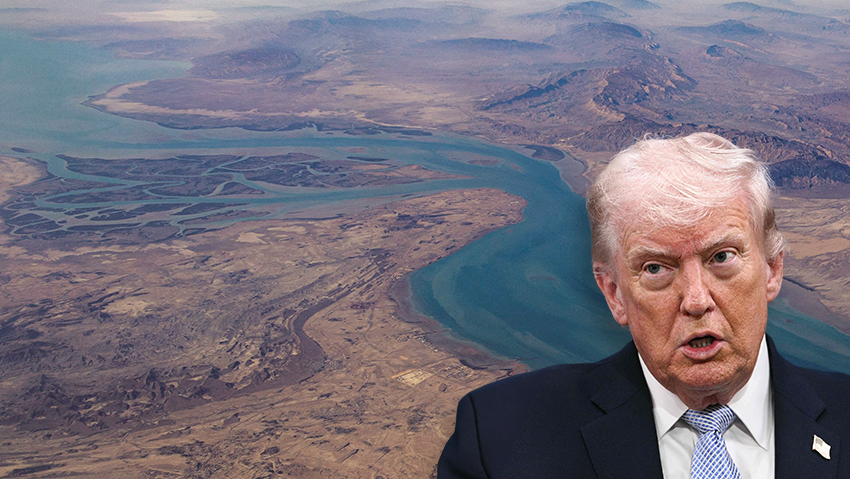
U.S. President Donald Trump gave Prime Minister Benjamin Netanyahu assurances that he would not sign a final agreement with Iran unless Tehran dismantles its nuclear program and removes all enriched uranium from its territory, a senior Israeli official said on Sunday.
The official said the United States is updating Israel on negotiations toward a memorandum of understanding to reopen the Strait of Hormuz and enter talks on a final agreement over unresolved issues.
Netanyahu has not publicly addressed the possible implications of the emerging U.S.-Iran deal for Israel. In a post on X, he referred only to gunfire near the White House and did not mention the reports of the emerging deal.
According to the official, Netanyahu told Trump in a call Saturday night that Israel would preserve freedom of action against threats on all fronts, including Lebanon. Trump again backed that principle, the official said.
The official said Trump made clear he would stand firm in negotiations on his demand for dismantling Iran’s nuclear program and removing all enriched uranium from Iranian territory, and that he would not sign a final deal without those conditions.
Netanyahu, the official said, again expressed appreciation for Trump’s “long-standing and extraordinary commitment” to Israel’s security.
Israel appears for now to be aligning with Trump’s messaging, days after the U.S. president said Netanyahu “will do whatever I want him to do.” Israelis who have lived under uncertainty for three months are still relying largely on foreign reports for details of the emerging agreement.
Even after the Israeli official’s statement, it remains unclear what threats are covered by Israel’s promised “freedom of action.” In Gaza, and now especially in Lebanon, Israeli forces operate under significant restrictions shaped in practice by Washington.

The uranium enrichment facility in Natanz, Iran
(Photo: AP)
It is also unclear what enriched uranium would have to be removed under Trump’s demand. According to the International Atomic Energy Agency, Iran holds about 11 tons of uranium enriched to various levels.
Even if Trump refuses to sign a final agreement because Iran does not meet his demands, he does not appear eager to return to war shortly before the World Cup, a posture that could significantly reduce pressure on Tehran.
Under the draft agreement, Tehran agreed to give up its stockpile of highly enriched uranium, though Iran denies the claim. The New York Times reported it, citing two U.S. officials, who said the proposal does not specify how Iran would relinquish the stockpile and that those details were deferred to the next round of nuclear talks.
IAEA figures show Iran has about 440 kilograms of uranium enriched up to 60%. Most of Iran’s stockpile was transferred to Russia after the 2015 nuclear deal, when Barack Obama was U.S. president, and The Times said that arrangement could serve as a model for a new agreement. Another possibility would be for Iran to dilute its uranium to lower enrichment levels, preventing it from being used later for a nuclear weapon. The United States has sought a roughly 20-year freeze on enrichment, but Iran has rejected that and offered a much shorter timeline.
Reuters, citing Pakistani officials, reported that the framework deal has three stages: ending the war, reopening the Strait of Hormuz and then holding 30 days of talks, with a possible extension, to address remaining details.
European leaders welcomed the prospect of reopening the strait. European Commission President Ursula von der Leyen wrote on X that any agreement must de-escalate the regional conflict, reopen Hormuz and guarantee full freedom of navigation without fees. She added that Iran must not be allowed to develop a nuclear weapon.
British Prime Minister Keir Starmer also addressed the issue, saying Britain would work with international partners “to seize this moment” and reach a long-term diplomatic arrangement.