


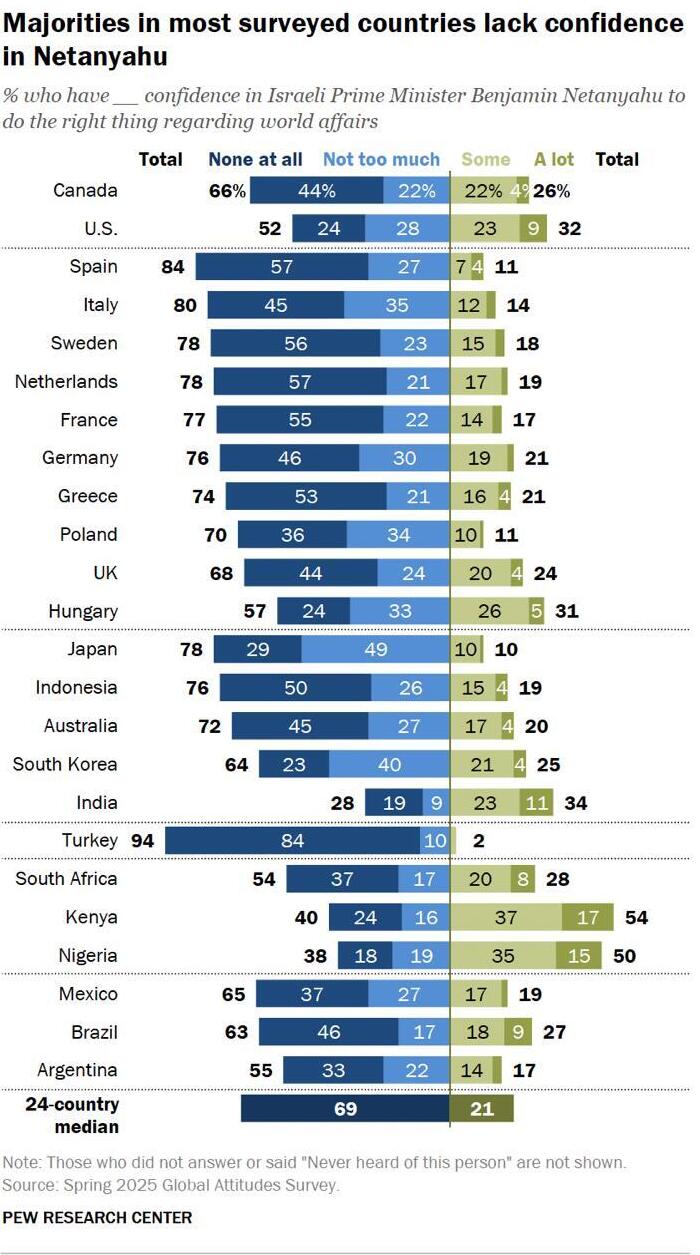
A new comprehensive global survey published Tuesday by the Pew Research Center reveals widespread negative sentiment toward Israel and its Prime Minister Benjamin Netanyahu. The survey, conducted in 24 countries among more than 28,000 respondents, found that in all but two countries—Kenya and Nigeria—Netanyahu's approval failed to exceed one-third.
Attitudes toward Israel as a whole were similarly critical: in 20 of the surveyed countries, a majority expressed an unfavorable view of the country. In the United States, 53% of respondents said they hold a negative opinion of Israel—an 11-point increase since 2022. In the United Kingdom, the percentage of those with an unfavorable view rose from 44% in 2013 to 61% today.
The data shows that younger people in many high-income countries—including Australia, Canada, France, Poland, South Korea and the U.S.—are more likely than older generations to view Israel negatively. The same trend is seen among those who identify as politically left-leaning, who consistently express more critical views of Israel than those on the political right.
The 10 countries with the most negative views of Israel were: Turkey (93%), Indonesia (80%), Japan (79%), the Netherlands (78%), Spain (75%), Sweden (75%), Australia (74%), Greece (72%), Italy (66%) and Germany (64%).
Conversely, the countries with the most favorable views of Israel were: Nigeria (59%), Kenya (50%), the U.S. (45%), India (34%), South Africa (34%), Hungary (36%), Brazil (32%), South Korea (31%), Canada (33%), and Argentina (26%). However, in most of these nations—except Nigeria and Kenya—negative opinions still outnumber positive ones.
Pew Research Ceter study
(Photo: Pew Center )
Public attitudes toward Netanyahu largely mirror those toward Israel, with trust in the prime minister often lower than overall favorability ratings for the country itself.
In Israel: Discontent with leaders and declining hope for peace
Domestically, Netanyahu also faces a divided public. According to the same Pew report, 53% of Israelis surveyed view him negatively, compared to 45% who still support him. Opposition leaders also fared poorly: dissatisfaction with Benny Gantz rose from 44% to 54% over the past year, while 61% of Israelis now view Yair Lapid unfavorably, with only 35% expressing a positive view.
Among Lapid’s supporters, 78% identify as secular, compared to 70% of Gantz’s base. Meanwhile, 86% of Netanyahu’s supporters are religious or ultra-Orthodox.
The survey, which included a representative sample of around 1,000 Israelis and was conducted between February and March—during the ceasefire before the resumption of hostilities in Gaza—also highlighted a sharp drop in optimism about peace with the Palestinians. Only 21% of Israelis now believe a Palestinian state could exist peacefully alongside Israel, the lowest percentage recorded since 2013 and a 14-point drop from last year. The divide is stark: just 16% of Jewish respondents are optimistic about peace, compared to 40% of Arab citizens of Israel.
Only 41% of Israelis believe the Palestinian people are committed to peace, while 56% believe the Israeli public is. Notably, 45% said the Palestinian Authority is at least somewhat committed to peace—nearly identical to the 47% who said the same about the Israeli government.
Trust deficit and divided views on Gaza’s future
The greatest perceived obstacle to peace is mutual distrust: 75% of Israelis cite the lack of trust as the central barrier. Other frequently cited challenges include the status of Jerusalem (70%), Israeli settlements (52%), internal political divisions, and the split between Hamas and Fatah. Despite the common view of settlements as a peace barrier, 44% of Israelis believe they enhance national security, while only 35% see them as harmful.
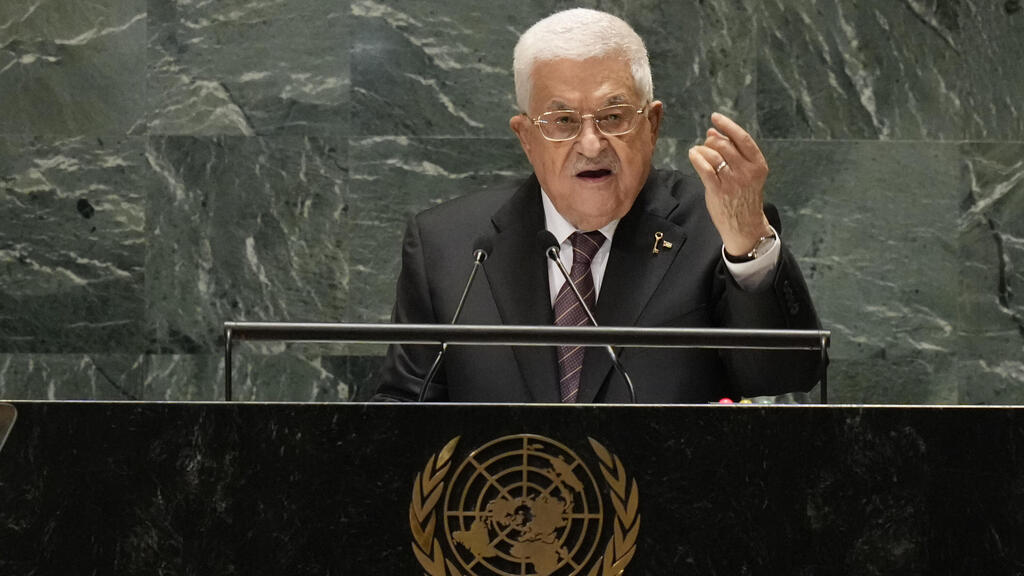
Palestinian Authority President Mahmoud Abbas addresses the UN General Assembly
(Photo: Frank Franklin II)
Opinions on Gaza’s future remain mixed. A third of Israelis support continued Israeli control over the Strip after the war—a drop from 40% in the spring of 2023. No other option commands majority support, including a unified Palestinian administration, UN or UNRWA oversight, or rule by the Palestinian Authority or Hamas. Just 16% support allowing Gazans to choose their own leadership, and only 11% support other unspecified leadership alternatives.
Israelis also express deep skepticism about the role of the international community, with most viewing foreign governments and the UN as detrimental to peace efforts. The notable exception is the United States: 81% of Israelis believe Washington’s involvement is helpful.
Get the Ynetnews app on your smartphone: Google Play: https://bit.ly/4eJ37pE | Apple App Store: https://bit.ly/3ZL7iNv
Despite its association with Hamas in Israeli public discourse, Qatar is seen by 29% of Israelis as a positive force in peace efforts—though 61% disagree. Support for Qatar is significantly higher among Israeli Arabs and political leftists, while it is nearly nonexistent on the political right.
While 62% of ultra-Orthodox Jews and 61% of religious Jews believe Israel is respected globally, only 25% of secular Israelis share that view—compared to 74% who say the country’s global image is negative.
Growing ambivalence and 'public fatigue'
The Pew report found clear ideological divides: secular and traditional Jews are more likely to see Palestinians and the Palestinian Authority as potential peace partners, while religious and ultra-Orthodox Jews favor continued Israeli control over Gaza and express near-total distrust of the Palestinian side.
In a range of key questions—such as whether peace is achievable or whether the world will recognize a Palestinian state—15% to 20% of Israelis chose “depends” or “don’t know.” Researchers interpret this as a sign of public confusion or loss of faith in clear solutions, reflecting what they call a growing sense of “mental or emotional fatigue” among the Israeli public.