

On February 24, 2022, Russia expanded its invasion of Ukraine into a full-scale offensive, a dramatic military move that shook Europe and the broader West, much of which had refused to believe Moscow would dare take such a step.
President Vladimir Putin’s move reflected his vision of bringing all of Ukraine under Moscow’s control, erasing Ukrainian national identity and turning the neighboring country into a de facto Russian client state. But Putin’s plans for a short and devastating military campaign unraveled completely. Ukraine refused to surrender and launched a fierce resistance that continues today.
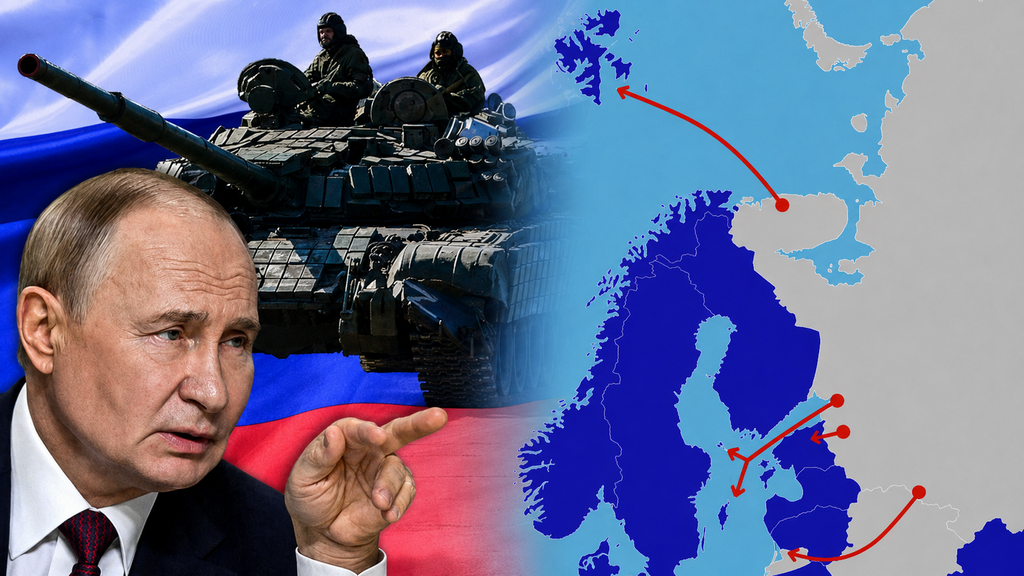
Nearly four and a half years later, the war has become a bloody, brutal and prolonged battle of attrition that has transformed Europe’s security landscape. Finland and Sweden both joined NATO as a direct result of Russia’s expanded invasion, presenting Moscow with a major strategic challenge in the Baltic Sea, now frequently described as a “NATO lake.”
Finland shares a 1,340-kilometer land border with Russia, which has effectively become a frontier between Russia and the forces of the North Atlantic alliance.
From a Western perspective, Russia is deeply bogged down in Ukraine. Its human losses are estimated at 400,000 dead, along with roughly 700,000 wounded and missing. Most of its modern main battle tanks have been destroyed, first by anti-tank missiles during the war’s opening stages and later by inexpensive Ukrainian explosive drones operating along a front stretching some 1,200 kilometers.
Russia has also suffered serious and humiliating blows at sea. Its Black Sea Fleet, once considered a source of pride for both the Russian Empire and the Soviet Union, lost its flagship and numerous other vessels. Many of its ships were forced eastward toward the Sea of Azov, where Ukrainian aerial and naval drones have continued striking Russian ships and tankers. The fleet has largely failed to play a decisive role in the war.
Russia continues attacking targets across Ukraine with missiles and drones, striking cities and energy and transportation infrastructure while inflicting heavy casualties. But over the past two years, Ukraine has also demonstrated an increasing ability to strike deep inside Russia with domestically produced drones.
Those attacks are now causing serious damage to Russian energy infrastructure, including refineries and oil storage facilities, generating significant economic losses and fuel shortages across the country.
Russia has fully shifted to a wartime economy, with 42% of the state budget, nearly 7% of gross domestic product as of the first quarter of 2026, allocated to defense. The economy’s condition continues to deteriorate, clearly affecting Putin’s domestic standing. Russians in Moscow and St. Petersburg, as well as in Siberia and the Ural Mountains, increasingly feel the consequences of the war and are far from satisfied.
On the surface, Putin appears to be in an extremely difficult position. The war is going nowhere, his battered military has still failed to capture the entire Donbas region after four and a half years, monthly casualties exceed 30,000 killed and wounded, the economy is under strain and Russian citizens are beginning to lose patience.
Under such circumstances, it might seem logical for Putin to seek an end to the war, or at least freeze it along the current front lines, allowing Russia to rebuild its forces and prepare for another offensive later.
But that is not happening.
According to Kremlin-linked sources who have spoken with Western media, Putin is more determined than ever to continue the war until he achieves his objectives and may even seek to escalate it. Ukraine’s recent momentum and a series of successful attacks that humiliated Moscow, including a strike on the Russian capital’s largest refinery, have only hardened his position.
Ukrainian strikes near Moscow
(Video: Reuters)


To understand the Kremlin’s next step and the thinking behind it, the situation must be viewed not through the West’s analytical framework, but through Putin’s own perspective, which is fundamentally different.
In Putin’s view, Russia’s situation is not nearly as dire as it appears. The country has not only survived sweeping sanctions but has also learned to bend the West, circumvent restrictions and help reshape a multipolar global order.
Putin repeatedly argues that Russia is not fighting Ukraine alone, but effectively all of NATO, which provides Kyiv with substantial military and financial assistance. When he looks toward Europe and the United States, he does not see a solid, unified front. He sees a weakened wall filled with cracks, declining cohesion within NATO and growing American reluctance, particularly under the Trump administration, to defend Europe in a crisis.
That may be where Putin sees an opportunity for controlled escalation against NATO forces that he believes are weaker than they appear.
A stark warning emerged recently in a comprehensive strategic paper published by the Atlantic Council, a prominent U.S. research institute. Written by military expert Richard Hooker, the report is titled “Putin’s next move? Five Russian attack scenarios Europe must prepare for.”
The analysis examines how recent geopolitical changes, particularly Finland and Sweden’s accession to NATO, have created a dangerous dynamic in which Putin, facing pressure at home and a stalemate in Ukraine, could seek his great victory elsewhere, on NATO territory, by exploiting isolated vulnerabilities in northern Europe and the Baltic region.
For Putin, political pressure is not a restraint
Understanding the Kremlin’s calculations requires first challenging the Western assumption that Putin is acting under domestic political pressure capable of threatening his rule.
Putin, who will turn 74 in October and has led Russia for more than a quarter of a century, still maintains an absolute and increasingly stable grip over the country’s political and social systems.
Parliamentary elections for the lower house of Russia’s legislature, the State Duma, are scheduled for September. Like the elections that preceded them, they are expected to be a carefully staged political performance posing no genuine threat to Putin.
Since the full-scale invasion, the regime has crushed nearly all meaningful opposition activity, passed extremely restrictive laws and brought political repression in Russia to a new peak.
The country’s leading oligarchs, military commanders and senior intelligence officials have been stripped of any meaningful ability to establish independent centers of power or challenge Putin’s decisions. They remain firmly loyal to him.
Russia’s real opposition has been effectively eliminated. Its most prominent leaders have been imprisoned in penal colonies, driven into exile or died under suspicious circumstances.
Russian society itself is subjected to intensive daily propaganda through state-controlled media. The war is presented not as a violation of international law but as an existential, almost sacred historical struggle against a Western effort to dismantle Russia.
(Photo: Alexander Kazakov, Sputnik, Kremlin Pool Photo via AP)
A population shaped by a long tradition of collective suffering and sacrifice has demonstrated a striking ability to absorb enormous military losses and a sustained decline in living standards without producing large protest movements capable of threatening the Kremlin.
For Putin, public pressure is not the restraining factor it would be in a liberal democracy. He understands that many Russians will accept almost any cost as long as it is framed as part of a struggle for the honor of “Greater Russia.”
So far, Putin has successfully sold the public a narrative in which the West declared war on Russia and seeks to “bring it to its knees.” Many Russians believe this completely and continue to support him despite the mounting costs.
The Western assumption that sanctions would force the Russian economy to collapse has also proved overly optimistic.
Russia’s economy did not collapse and recorded growth of 3.4% in 2024, driven largely by the strategic decision to convert the country into a full wartime economy.
The official defense budget rose to nearly 7% of GDP. Production lines in defense plants operate around the clock in three shifts, allowing Russia to produce and repair ammunition, rockets, armored vehicles and tanks at a far faster rate than Western intelligence agencies had predicted.
The economic situation is far from good, but it is also not as catastrophic as many in the West expected, and that works to the Kremlin’s advantage.
Russia’s resilience is supported by several structural strengths. It is largely self-sufficient in agriculture and energy, meaning it can supply its own food, fuel and electricity without relying heavily on imports. It also possesses some of the world’s largest reserves of oil, natural gas, timber, coal, rare metals and iron ore.
When Europe attempted to wean itself off Russian oil and gas, Moscow rapidly built a “shadow fleet” of hundreds of aging oil tankers operating under foreign registrations and flags of convenience. These vessels allow Russia to evade international price caps and direct oil toward new markets in China, India, Turkey and elsewhere.
Ironically, some of the energy now consumed in Europe still originates in Russia but reaches the continent through third countries and secondary markets.
Ukraine has recently attacked numerous vessels linked to Russia’s shadow fleet, but Moscow continues to find creative ways to circumvent sanctions, export oil and generate revenue for the state and the war effort.
Russia is also not nearly as isolated as the West would like to believe. It benefits from the direct and indirect support of a stable bloc of authoritarian states.
China provides alternative trade routes and supplies advanced electronic components and microchips needed by Russia’s defense industry for guided weapons and communications systems. Iran supplies thousands of explosive drones, ballistic missiles and production technology. North Korea has sent millions of artillery shells, ballistic missiles and even combat troops to reinforce Russia’s campaign.
These relationships reassure Putin that Russia is not alone and has the economic and logistical endurance to sustain confrontation with the West for years. Moscow also maintains good relations with much of the Global South, including India and countries across Asia, South America and Africa.
A window to shatter NATO’s ‘illusion of deterrence’
If Putin’s regime is stable and the Russian economy is still functioning, why would he risk a new military adventure beyond Ukraine?
The strategic analysis suggests that two factors may now be converging in his mind: the battlefield stalemate in Ukraine and what he perceives as a historic weakness and widening cracks within NATO.
Putin may see an extraordinary window of opportunity created by internal fractures in the alliance and the transformation of American foreign policy.
Washington has increasingly sent critical and complicated messages to its European allies. The Trump administration has adopted an explicitly transactional approach, identifies China and the Indo-Pacific as its primary strategic challenge and demands that Europe take greater responsibility for its own defense.
Sweeping U.S. demands that European states increase defense spending to an unprecedented 5% of GDP have generated anxiety, anger and confusion in European capitals. At the same time, influential voices in American politics have called for a dramatic reduction in the U.S. military presence in Europe or even a complete withdrawal from NATO.
For Putin, this is music to his ears and an opportunity he may consider worth exploiting.
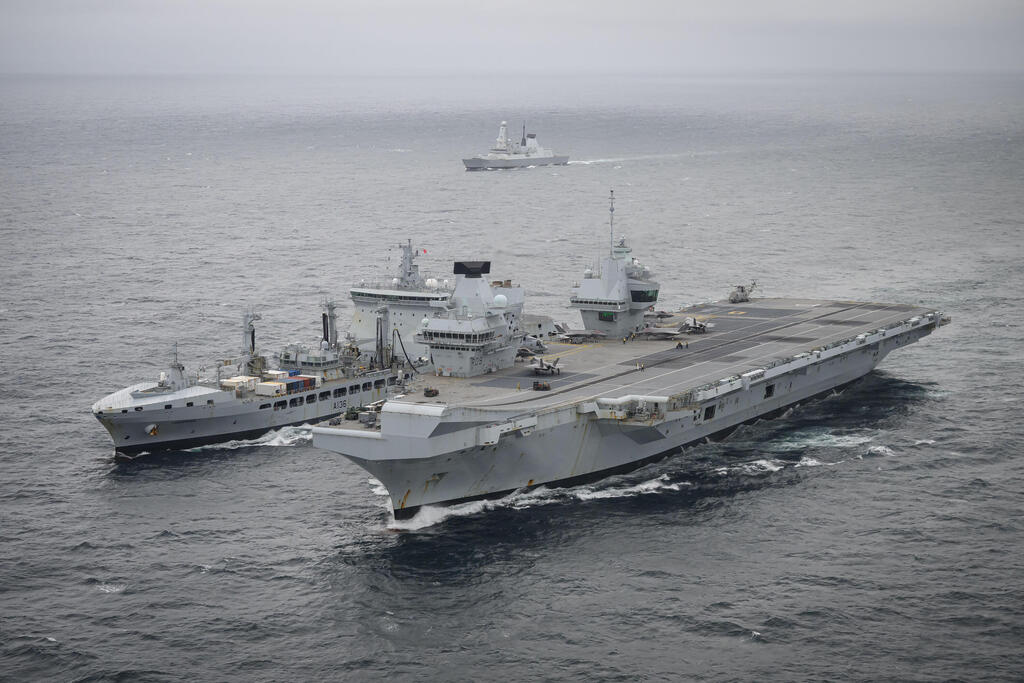
The British aircraft carrier HMS Prince of Wales during a NATO exercise at sea near Norway on June 25
(Photo: Leon Neal/Getty Images)
He genuinely believes the Western order can be dismantled. The rise of far-right and populist movements across Europe, along with the positions of NATO members such as Bulgaria, Turkey and Slovakia, which have resisted sanctions or major military aid commitments, may signal to Putin that invoking Article 5 is no longer automatic.
Article 5 of the NATO treaty declares that an attack on one member is an attack on all.
Putin may calculate that in a limited crisis, political disagreements and delay within NATO would paralyze the alliance and produce a psychological collapse.
A limited offensive could allow him to shatter what he sees as the “illusion of NATO deterrence.” If Russia attacks a small, isolated or restricted part of a NATO member’s territory and the alliance fails to respond with clear, united military force because of fear of nuclear escalation or internal division, NATO would effectively cease to function.
Putin may also believe he has only a narrow window in which to attempt such a move.
Five possible invasion scenarios
The Atlantic Council analysis outlines five principal scenarios, ranked from the highest risk for Moscow to the lowest.
1. A land corridor to Kaliningrad
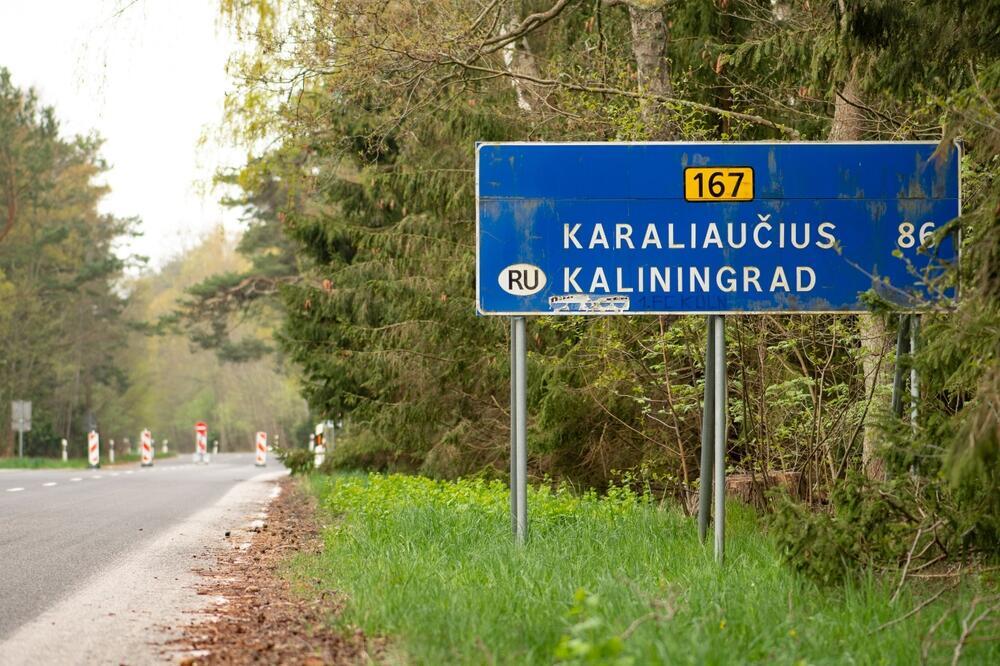
The highest-risk and potentially most explosive scenario would involve Russia attempting to create a land corridor to Kaliningrad, its Baltic enclave located between Poland and Lithuania.
Since the collapse of the Soviet Union, Kaliningrad, which serves as the home base of Russia’s Baltic Fleet and a vast weapons depot that reportedly includes tactical nuclear capabilities, has been geographically separated from mainland Russia by roughly 300 kilometers.
(Photo: Shutterstock)
In this scenario, Russian forces positioned in Belarus, which functions as a client state and forward base for Moscow, would launch a massive surprise offensive through Lithuania to establish a direct land connection to the enclave.
Such an attack would physically sever Lithuania, Latvia and Estonia from the rest of Europe and confront NATO with a full-scale war against a rebuilt Russian military.
The danger for Putin would be enormous. Poland, which possesses one of NATO’s strongest and most modern armed forces, would almost certainly be drawn immediately into the fighting to defend its borders and neighboring states.
2. Seizing Sweden’s Gotland
A second scenario, assessed as carrying medium-to-high risk, centers on the Swedish island of Gotland.
Located in an exceptional strategic position in the heart of the Baltic Sea, Gotland is sometimes described by military planners as an “unsinkable concrete aircraft carrier.”
Russian control of Gotland would give Moscow the ability to severely disrupt NATO’s maritime and air movement across the Baltic region, deploy advanced radar and missile systems threatening Stockholm and potentially shift control of the sea toward Russia.
An attack on Gotland could also be intended to punish Sweden for its historic decision to join NATO and intimidate the Nordic states.
3. Hybrid warfare in eastern Estonia
A medium-risk scenario would focus on eastern Estonia, particularly the region around the city of Narva, directly on the Russian border.
The area has a large ethnic Russian majority. Many residents hold Russian passports and do not speak Estonian.
Rather than launch an overt war involving tanks and aircraft, Moscow could deploy one of its preferred tools: covert hybrid warfare.
Intelligence agents, unmarked special forces personnel known as “little green men” and propaganda operatives could infiltrate the area, incite civil unrest, seize government buildings and declare an “independent people’s republic” seeking annexation by Russia.
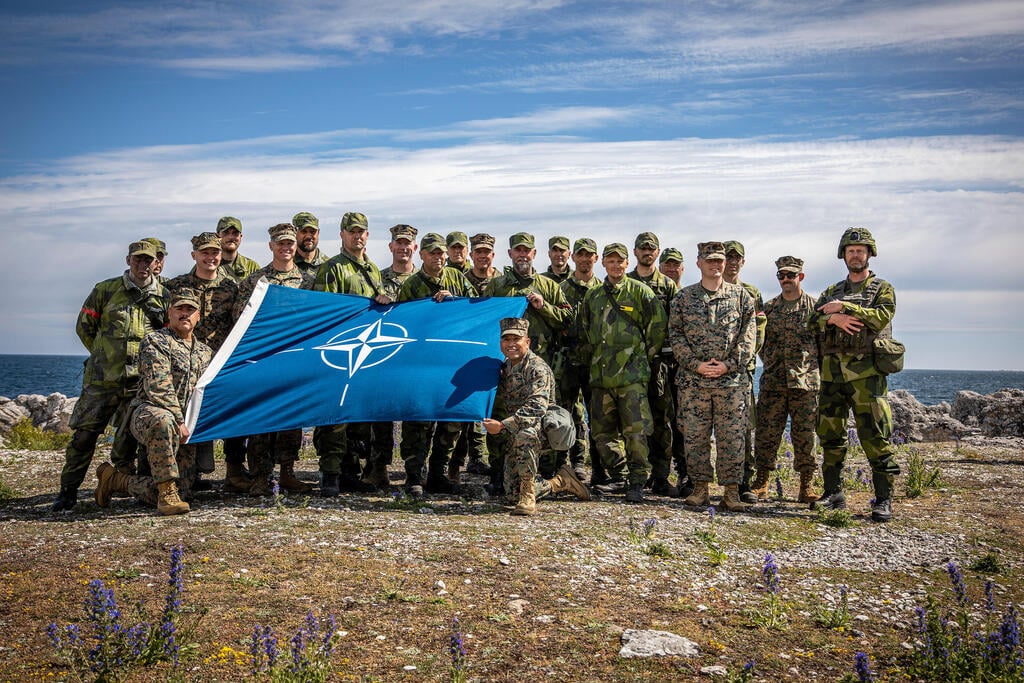
American and Swedish troops pose for a group photo during a 2024 NATO exercise on Sweden’s Gotland island in the Baltic Sea
(Photo: US Marine Corps photo by Sgt. Andy Martinez)
The model would closely resemble the operations used in Crimea and the Donbas in 2014.
Putin would then confront the West with a politically difficult question: Are American or British soldiers really prepared to fight a war to retake a small city whose residents are presented as wanting to join Russia?
4. A rapid assault on Finland’s Åland Islands
The fourth scenario, assessed as medium-to-low risk, involves Finland’s Åland Islands.
The archipelago consists of thousands of small islands controlling the passage between the Baltic Sea and the Gulf of Bothnia.
Under longstanding international agreements, the Åland Islands are completely demilitarized, with no permanent Finnish military presence or defensive fortifications.
A rapid Russian takeover by naval commandos or a covert airborne force could give the Kremlin a powerful choke point over maritime and commercial routes leading toward Helsinki and Stockholm. It would also deliver a painful surprise blow against Finland, one of NATO’s newest members.
5. The Svalbard ‘cold trap’
The fifth scenario, and according to the Atlantic Council authors the most plausible, centers on the Svalbard archipelago.
Of the five possible targets, Svalbard offers Putin what could appear to be an ideal combination: almost no initial resistance, international legal ambiguity, major strategic importance and a relatively low risk of a unified NATO military response.
Svalbard, formerly known as Spitsbergen, is a remote and frozen group of islands in the Arctic Ocean, about 750 kilometers north of mainland Norway.
The archipelago has fewer than 3,000 residents, concentrated primarily in two small settlements.
Its international legal status is unusual. Under the 1920 Svalbard Treaty signed in Paris, sovereignty over the islands was granted to Norway but under significant restrictions.
The treaty designates the archipelago as demilitarized. Norway may not establish military bases or fortifications there or permanently station regular forces. It also grants citizens of all signatory states equal rights to live and conduct commercial activity on the islands, subject to Norwegian civil law.
Russia has long recognized the potential created by this ambiguity. Russian civilians have maintained a permanent presence on the islands for decades, primarily around the coal-mining settlement of Barentsburg.
In recent years, the Kremlin has pursued a coordinated propaganda strategy. Russian officials have repeatedly accused Norway of violating the treaty, secretly militarizing the islands and restricting the activities of Russian researchers and miners.
From a Western perspective, such accusations resemble the Kremlin’s familiar method of preparing the political and legal justification, or casus belli, for possible future military action under the pretext of defending Russian citizens and historical interests.
Svalbard’s geopolitical and military importance to Russia is immense.
The islands sit near the crucial maritime gateway between the North Atlantic and Arctic oceans. The nearby Kola Peninsula is one of Russia’s most strategically important regions and hosts major bases of the Northern Fleet.
That fleet includes many of Russia’s attack submarines and nuclear-powered ballistic missile submarines, which form a central pillar of Moscow’s strategic nuclear deterrent.
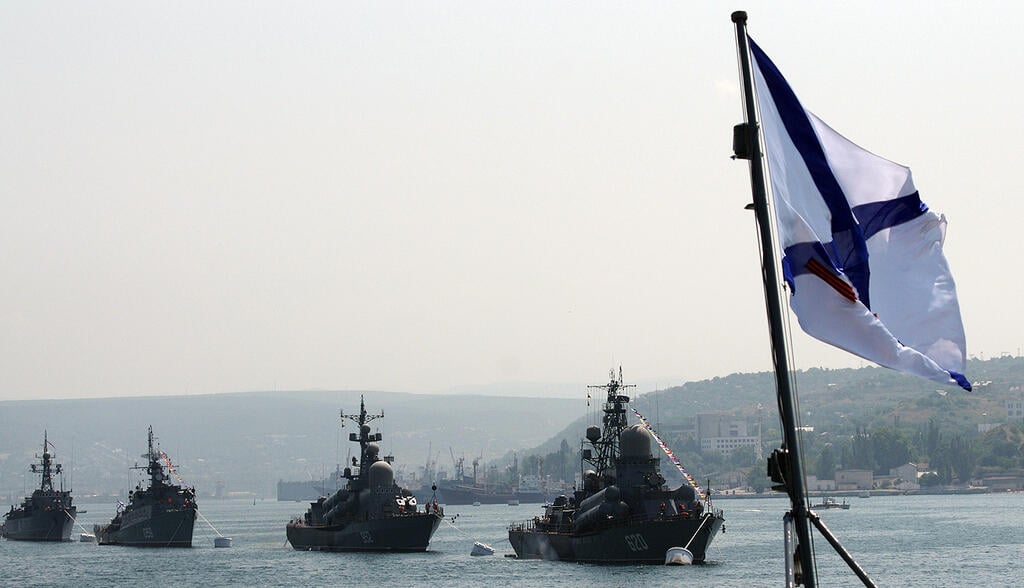
Russian Navy vessels in the Black Sea near Sevastopol
(Photo: AFP)
Russian control of Svalbard could help the Kremlin create a fortified defensive zone around the Kola Peninsula, prevent NATO from deploying radar or intelligence systems capable of tracking Russian submarines and disrupt transatlantic shipping routes during a conflict.
A Russian operation to seize Svalbard could be designed as a short, covert and rapid fait accompli intended to leave the West shocked and divided.
It could unfold in several stages.
First, covert and plausibly deniable sabotage operations could sever the undersea communications and fiber-optic cables connecting Svalbard to mainland Norway, blinding Oslo’s monitoring systems and cutting the flow of information from the islands. A similar unexplained incident occurred in January 2022, when a major communications cable in the area was suddenly severed.
At the same time, Russian intelligence officers and special forces personnel could infiltrate the islands disguised as tourists or replacement workers. These forces could rapidly seize the archipelago’s only civilian airport, located north of Longyearbyen.
Once the runway was secured, heavy Russian military transport aircraft could land Northern Fleet marine battalions, including troops from the 61st Naval Infantry Brigade based near Murmansk.
They could seize government buildings, the major satellite communications station and the ports without facing substantial resistance, because no Norwegian military force is permanently stationed there.
Within hours, Russia could deploy advanced air-defense systems and coastal anti-ship missile batteries. Together with Northern Fleet submarines and warships closing the surrounding seas, these systems could create a powerful air and maritime exclusion zone, making any NATO attempt to approach the islands extremely costly.
After completing the physical seizure, Putin could activate the central element of the strategy: a political and psychological trap for NATO.
Moscow could announce that it had temporarily occupied the islands to protect Russian citizens and prevent NATO from violating the international treaty. It could then warn that any Western attempt to retake the territory would trigger a severe Russian response, potentially including the use of tactical nuclear weapons deployed in the region.
Putin would be counting on a paralyzing internal debate in NATO headquarters in Brussels and major European capitals.
Western leaders, already facing domestic political pressure and exhaustion from the long confrontation in Ukraine, would be forced to ask whether they were truly prepared to risk World War III, total economic devastation or even a nuclear exchange with Russia to return several sparsely inhabited frozen islands to Norway.
If NATO hesitated, delayed or settled for another round of economic sanctions and diplomatic condemnation instead of sending military forces to fight Russia, Putin could achieve perhaps the greatest strategic victory of his rule.
Article 5 would be exposed as an empty promise, NATO would effectively begin to disintegrate and the old U.S.-led world order could reach its formal end, all through a limited operation that was relatively inexpensive for the Kremlin and produced few casualties.