

Since Hamas’ October 7 attack, the trajectory of relations between Israel and Turkey has reflected a deep and deliberate political rupture, driven by an escalating strategy of delegitimization by Ankara that includes inciting rhetoric, systematic media narratives, diplomatic sanctions and participation in international legal initiatives.
That is the assessment of a Turkey expert, who outlines what he describes as a troubling deterioration in ties between the two countries and a broad campaign led by the Turkish state against Israel on diplomatic, legal and media fronts.
Gallery
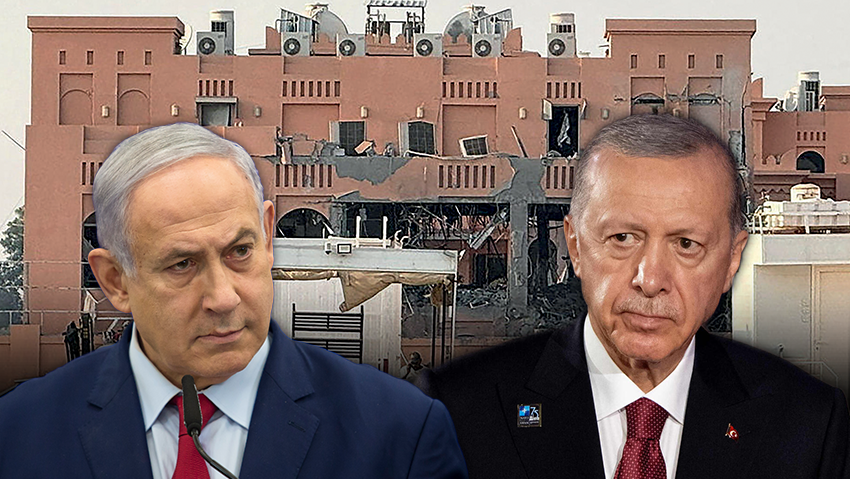
Prime Minister Benjamin Netanyahu, Turkish President Recep Tayyip Erdogan
(Photo: Ibraheem Abu Mustafa/Reuters, Andrew Harnik/GETTY IMAGES/AFP, Amir Levy/Getty Images)
“President Recep Tayyip Erdogan’s policy toward Israel has transformed bilateral relations from a pragmatic partnership into an ideological confrontation,” said Dr. Hay Eytan Cohen Yanarocak, a Turkey specialist at Tel Aviv University’s Moshe Dayan Center for Middle Eastern and African Studies. In his research, he warns that if Erdogan continues on this path, the crisis between the two countries could become irreversible.
“By comparing Israel to Nazism, weaponizing Holocaust memory, blocking maritime and diplomatic access to airspace, and cultivating Hamas as a legitimate political actor, Turkey has positioned itself as one of the leading global players challenging Israel’s legitimacy,” he said. “This shift has long-term consequences: it narrows the diplomatic space for reconciliation, reshapes regional alliances and undermines trust between the two nations at a structural level. Unless Ankara reconsiders this delegitimization paradigm, Israeli-Turkish relations will remain locked in a cycle of alienation and continue to deteriorate.”
According to Yanarocak, relations since October 7 illustrate a calculated political break rooted in the same strategy. “What began as rhetorical support for Hamas quickly evolved into a comprehensive policy framework aimed at undermining Israel’s moral, political and even historical legitimacy,” he wrote. “Through inciting discourse, systematic media narratives, trade suspensions, symbolic diplomatic sanctions and active participation in international legal initiatives, Turkey’s leadership has signaled that it is no longer seeking functional normalization with Israel, even after a ceasefire in Gaza.”
He added that Ankara has reframed Jerusalem not merely as a regional rival but as a “civilizational threat” to Turkey’s security identity, embedding anti-Israel hostility deeply within both state institutions and public consciousness.
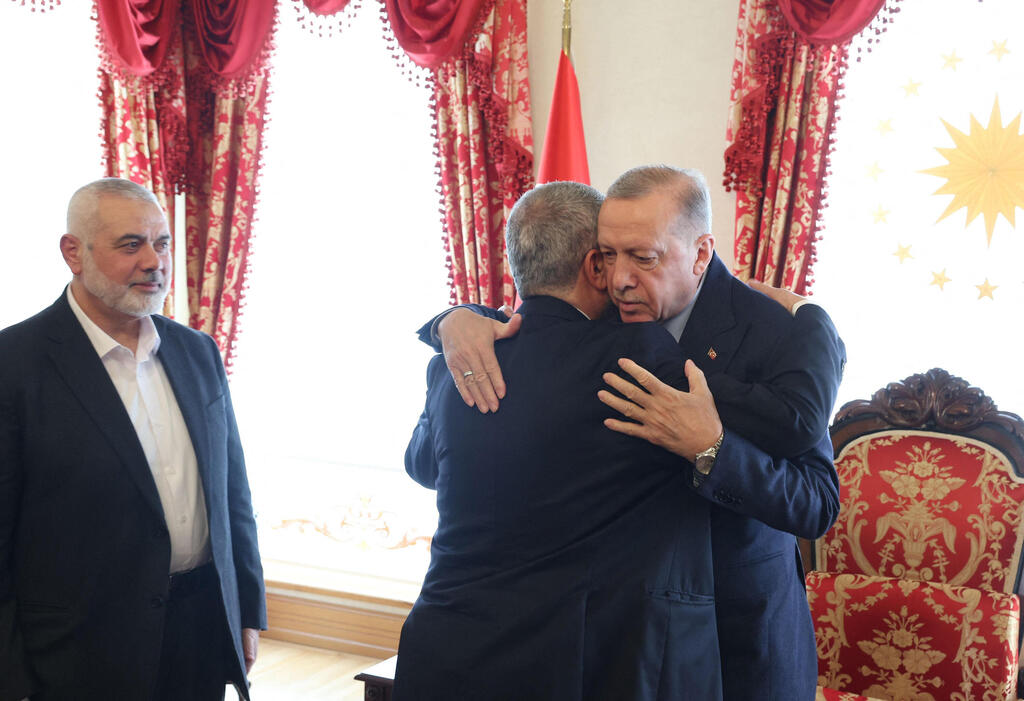
Erdogan meets with Hamas leaders in Ankara
(Photo: AFP / TURKISH PRESIDENCY PRESS OFFICE)
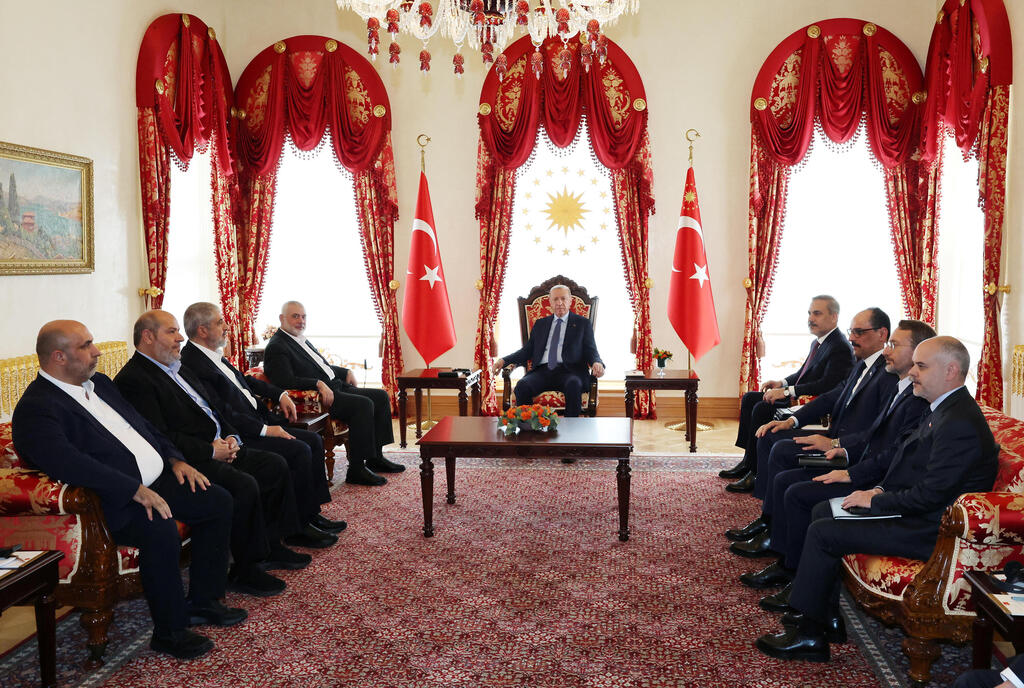
(Photo: Murat Cetinmuhurdar/Turkish Presidential Press Office/ REUTERS)
Yanarocak traces the sharp downturn to late 2023. “Just one month before the outbreak of fighting, President Erdogan and Israeli Prime Minister Benjamin Netanyahu stood side by side before cameras, flanked by senior advisers, beneath the flags of both countries at the Turkish House in New York,” he said. “Yet just over two years later, on November 7, 2025, Istanbul prosecutors issued arrest warrants for 37 senior Israeli officials involved in managing the war against Hamas, including Prime Minister Netanyahu, Defense Minister Israel Katz and IDF Chief of Staff Eyal Zamir.”
That move, he said, extinguished hopes that tensions would gradually ease after the fragile Gaza ceasefire brokered in October 2025 by U.S. President Donald Trump. “In this overtly political decision, Istanbul signaled that it had no intention of returning to normalized relations with Jerusalem despite the ceasefire,” Yanarocak said.
He noted that the delegitimization campaign formally began on October 25, 2023, when Erdogan described Hamas members as “freedom fighters.” Pro-government Turkish media quickly aligned their coverage with the president’s stance, a narrative that soon spread beyond Erdogan-aligned outlets to secular and left-leaning opposition media as well.
Yanarocak said public discourse in Turkey began minimizing Ankara’s 1949 decision to recognize Israel, dismissing Jewish historical ties to the land and portraying Israel as a rootless Western project. Erdogan’s declaration at a mass rally on October 28, 2023, that “Israel is merely a pawn in the region, to be sacrificed when the time comes,” contributed to this shift.
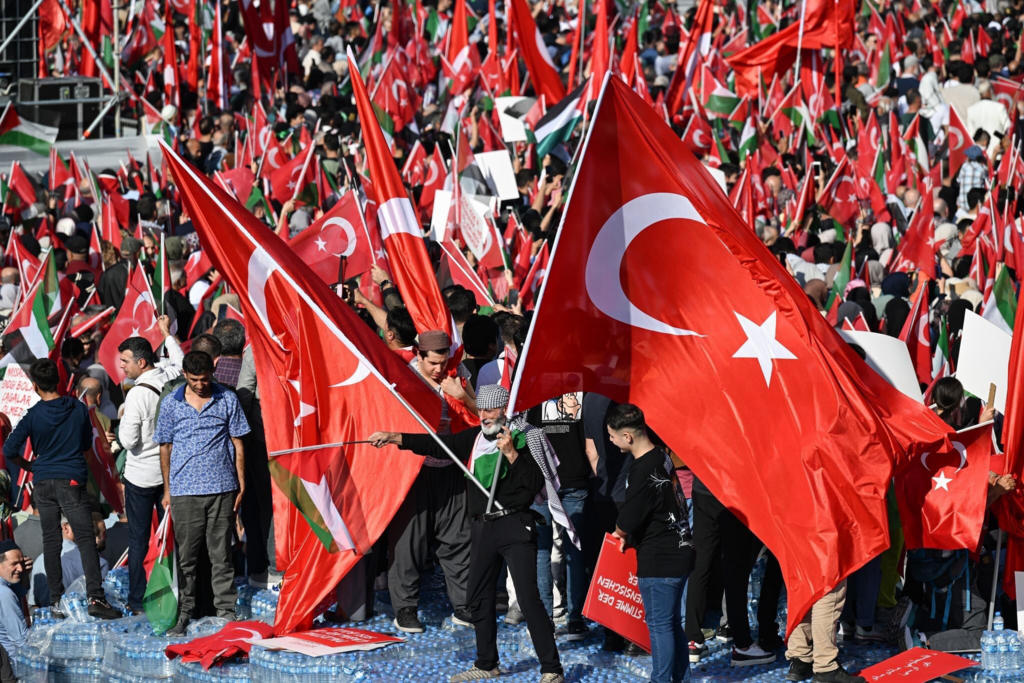
Pro-Palestinian rally in Istanbul
Addressing the crowd, Erdogan asked, “Who is behind the PKK?” When participants responded, “America,” he added: “Israel too. Whether it’s money or weapons, they provide them. We know this,” openly casting Israel as a national security threat to Turkey.
From there, Yanarocak said, both conservative and liberal media outlets intensified a delegitimization campaign against Israel, with Turkish policymakers and journalists using labels such as “gangster,” “massacre network,” “rogue state,” “terror state,” “virus,” “murderer,” “occupier,” “genocidal” and even “Zio-Nazi.” He said this terminology was aimed at “Nazifying” Israel and trivializing the Holocaust. Erdogan himself declared that “Netanyahu has surpassed Hitler” and predicted that “Netanyahu’s end will be like Hitler’s.”
Holocaust-related terms and sites, such as “concentration camp” and “Auschwitz,” were also distorted and applied to Gaza, with phrases like “Zio-Nazi camp” or “Gazawitz,” which Yanarocak said trampled the memory of Holocaust victims.
After the killing of Hamas leader Ismail Haniyeh in Tehran on July 31, 2024, Erdogan labeled the Israeli operation “Zionist barbarism” and ordered Turkish flags lowered to half-staff at all Turkish missions worldwide in his honor, including the Turkish Embassy in Tel Aviv, a move Israel viewed as unacceptable.
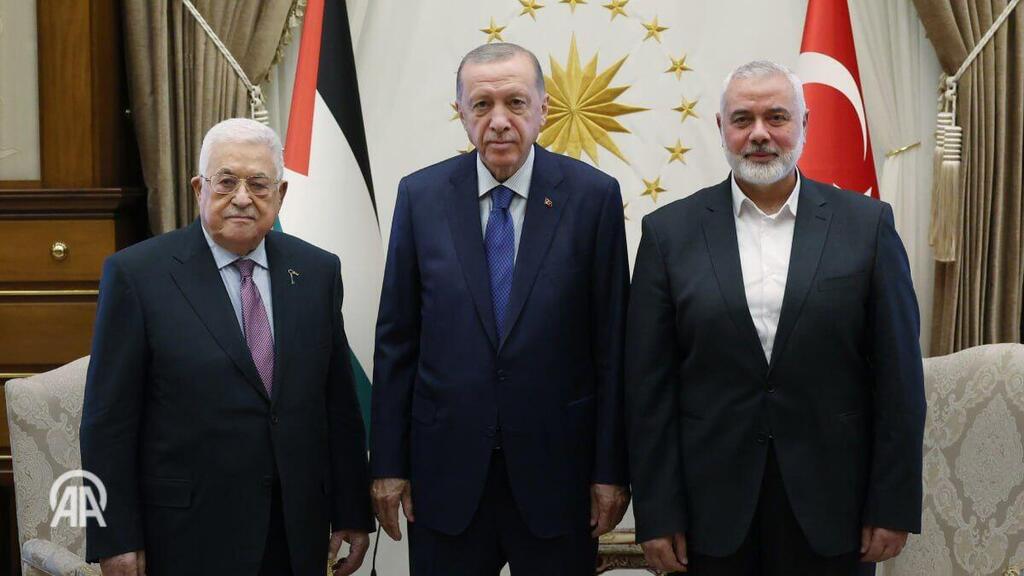
Palestinian Authority Chairman Mahmoud Abbas, Erdogan and Hamas leader Ismail Haniyeh
(Photo: Anadolu)
In August 2024, Turkey formally joined South Africa’s case against Israel at the International Court of Justice in The Hague, a step Yanarocak described as the most critical element of Ankara’s delegitimization campaign. On April 30, 2025, the Turkish delegation presented a submission to the court titled “War crimes committed by Israel.”
In September, Erdogan called from the UN podium for the implementation of the 1950 Uniting for Peace resolution, indirectly likening Israel to Nazi Germany and justifying international military intervention. The following month, he escalated his rhetoric further by claiming Israel harbored ambitions on Turkish territory and declaring it a national security threat.
The policy reached another peak on November 17, 2024, when President Isaac Herzog was forced to avoid Turkish airspace on his way to Azerbaijan. After the fall of Syria’s Assad regime in December 2024, Turkey and Israel entered a new phase of rivalry in Syria. In April 2025, Turkey again closed its airspace to an Israeli delegation en route to Baku.
In 2025, Yanarocak said, Ankara further deepened its ties with Hamas, portraying meetings with senior Hamas figures as official national delegations and granting the group legitimacy through Turkish media. Under the pretext of mediating prisoner exchanges, Turkey also allowed released Hamas operatives to relocate to its territory. According to various reports, Turkey has additionally permitted Iran to transfer funds through Istanbul to Hezbollah and Hamas for reconstruction purposes.