


A member of the Likud party proposed on Wednesday to expand his legislative plan to establish a new antiquities authority for the West Bank to also give Israel jurisdiction over antiquities in Gaza.
During a session of the Knesset Education Committee preparing the bill for its first reading, lawmaker Amit Halevi presented an updated version of the proposal that would authorize the new Heritage Authority for west bank and Gaza to preserve and manage archaeological sites not only in the West Bank but also within the Gaza Strip.
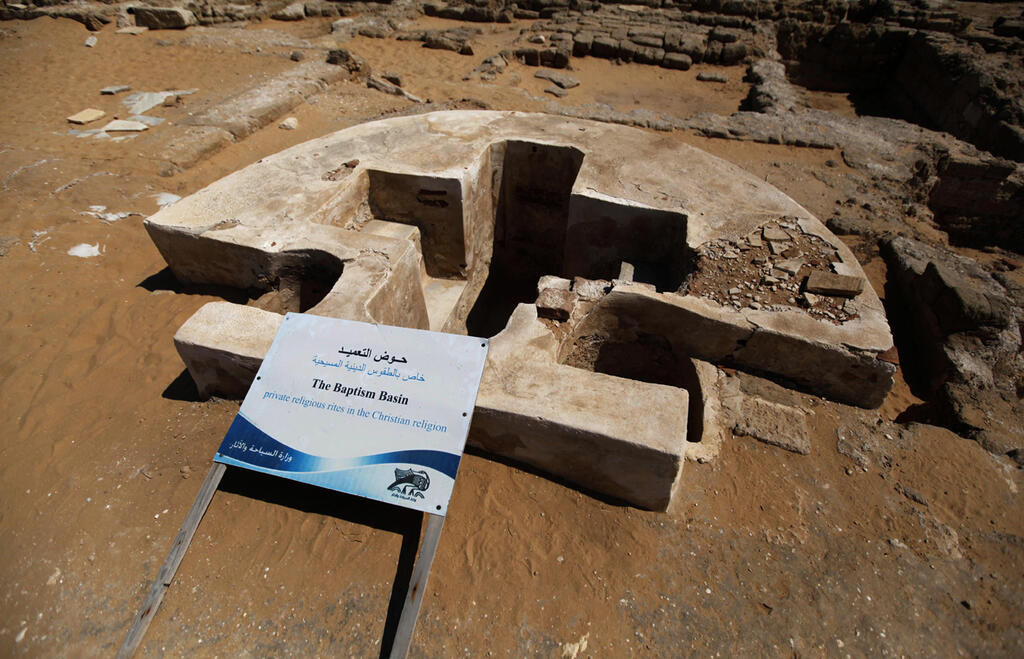
An archaeological site in Gaza
(Photo: AP)
The revised draft, debated under the committee chaired by Knesset member Zvi Sukkot, calls for an agency similar to the Israel Antiquities Authority. Under Halevi’s version, the body would have the authority to operate in areas of the West Bank designated as Area A and also in Gaza, parts of which are currently under the control of Hamas.
Committee members did not have time to fully consider Halevi’s request to extend Israeli operational authority to Gaza and focused their discussion on the West Bank. Sukkot said the bill was among the most important he aims to advance. “Most of the biblical stories took place in the West Bank,” he said. “Our fathers and mothers, all the great kings, left signs there. Archaeology has been neglected for many years. Antiquities are destroyed and disappear almost daily, and we want to bring order to this. The state needs to take responsibility for the heritage. We do not have the privilege of being negligent.”
Heritage Minister Amihai Eliyahu voiced support for the proposal but described it as “an interim stage until full sovereignty is applied.” He said, “We certainly want to apply sovereignty in the West Bank. It is ours. Christian heritage sites are also being destroyed, not just those of the Jewish people.” Opposition lawmaker Gilad Kariv called the bill “absurd” and said he would do everything possible to delay it. Arye Balaban of the Justice Ministry’s Legislation and Legal Advice Department warned that “the legislation contradicts long-standing Israeli policy regarding the West Bank and raises international sensitivities. We would like to address specific sensitive clauses in a smaller forum.”
Committee legal adviser Tami Sela said the language had been altered amid objections, and the current draft includes the creation of a governmental support unit that would be a separate authority under Israeli law with its own budget and powers to manage archaeological and heritage sites. She said the bill would include a temporary provision for three to four years.
Shira Emanuel, also from the Justice Ministry, cautioned that the version approved by the Ministerial Committee for Legislation was narrower. “The understanding in the Ministerial Committee for Legislation was that the bill would be returned there before its first reading,” she said, citing existing Jordanian-era legislation and military orders governing the issue. She warned the proposed law could lead to “conflicts and inconsistencies that could outweigh its benefits.”