

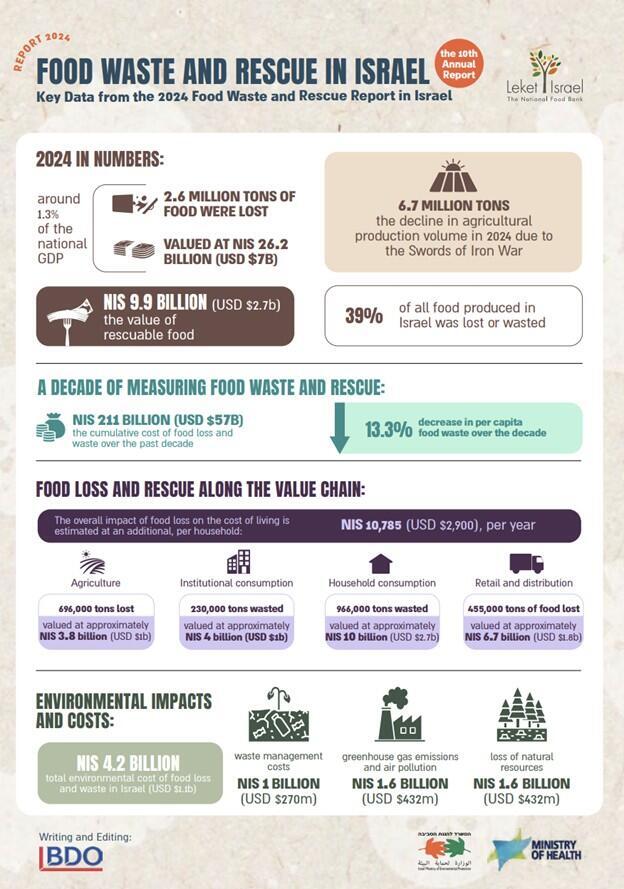
Israel has discarded food worth NIS 211 billion ($64 billion) over the past decade, according to the 10th Annual Food Waste and Rescue Report by Leket Israel and BDO, prepared in cooperation with the Ministry of Environmental Protection and the Ministry of Health.
While per capita food waste has decreased by 13.3%—dropping from 300 to 260 kilograms per person per year—rising living costs and population growth have kept the total volume of waste high.
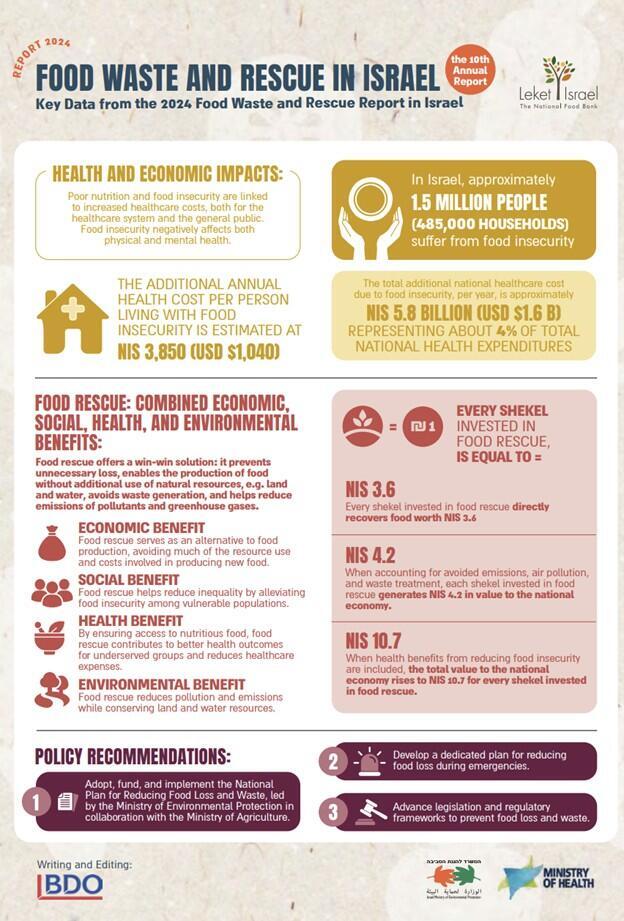
In 2024 alone, 2.6 million tons of food, valued at NIS 26.2 billion (USD 7 billion), were wasted in Israel. This represents 39% of all food produced, or 1.3% of the national GDP. Within household consumption alone, the loss amounted to NIS 10 billion (USD 2.7 billion), an annual cost of NIS 10,785 (USD 2,915) per household. At the same time, about 1.5 million people—some 485,000 households—experience food insecurity and are uncertain whether they can afford adequate, nutritious food each month.
The impact is not only economic. Food waste carries steep environmental and health costs. The environmental toll is estimated at NIS 4.2 billion (USD 1.14 billion) annually, including wasted water and land, pollutant emissions, and waste treatment. The health cost of food insecurity reaches NIS 5.8 billion (USD 1.57 billion) annually—about 4% of the national healthcare budget—adding pressure to an already burdened system.
Since a 2015 State Comptroller’s Report highlighted the absence of a national food rescue policy, Leket Israel has helped drive policy changes and raise public awareness. Over the past decade, the Food Donation Act was passed and later amended; food rescue and food security became part of the National Food Security Program; and new inter-ministerial frameworks for measurement and action were introduced. In 2025, for the first time, the government launched a national plan to reduce food loss, led by the Ministry of Environmental Protection in cooperation with the Ministry of Agriculture. The plan introduces measurable national targets for reducing waste and increasing food rescue, with a focus on easing the financial burden on lower- and middle-income groups.
Leket Israel
Gidi Kroch, CEO of Leket Israel, called the findings a “national failure with no moral, environmental, social, or economic justification.” He added, “After a decade of awareness, the time has come for action. We must stop throwing food away and start rescuing it.”
“For 22 years, Leket Israel, the National Food Bank, has worked with farmers, manufacturers, retailers, and volunteers to rescue high-quality food and distribute it to hundreds of thousands of families,” he said. “Every shekel invested in food rescue yields NIS 10.7 in value to the national economy. This is an immediate, sustainable, and cost-effective solution. The government must allocate funding to achieve a clear goal: an Israel without food loss.”
Environmental Protection Minister Idit Silman said the ministry's new national plan “charts the path forward and provides an environmental and socio-economic response to one of the major challenges facing Israel’s food systems.” She emphasized that food rescue is essential for building a sustainable food economy, easing burdens on households, reducing inequality, and shrinking Israel’s environmental footprint.
Dr. Moran Blaychfeld Magnazi, director of the Nutrition Division at the Ministry of Health, noted the health benefits of improved access to fresh produce. “Increasing fruit and vegetable intake among food-insecure populations can significantly improve their health, enhance quality of life, and save the economy substantial costs,” she said.
Chen Herzog, chief economist at BDO and editor of the report, warned that food loss is fueling rising prices. “The economy paid a high price during the war due to increased food loss, especially in agriculture,” he said. “Food loss has contributed to a roughly 15% rise in fruit and vegetable prices since the war began. The confrontation line areas near Gaza and the North—responsible for about 30% of agricultural output—must be part of any recovery plan that includes an operational policy to reduce food waste.”
According to Herzog, the annual cost of food loss has increased by 45% over the past decade, from NIS 18 billion (USD 4.87 billion) in 2015 to NIS 26 billion (USD 7 billion) today. He called the lack of budget allocation for food rescue “an ongoing failure” and urged the government to include funding for the plan in the 2026 state budget.
- Leket Israel is the country’s largest food rescue organization. In 2024, it rescued 2 million cooked meals from IDF bases, hotels, and catering companies, and collected 31,402 tons (69.1 million pounds) of agricultural produce. For more information, visit the website.