

Rom Braslavski, a survivor of the October 7 Nova music festival massacre and more than two years in captivity by Palestinian Islamic Jihad (PIJ) in Gaza, revealed for the first time that he was sexually assaulted during his 738 days in captivity.
“They stripped me of all my clothes — underwear, everything. They tied me up from my... while I was completely naked. I was torn apart, dying, with no food,” Braslavski said in an interview set to air Thursday night on Channel 13 program Hazinor. “I prayed to God, 'Please, save me, get me out of this already.' And you just say to yourself, 'What the f***?'”
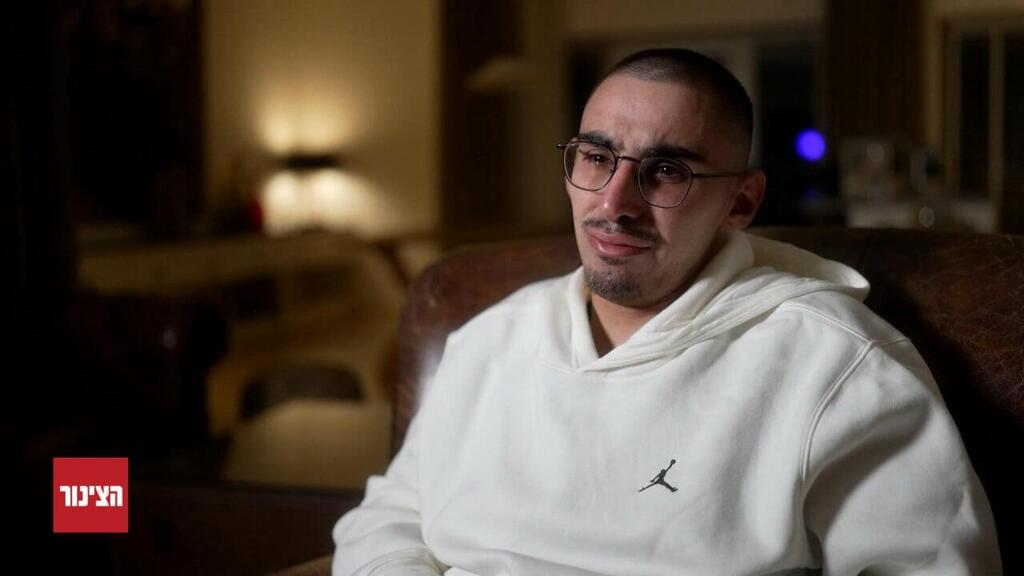
Rom Braslavski
(Photo: from Hazinor)
Excerpts from the interview, conducted by journalist Roni Aviram, were published Wednesday by the UK’s Daily Mail. “It was sexual violence — and its main purpose was to humiliate me,” Braslavski said. “The goal was to crush my dignity. And that's exactly what he did.”
When asked whether there were more incidents beyond the one he described, Braslavski responded: “Yes. It's hard for me to talk about that part specifically. I don't like to talk about it. It's hard, It was the most horrific thing. It's something even the Nazis didn't do. During Hitler's time, they wouldn't have done things like this. You just pray for it to stop. And while I was there — every day, every beating — I'd say to myself, 'I survived another day in hell. Tomorrow morning, I'll wake up to another hell. And another. And another. It doesn't end.”
Braslavski, who was kidnapped from the festival and taken into Gaza by PIJ terrorists, had previously said that his captors repeatedly tried to force him to convert to Islam—an effort he resisted. “They kept telling me, ‘We are Muslims,’ ‘We are Arabs,’ ‘We are the true religion,’ ‘We are Muhammad,’” he recalled in a statement last month. “The only thing that gave me strength was knowing that everyone around me wasn’t Jewish, and that the reason I was there was simply because I’m a Jew.”
His mother, Tami, said Rom was held alone for two years, often outside the tunnels, and at times alongside the bodies of other hostages. Upon his return, he reported the identities of fallen captives to Israeli authorities.
Palestinian Islamic Jihad propaganda video featuring Rom Braslavski


According to Tami, his captors showed him footage of protests at Tel Aviv's Hostage Square and told him his photo was missing from public displays—part of a psychological campaign to break him. “They told him no one was talking about him, that we were broken and had no strength to protest,” she said.
She also described how the abuse intensified in the final months of his captivity. Despite promises of food and gifts, he refused to convert. “They tried to make him convert to Islam, promising him food in return, but Rom insisted on preserving his Jewish identity. The moment he came back, he put on tefillin.”
Tami recounted an episode in which, during a period of extreme hunger and weight loss, Rom managed to free himself from handcuffs, gathered clothing from his captors and set them on fire in a bathroom. He then used the fire to heat a pot of pasta and water. The fire spread and drew the attention of a crowd outside, who began banging on the windows and shouting. Rom hid under a bed as dozens broke into the house. When they saw the handcuffs, they realized a hostage was inside. “He recited the Shema Yisrael prayer over and over, praying not to be killed in a lynch. Then suddenly, he heard a set of keys—it was his captor, returning at exactly that moment,” Tami said.
Before his release, the terrorists force-fed him, which she says now causes dangerous blood sugar fluctuations. In the early months of his captivity, he was shackled at all four limbs, forced to relieve himself into a bottle and given just half a piece of dry flatbread a day.
“He told us these horrific things as if they were routine,” she said. “I hear them and my heart breaks. But this time, I can hold him for real—he’s not there anymore. He’s here.”