

Germany’s political attention is fixed Sunday on the eastern state of Saxony-Anhalt, where an election in a region of just 2.1 million people could become one of the most consequential moments in German politics since World War II. For the first time since 1945, a far-right party could win enough power to govern a German state.
Alternative for Germany, or AfD, enters the vote with a commanding lead. The latest ZDF poll put the party at 41%, compared with 23% for the Christian Democratic Union, or CDU, of incumbent state premier Sven Schulze. Another poll placed the AfD as high as 43%. That would represent close to a doubling of its 20.8% result in the previous Saxony-Anhalt election in 2021. The party has also surged nationally: in Germany’s 2025 federal election it doubled its support from 10.4% to 20.8%, becoming the largest opposition party in the Bundestag.
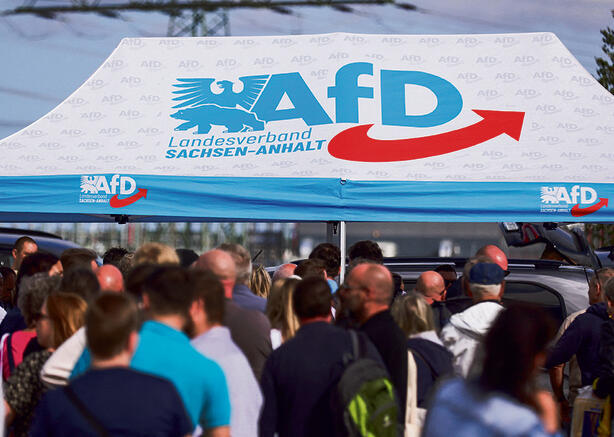
But winning the most votes does not necessarily mean taking power. Germany’s major parties have so far refused to enter coalitions with the AfD, maintaining the political “firewall” designed to isolate it. The party’s 35-year-old candidate for state premier, Ulrich Siegmund, has said he is not interested in coalition partners either and would seek the premiership only if the AfD wins an absolute majority and can govern alone.
That makes Germany’s 5% electoral threshold one of the biggest variables in Sunday’s vote. Parties that fail to cross it are excluded from the distribution of parliamentary seats, meaning the AfD would not necessarily need 50% of the popular vote to control more than half the legislature. The more votes cast for parties that fail to enter parliament, the greater the AfD’s relative share of seats could become.
The Social Democrats, or SPD, and the Greens are projected by some polls to clear the threshold, though the Greens remain close to the danger zone at around 5% to 6%. The Free Democratic Party, or FDP, and the Sahra Wagenknecht Alliance, BSW, are expected to fall short.
The prospect of an AfD majority has even triggered a campaign for tactical voting, urging opponents of the party to back the SPD or Greens even if they would not normally support them, simply to ensure those parties cross the threshold and reduce the AfD’s share of seats. As a result, one of the central questions Sunday is not only who finishes first, but how many parties make it into parliament at all.
“No matter what tomorrow’s result is, we have already made history,” Siegmund told an AfD closing rally in Magdeburg on Saturday night. “What we started here in Saxony-Anhalt, and what is now sweeping across all of Germany, can no longer be stopped.”
Immigration, schools and Pride flags
An AfD government in Saxony-Anhalt would have consequences far beyond symbolism. Germany’s states wield broad powers over education, culture and internal security, while also holding seats in the Bundesrat, the upper house of the federal parliament. Saxony-Anhalt controls four of its 69 votes.
In its “Vision 2026” platform, the AfD lays out how it would use that authority. The party pledges to launch a deportation drive and establish a task force to accelerate removals, reduce reliance on foreign workers it describes as coming from “culturally foreign backgrounds,” and challenge the status of Ukrainian refugees.
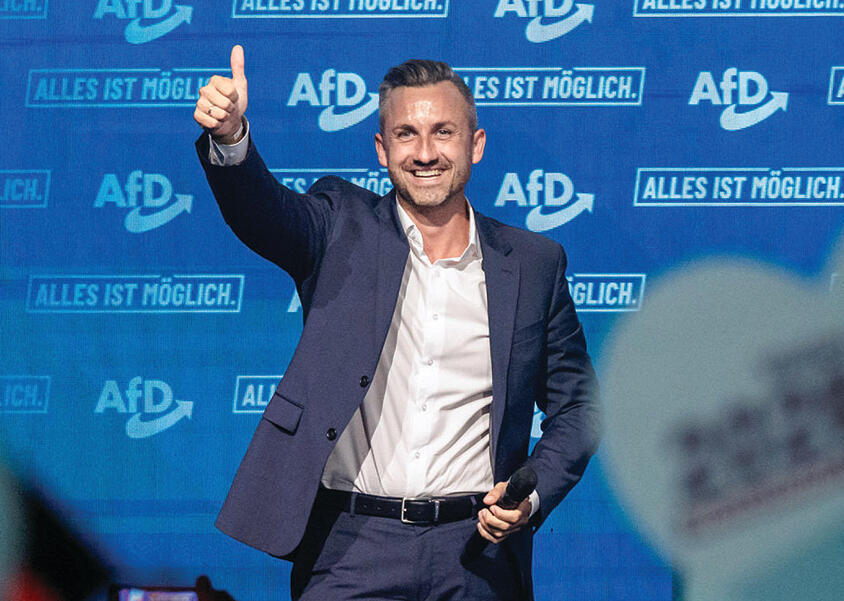
Ulrich Siegmund, the AfD’s candidate for state premier in Saxony-Anhalt
(Photo: Jens Schlueter, Getty Images)
In schools, the AfD proposes placing refugee children in separate classes, returning students with disabilities to special education frameworks, banning Pride flags and requiring the German flag to be flown daily. It also wants to reshape school curricula in what it describes as a more patriotic direction, restrict Islamic practices including the Muslim call to prayer, dismantle the state’s current public broadcasting structure and withdraw funding from certain cultural institutions.
Ahead of the election, ynet spoke with two Jewish figures who have extensive experience with both antisemitism and Germany’s far right: Max Privorozki, chairman of the Jewish community in Halle, where a neo-Nazi gunman tried to storm a synagogue on Yom Kippur in 2019 before murdering two people outside; and Stephan Kramer, a German Jew who has headed the domestic intelligence agency in neighboring Thuringia since December 2015.
“Alternative must be under surveillance,” Kramer said. “There are strong indications that influential parts of the party are acting against human dignity and the German Constitution and are working against the democratic order.” He noted that the AfD has been classified as a confirmed far-right extremist organization by local domestic intelligence authorities in Thuringia and, since 2023, in Saxony-Anhalt.
At the federal level, the legal picture is more complicated. Germany’s domestic intelligence agency, the BfV, announced in May 2025 that it was classifying the AfD as a confirmed far-right extremist organization, but later temporarily suspended use of that designation pending a legal challenge by the party. The Saxony-Anhalt branch itself remains classified by the state intelligence service as confirmed far-right extremist.
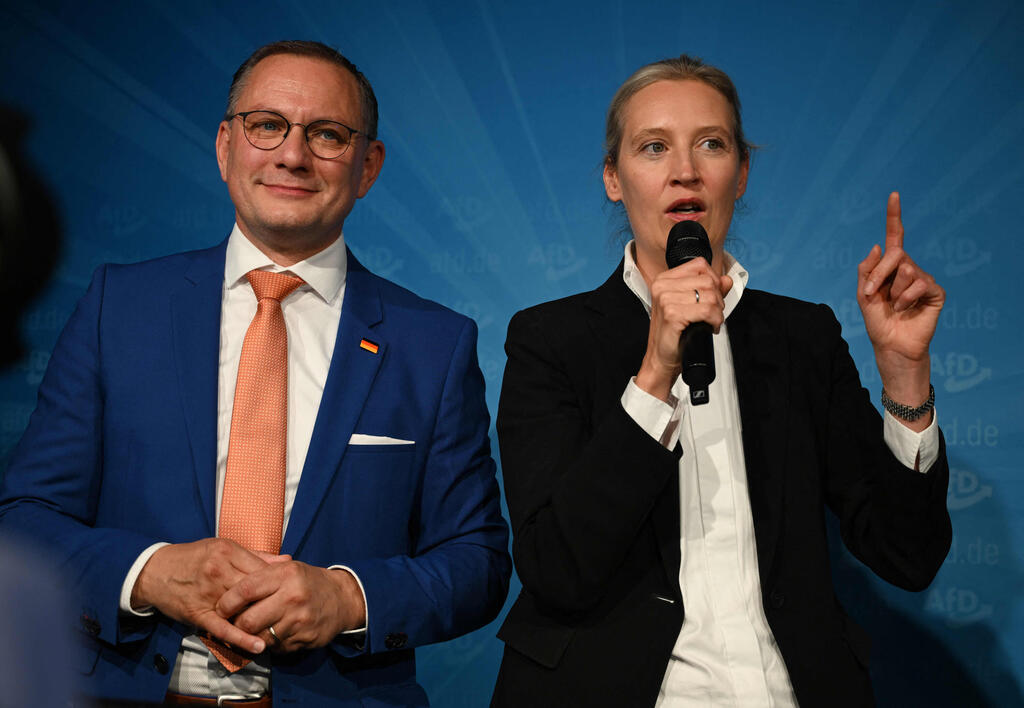
Alice Weidel and Tino Chrupalla, leaders of the AfD
(Photo: RALF HIRSCHBERGER / AFP)
“The party’s appeal comes from a mixture of protest, distrust of the traditional parties, concern about immigration and social change, and the sense that it is talking about problems the other parties ignore,” Kramer said. “In that sense, some of the attraction is also a symptom of the failure of the other parties to reach these voters. There are even Jews who support it because of its positions on Israel, Islam, security and immigration, despite the fact that it is an extremist party.”
Kramer cautioned against confusing control of one German state with control of the country as a whole. “You have to put things in proportion. In the upper house, it would have only four votes out of 69,” he said. “But if it forms a government, it will have power, access to sensitive information and the ability to appoint people in the police, intelligence services, security forces and the Interior Ministry. Using the machinery of government could also give the party momentum at the federal level.”
‘Jews don’t have the luxury of choosing whom to fear’
For Germany’s Jewish community, Kramer said, the contradiction surrounding the AfD is particularly stark. “Alternative presents itself as supporting Jewish life and Israel,” he said. “But it opposes kosher slaughter, it has leaders who use conspiracy theories and antisemitic language, and senior figures who want to challenge the way Germany deals with its historical responsibility and focus less on the darkest years of German history.”
“The problem is not that every Alternative voter is an antisemite,” he added. “The problem is that parts of the party promote ethno-nationalist ideas of belonging and want to weaken institutions that were built specifically after 1945 to protect democracy and minorities. At that point, the question is no longer whether Alternative is good for Jews, but whether liberal democracy is capable of protecting Jewish life and other minorities, whose rights can exist only if everyone is equal before the law.”
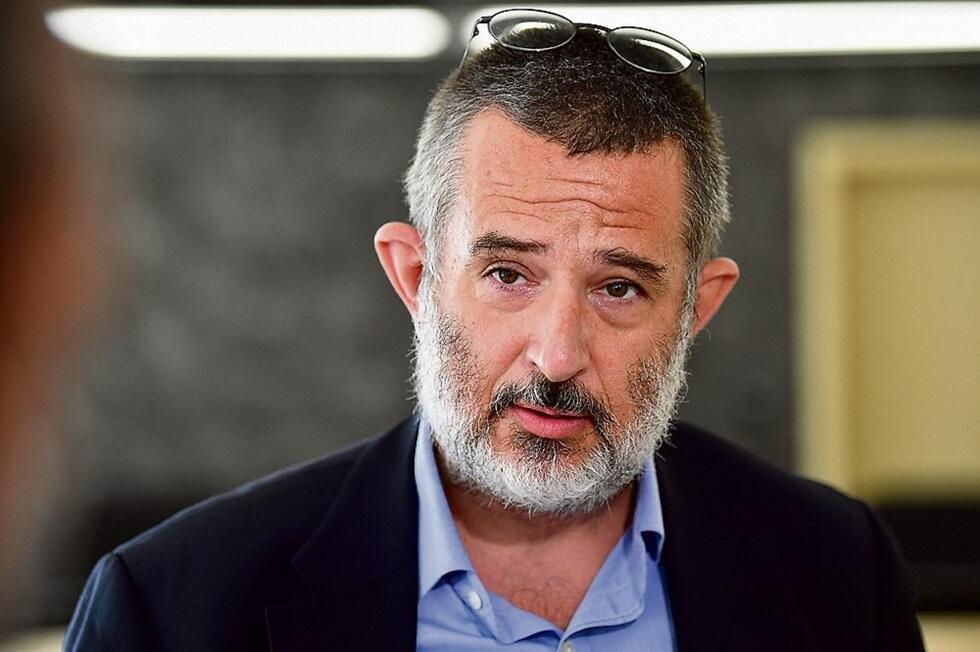
Stephan Kramer
(Photo: AFP)
German law bans the public use of Nazi symbols and slogans, as well as Holocaust denial and the trivialization of Nazi crimes. Kramer said several senior AfD figures have repeatedly tested those limits. “There are leaders in the party who have clearly crossed the forbidden lines,” he said. “Björn Höcke, the party leader in Thuringia, was convicted of using the Nazi slogan ‘Everything for Germany.’ There are other examples of him using similar language. He is a trained history teacher. He knows what he is talking about. But in general, their language is much more sophisticated: coded language with several meanings that pushes and tests the boundaries of the law.”
Kramer said even banning the party would not solve the deeper social forces behind its rise. “Democracy cannot and should not ban frustration, anger or radical political opinions,” he said. “You have to act against an organization that works against the Constitution and the democratic order, but that will not address the social problem it represents. We have to ask why 40% do support it. That question should have been asked 10 years ago. If there is a ban in order to protect our democracy, the real challenge will begin the day after.”
Kramer has previously said he would consider leaving if the AfD came to power. He is now more cautious, but says the concern remains. “I still work in Thuringia, but of course my family and I are taking precautions for the possibility that a far-right party forms a government in a German state.”
Asked what it would mean if roughly 40% of voters backed the AfD but people nevertheless celebrated because it failed to win an outright majority, Kramer said the result would be deeply ambiguous. “First of all, it means that the majority, 60%, did not vote for the party,” he said. “But I hope people will be shocked and understand the danger our democracy is in and what needs to be done. It would be a very ambivalent moment. It would show how far the political center of gravity has shifted and how much our standard for political stability has been lowered.”
Kramer also rejected attempts to rank the threats facing German Jews today, whether from the far right or from the convergence of parts of the far left and Islamist movements since October 7. “I would take that argument seriously,” he said. “Last year there were 8,725 antisemitic incidents, more than three times the number in 2022, and 68% were classified as Israel-related antisemitism. That is a physical, immediate and visible problem that threatens Jewish life every day.”

Antisemitic graffiti in Berlin
The figures correspond with the 2025 annual report by Germany’s RIAS antisemitism monitoring organization.
“But far-right rule is dangerous in a different way, through appointments, budget priorities, education and memory culture,” Kramer said. “This is a party where many far-right extremists and antisemites have found a home. Jews today do not have the luxury of choosing whom to fear. The authorities have not helped them on this point. They have left that field open to Alternative as well.”
For Kramer, Saxony-Anhalt could serve as a preview of what lies ahead for Germany. “It is certainly a warning of what could happen,” he said. “This is a party that was once on the fringes of German politics, and today, without substantially changing its platform, it can govern.”
He said he sees three possible consequences. “The first is that people get used to it and understand that if it gets numbers like these, it has to be taken into account, and then the psychological barrier breaks. The second is that the eastern states become a laboratory where we can see how Alternative functions in government. And the third is what we are seeing now: parties band together simply to keep it out. That was possible when it was at 10%. When it reaches 25%, 35% or more, you cannot freeze it out forever.”
‘If I leave Germany, it will be for the same reason I left the Soviet Union’
In Halle, where a neo-Nazi gunman tried to storm the synagogue on Yom Kippur in October 2019 and murdered two people after failing to enter, the election is being watched particularly closely. Max Privorozki, chairman of the city’s Jewish community, said the past seven years have left little room for optimism.
“What happened on October 7 overshadowed even the attack on the synagogue on Yom Kippur,” he said. “Everything that has happened to us since leaves us little room for optimism, especially antisemitism and the connection between the far left and radical Islam.”

Max Privorozki, head of the Jewish community in Halle, Germany
He said the rise of populist and extremist parties is not accidental. “There is disappointment here with the policies of the authorities in Germany and the European Union,” he said. “Disappointment with current politics causes people to look for alternatives, sometimes simply for the sake of an alternative. People do not always ask whether these parties are actually capable of solving the problems. I hope we manage to hit the brakes before it is too late.”
Despite the concerns, Privorozki insisted that Halle’s Jewish community has no intention of disappearing. “Whatever happens, Jewish life in Halle and Saxony-Anhalt will continue,” he said. “We have had problems in the past and dealt with them. There is no discussion of leaving.”
Then he added: “I left the Soviet Union because I did not want to continue living in a totalitarian state. If one day I leave Halle and Germany, it will be for the same reason I left the Soviet Union 37 years ago.”
Polls close at 6 p.m. local time, with initial results expected immediately afterward. Germany will then learn whether Saxony-Anhalt has simply become another powerful AfD stronghold, or whether it has broken the final postwar barrier preventing a far-right party from governing a German state.