


As international pressure mounts over the humanitarian crisis in Gaza, Israel is signaling readiness to advance a hostage deal while seeking to bolster its humanitarian image. Yet defense officials in Jerusalem have expressed growing pessimism in recent days, doubting the likelihood of a breakthrough.
Israeli officials believe Hamas is not genuinely interested in reaching an agreement, operating instead under the assumption that international pressure alone will force Israel’s hand. They argue that the influx of humanitarian aid into Gaza, following what Israel described as a strategic “concession,” has only emboldened the terrorist group, which continues to present far-reaching demands.
Gallery

Steve Witkoff, Benjamin Netanyahu, Bezalel Smotrich, Itamar Ben-Gvir
(Photo: REUTERS/Evelyn Hockstein, Shalev Shalom, Chaim Goldberg/Flash90, Moti Kimchi)
On Wednesday, Israel conveyed a formal response to mediators, rejecting several core Hamas conditions, including control over the timing and sequencing of prisoner releases, the reopening of the Rafah border crossing, a full IDF withdrawal from the Philadelphi Corridor and the expulsion of the U.S.-funded Gaza Humanitarian Foundation (GHF) from the enclave. Despite this, Israeli sources say the gaps between the parties remain wide, and bridging them will be difficult.
Against this backdrop, U.S. special envoy Steve Witkoff is set to return to the region Thursday in what Israeli officials view as a signal from Washington. Witkoff, who had previously said he would only return if a deal were imminent, last visited Israel on May 13, attending the release of Israeli American hostage Edan Alexander. He has since kept a low profile, telling both Israeli and Qatari interlocutors that he would not reengage without concrete progress.
Israel has recently shown increased flexibility on several negotiation points, which U.S. officials view as a rare, and possibly final, opportunity to reach an agreement. Witkoff's return comes just hours after Israel submitted its updated proposal via intermediaries, reinforcing the U.S. view that momentum may be building and that the moment calls for high-level intervention.
Still, concern remains. Witkoff is reportedly worried that Cabinet hardliners Itamar Ben-Gvir and Bezalel Smotrich could attempt to derail the deal due to domestic political pressures on Prime Minister Benjamin Netanyahu. The envoy may seek direct meetings with the ministers to urge them to support the negotiations at this critical juncture.
Humanitarian aid airdropped over Deir al-Balah, central Gaza


During his visit, Witkoff is expected to travel to the Gaza Strip to visit a GHF aid distribution center and assess the humanitarian situation firsthand. He will then continue on to Qatar and Egypt, both of which are leading mediation efforts and remain in close contact with all parties.
Meanwhile, Prime Minister Netanyahu is convening a limited security consultation Wednesday evening to assess the state of the negotiations. An Israeli delegation may soon be dispatched again to Doha or Cairo for follow-up proximity talks.
Flooding Gaza with aid—in message to Hamas
A senior Israeli defense official said Wednesday that the volume of humanitarian aid entering Gaza now exceeds operational planning requirements, citing both the need to reach vulnerable populations and to counter “false famine narratives” circulating globally.
The remarks come as Israel faces increasing international criticism over conditions in Gaza, including graphic reports and footage of suffering civilians. In response, the official said, Israel has built a humanitarian system alongside military operations, offering basic relief while applying indirect pressure on Hamas.

Humanitarian aid airdropped over Deir al-Balah, central Gaza
(Photo: AP Photo/Abdel Kareem Hana)
“Hamas has launched a targeted campaign accusing Israel of starving the population, a claim the world sees differently,” the official said, noting that the terrorist group’s rhetoric has impacted political decision-making and shaped aid policies aimed at calming the situation and signaling international responsiveness.
Since the start of Operation Gideon's Chariots on May 19, more than 5,000 aid trucks have entered Gaza, the official said, including over 1.5 million weekly food packages distributed by an American company and 3,000 tons of baby food. Israel has also supported Gaza’s healthcare infrastructure by supplying fuel to hospitals, rotating medical staff, providing blood donations and conducting continuous needs assessments.
Get the Ynetnews app on your smartphone: Google Play: https://bit.ly/4eJ37pE | Apple App Store: https://bit.ly/3ZL7iNv
Three water pipelines into Gaza remain operational, and a power line was recently reactivated to the central UNICEF desalination plant, serving roughly 900,000 residents. While the official rejected claims of famine, calling the term professionally unfounded, he acknowledged localized access challenges in impoverished areas. In response, Israel has established humanitarian corridors such as the Netzarim Corridor and direct routes to central Gaza refugee camps and Deir al-Balah.
Currently, about 200 aid trucks enter Gaza daily, with 60 heading to the north, 40 to the center and 100 to the south.
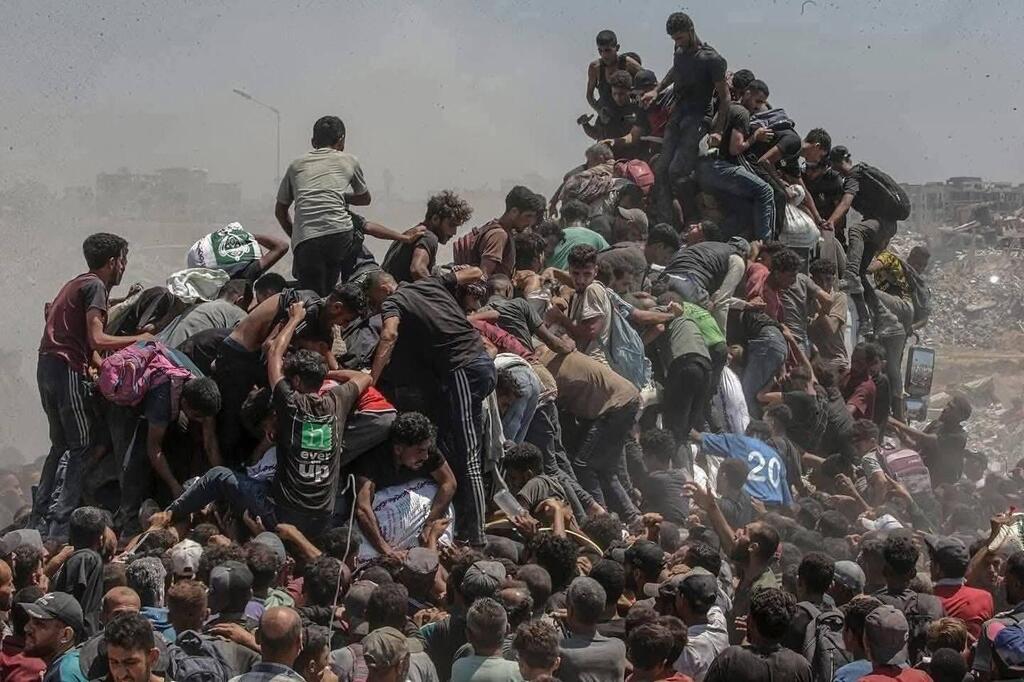
Palestinian masses looting humanitarian aid convoy
Israel has also resumed coordinated aid airdrops with Jordan, the United Arab Emirates and Egypt. Since last weekend alone, 150 aid packages have been dropped—including 18 on July 26, 28 on July 27, 20 on July 28, 52 on July 29 and 32 on July 30. In total, 150 airdrop missions have been carried out since the war began, delivering nearly 10,500 packages with assistance from France, the United Kingdom, Germany, Singapore, Spain and the United States.
In addition, Israel approved the entry of Moroccan humanitarian aid via the Kerem Shalom crossing, pending security inspection at Ben Gurion Airport.
Although current aid volumes “exceed needs,” the official said, the expanded effort also aims to influence morale on the ground. “Based on our dialogue with interlocutors and field assessments, there’s a growing recognition that Israel is acting differently, and that understanding is likely to endure,” he added.
The push to scale up humanitarian operations comes amid heightened diplomatic pressure. In recent days, Israel has faced calls for sanctions, antisemitic incidents abroad and warnings from France and the UK that they may unilaterally recognize a Palestinian state if political progress stalls.