


In recent months, Israel’s Southern Command has been carrying out “statistical drillings” to locate tunnels along the eastern side of the so-called Yellow Line in the Gaza Strip, the agreed buffer line inside Gaza under Israeli control.
The method is straightforward: drills are inserted dozens of meters underground at fixed intervals of about 14 meters, and sensors are then used to detect metal and underground voids. The project began in northern Gaza and was intended to progress southward.
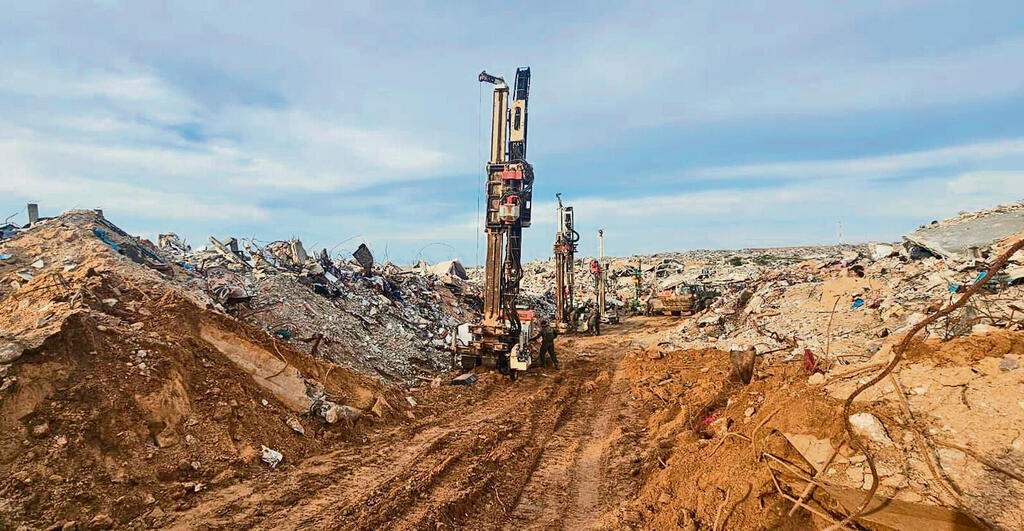
IDF drilling along the “Yellow Line” in Gaza. “One of the tunnels is so large you could fit three trucks inside”
In practice, however, progress has slowed. The large number of tunnels uncovered in the north has led the military to reduce the spacing between drilling points to about seven meters or less, significantly improving detection but delaying the advance south.
A senior security official is now pushing to complete drilling in the central Gaza camps, citing two main reasons. First, the Yellow Line runs closer to Israeli communities in that area. Second, Hamas is still believed to maintain operational control there, in part because Israeli forces have not conducted extensive ground maneuvers in the region.
According to testimony from a local security coordinator, first reported by Ynet, Col. Gil Werner, commander of the southern brigade in the Gaza Division, acknowledged that Hamas’ condition in central Gaza remains relatively strong and that the group retains full operational control. One reason, he said, is that Israeli forces avoided major ground operations there due to earlier indications that hostages might be present.
“We have destroyed most of the underground infrastructure,” the IDF says, asserting it has a clear picture of the tunnel network in Gaza. Still, new tunnels continue to be discovered during drilling operations. Dozens of tunnels have been found in northern Gaza alone. In the past week, reports have emerged of at least five additional tunnels uncovered, including one that reaches close to the border fence.
“One of the tunnels is so large you could fit three trucks side by side,” said a source familiar with the findings. “It’s one of the largest uncovered since the war began.”
The military maintains confidence in its data. “Based on extensive work across the Strip, we are highly confident we have an accurate picture of the situation and that the majority of the tunnels have been destroyed,” the IDF said.
Footage from Khan Younis shows a convoy of Hamas terrorists with weapons drawn


Meanwhile, as attention shifts northward and toward Iran, Hamas appears to be exploiting the situation to reassert its presence and consolidate control. This has included public displays such as armed convoys in pickup trucks, parades and visible activity in areas under its authority.
“We know Hamas is making every possible effort to rebuild its capabilities,” the IDF said, acknowledging ongoing attempts to smuggle goods into Gaza, either through humanitarian aid channels or via drones from Egypt. However, the military says there has been an improvement in efforts to thwart smuggling.
The IDF insists that statistical drilling is also being carried out in the central camps as part of the broader project. However, senior officers involved in the drilling effort say no such activity is currently taking place there, and no drilling equipment has been observed on the ground.
While the request for comment focused specifically on Hamas’ status in central Gaza, the IDF responded more broadly, indicating limitations in its ability to operate fully west of the Yellow Line, outside Israeli-controlled areas.
“The claims that the IDF is not acting against Hamas’ buildup are incorrect,” the military said in a statement. “The IDF is operating against attempts to rebuild terrorist infrastructure and views such efforts with great severity.”
It added that forces remain deployed across the area, working to eliminate terrorists, destroy underground infrastructure, secure the Yellow Line zone and remove threats in Gaza in accordance with the agreement.
“The defense concept along the Yellow Line and the border includes a physical barrier, a security zone, advanced intelligence capabilities, technological means and ongoing operational activity, with the clear goal of protecting Israeli civilians, particularly residents of the western Negev,” the statement said.
“During the war, the IDF acted to defeat Hamas and will continue to act to prevent its buildup.”