

A young mother on her way to the hospital to deliver her fourth child was murdered in a terror attack. To the outside world, it may seem like an isolated incident—one of those rare, tragic outliers.
But security experts said that such attacks are frequently attempted and only appear rare because the Israel Defense Forces’ (IDF) counterterrorism efforts in the West Bank largely prevent them.
Fatal West Bank shooting attack


Gallery
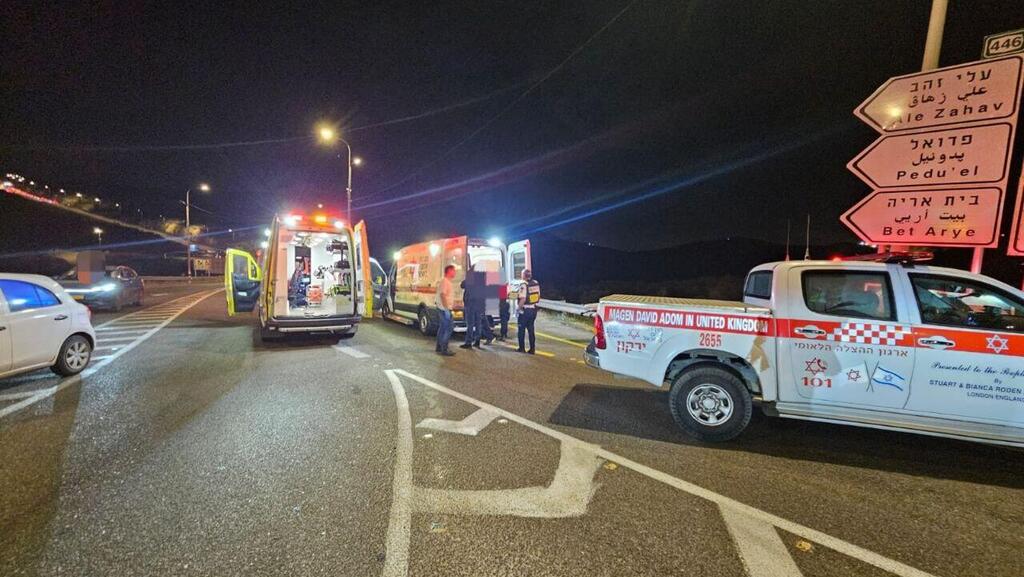
Aftermath of the deadly terror attack on the West Bank killing a woman on her way to give birth
(Photo: MDA)
Or Yissachar, vice president of research and content at the Israel Defense and Security Forum, said that without Israeli operations in the West Bank, there would be many more tragedies like that of Tzeela Gez.
“In the past few months, the IDF has continued with counterterrorism operations against Palestinian targets that were ticking time bombs for terror attacks, especially around Jenin, Tulkarem, and Nablus—but everywhere, really,” Yissachar said. “There are many IDF reservists operating with the standing army to safeguard our bus stops and participate in counterterrorism raids. Hamas clearly wants Judea and Samaria to be another front—a much bigger one than it is now.”
He added, “If we were to retreat from Judea and Samaria [the biblical names for the West Bank], I can’t imagine what would happen there.”
A recent report by the Shin Bet, Israel’s internal security agency, revealed a sharp rise in terror activity across the West Bank. In 2024, 6,828 terror incidents were recorded—nearly double the 3,436 recorded in 2023. The data also showed a 44% drop in what the Shin Bet classifies as “significant attacks”—those involving shootings, stabbings, or vehicular assaults. There were 231 such incidents in 2024, compared to 414 the previous year.
Security forces successfully thwarted 1,040 significant attacks in 2024 across the West Bank and Jerusalem, nearly identical to 2023’s figure of 1,032. For comparison, only 472 attacks were prevented in 2022, and 351 in 2021.
Despite Israel’s defensive efforts, 46 Israelis and foreign nationals were killed in terror attacks in 2024, and another 337 were injured. Of the attacks foiled in 2024, the majority—689—were shooting plots involving firearms, the same type of weapon used to murder expectant mother Gez.
“If you take 100% of them trying to hurt us, only 2% to 5% succeed,” Lt. Col. (res.) Tal Nir, a member of the IDF’s Combat Engineering Corps in the West Bank, said.
Nir echoed Yissachar’s assessment, noting that while the number of attempted attacks has not decreased, Israel is managing the threat more effectively than before. He said most attacks in the West Bank are carried out by individuals living in refugee camps. Since October 7, 2023, it has become significantly harder for those individuals to leave the camps and launch attacks.
“The difference between before and after October 7 is that Israel has shifted the rules of engagement,” Nir said. “If before October 7, there were places we [the IDF] would not go, like mosques—even when we knew they had ammunition there; now we’re not afraid to go in and get the job done.”
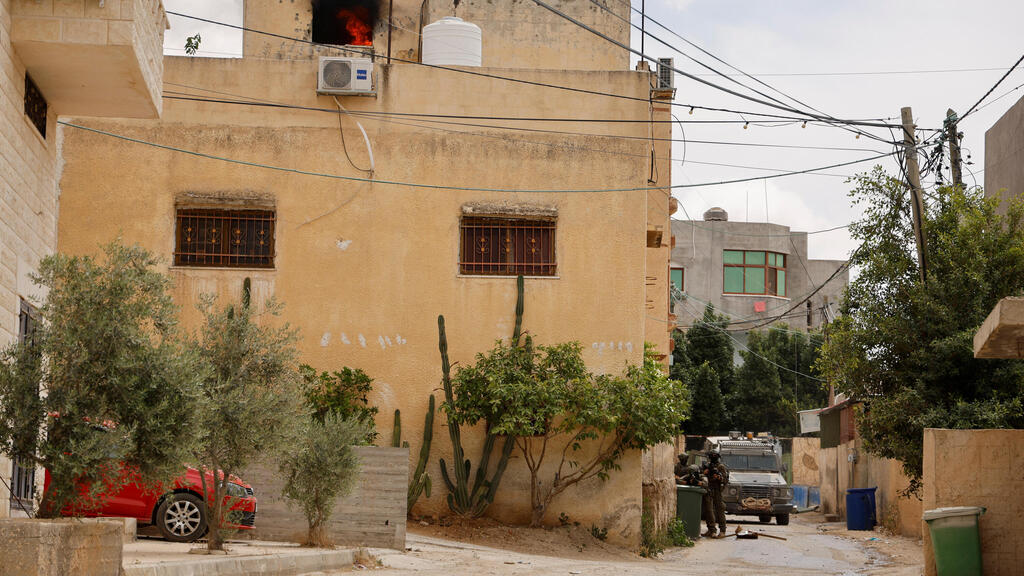
IDF forces in counter-terrorism operation on the West Bank
(Photo: Raneen Sawafta / Reuters)
He explained that since the Hamas-led massacre—and especially during lulls in fighting in Gaza or on Israel’s northern border with Lebanon—the IDF has reallocated additional forces to the West Bank to support broader counterterrorism operations.
“The threat is always there,” Nir said. “They [the terror organizations] are constantly trying, but they’re not succeeding the way they’d like to.”
According to Yochai Provisor, director of security projects at the One Israel Fund—which has provided millions of dollars’ worth of security and surveillance equipment to the West Bank since October 7, 2023—terror attacks tend to come in waves.
“Right after October 7, the Palestinians saw that Jews were in a very tough, resilient place, and so they were afraid to confront them,” Provisor said. “But they [the Palestinians] regained their confidence, and attacks went up.”
He explained that since the Hamas-led massacre—and especially during lulls in fighting in Gaza or on Israel’s northern border with Lebanon—the IDF has reallocated additional forces to the West Bank to support broader counterterrorism operations.
“The threat is always there,” Nir said. “They [the terror organizations] are constantly trying, but they’re not succeeding the way they’d like to.”
According to Yochai Provisor, director of security projects at the One Israel Fund—which has provided millions of dollars’ worth of security and surveillance equipment to the West Bank since October 7, 2023—terror attacks tend to come in waves.
If before October 7, there were places we [the IDF] would not go … now we’re not afraid to go in and get the job done
“Right after October 7, the Palestinians saw that Jews were in a very tough, resilient place, and so they were afraid to confront them,” Provisor told The Media Line. “But they [the Palestinians] regained their confidence, and attacks went up.”
He said the frequency of attacks often depends on how strong the Jewish community appears and how proactive the Israeli government and army are in their response. “When Jews show they are strong, the Palestinians understand it’s not a good time to attack,” he said, noting that terrorists “recognize weakness.”
Provisor said Israel’s entire security apparatus has undergone a significant transformation since October 7. Local security councils, the IDF, the Shin Bet, and Israel’s Defense Ministry have all become better prepared to confront threats in the West Bank.
“Since the war, the amount of equipment, training, and awareness has grown immediately,” Provisor said. “The main mission is to prepare everyone in the best way possible, to learn from the mistakes of October 7, and to be ready if a similar situation arises [in the West Bank].”
When asked which tools have proven most impactful, Provisor pointed to surveillance systems with early warning and analysis capabilities. These technologies enable security personnel to detect suspicious activity before an attack occurs.
He explained that strategically placed cameras monitor areas where multiple attacks have been attempted or carried out. The most effective systems, he said, include thermal imaging for 24/7 surveillance. Most of the footage is fed into viewing centers, where personnel can monitor activity in real time.
Get the Ynetnews app on your smartphone: Google Play: https://bit.ly/4eJ37pE | Apple App Store: https://bit.ly/3ZL7iNv
Artificial intelligence now plays a key role. Provisor said these systems can detect environmental changes and issue alerts. “Often, when a terrorist is planning an attack, he will drive by [the targeted area] a few times to be certain,” Provisor explained. “The system will pick up the fact that the same car returned three times and send an alert.”
These systems are also critical after an attack to help identify and track down the perpetrator. “With cameras placed all over at different junctions and points, they can backtrack to see where the terrorist went,” Provisor said.
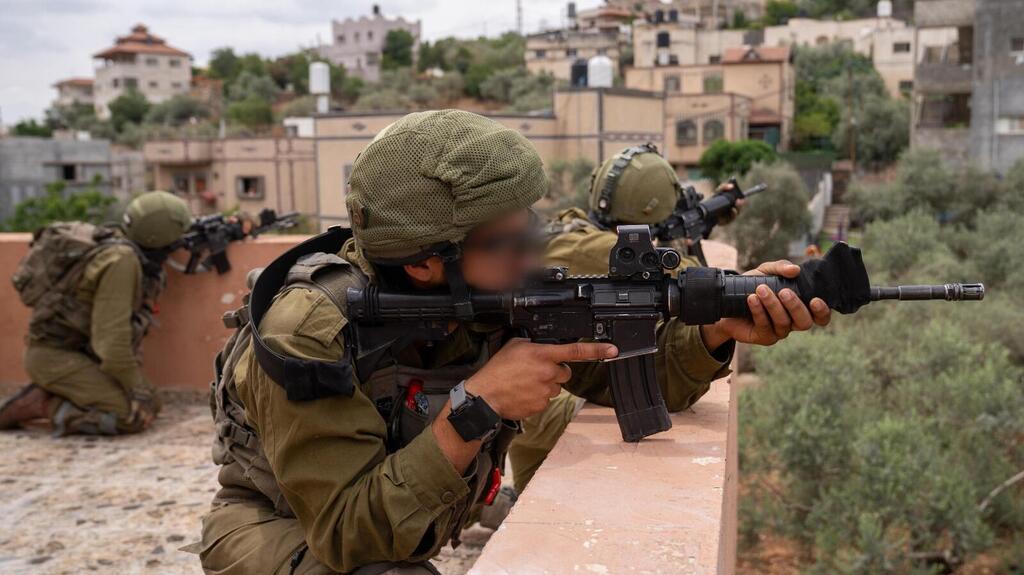
IDF forces in counter-terrorism operation on the West Bank
(Photo: IDF)
The terrorist who murdered Gez is still at large. But Provisor believes that the combination of intelligence and technology will likely lead to his capture. “History shows these things work, and in most cases, they [the culprits] do not get away,” he said.
According to officials, one of the most alarming threats today is the influx of weapons smuggled by Iran through Jordan into the West Bank.
When Jews show they are strong, the Palestinians understand it’s not a good time to attack
“Right now, one of the biggest threats is the daily flow of weapons coming into Judea and Samaria from Jordan, and it’s hard to prevent,” Provisor said. “The fear is that more Arab extremists will get more weapons, and we’ll have to deal with that. As a result, Jewish communities are getting more advanced offensive capabilities from the IDF—not just for defense, but for offense as well.”
Yissachar added that more IDF soldiers are now stationed along the Jordan-Israel border to help stop the smuggling, with drones increasingly used to detect and intercept weapons.
Ultimately, as Nir explained, deterrence requires direct action. “Every time a terrorist carries out an attack, the IDF should enter the village, arrest him and his family, and destroy their home,” he said. “There are several actions we can and must take.”
Still, Nir expressed cautious optimism. He believes the situation isn’t as dire as some think, mainly because the IDF remains actively engaged in the region. “I think some actions can be done more severely, more fiercely, until the terrorists understand they cannot carry out any more attacks,” Nir added. “Israel has the capacity to do it.”