

Former Knesset member Dan Illouz, who left Prime Minister Benjamin Netanyahu's Likud party over legislation exempting ultra-Orthodox men from military service, found himself confronting the same political battle Friday, this time against the leader of the party he joined to fight it.
Illouz, who was placed 10th on Yisrael Beytenu's electoral list but failed to win a seat in the Knesset, publicly challenged party chairman Avigdor Liberman over his dramatic reversal on forming a government with ultra-Orthodox parties. Liberman, who campaigned on a promise to exclude those parties from his coalition, said he was now prepared to show flexibility and make compromises, including on military conscription, to facilitate the formation of a new government.
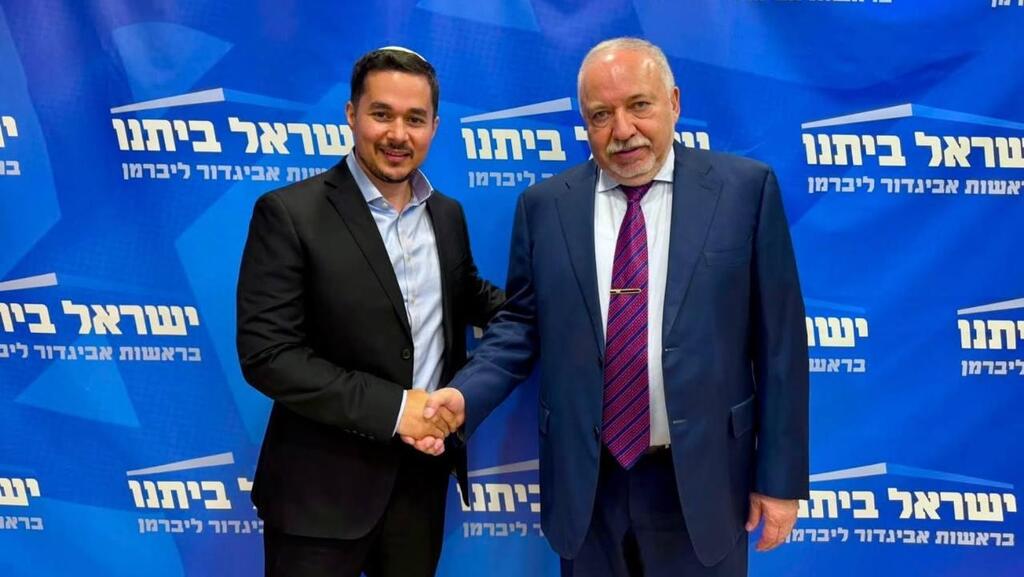
Avigdor Liberman and Dan Illouz: Illouz accuses the Yisrael Beytenu leader of breaking an election promise
"We cannot give up on the draft law," Illouz wrote in a social media post Friday afternoon, warning that any agreement allowing widespread exemptions from military service would betray an explicit election promise.
"This is not just a matter of values. It is an existential necessity," he wrote. "Reservists are serving hundreds of days of reserve duty. The army is crying out for combat soldiers. The economy cannot sustain this. The security challenges we face are enormous. And all this is before we even begin discussing core curriculum studies and integration into the economy."
Illouz acknowledged the political pressure to avoid another election but insisted that ending the deadlock could not come at the expense of military service obligations. "I understand the desire to prevent another election. But the price cannot be an exemption law. This was an explicit promise we made to voters before the elections. It is why I left Likud for Yisrael Beytenu."
From Likud rebel to Yisrael Beytenu dissenter
Illouz's criticism carries particular political significance because his opposition to military service exemptions was the very issue that drove him out of Likud. He resigned from the Knesset and the party's electoral list after clashing with its leadership over legislation addressing the conscription of ultra-Orthodox men, then joined Yisrael Beytenu, which had made opposition to exemptions a central campaign pledge.
He was placed 10th on Liberman's list but did not secure a parliamentary seat in the election. His latest public position also makes it unlikely that Liberman would seek to bring him into the Knesset even if a government including ultra-Orthodox parties were formed and ministers resigned their parliamentary seats under the so-called Norwegian Law, allowing candidates further down their party lists to enter parliament.
"In the 25th Knesset, I fought against the coalition's exemption law. I was removed from the Foreign Affairs and Defense Committee because of it, and the law did not pass," Illouz wrote. "If necessary, I will fight an exemption law if it comes from the other side, even as a private citizen. I succeeded then, and I hope to succeed now."
His warning underscores the growing tensions within the bloc of parties seeking to replace Netanyahu, as political leaders weigh compromises with ultra-Orthodox factions against campaign promises to overhaul Israel's military conscription system.
Gadi Eisenkot, leader of the Yashar! party, and former prime minister Naftali Bennett had not directly addressed Liberman's announcement. Democrats chairman Yair Golan, however, struck a more optimistic tone about the coalition negotiations.
"I am more optimistic than I was Wednesday morning, after the election results," Golan said. "There is progress. There is willingness. And serious work is taking place every day to turn the election results into a government of change. There are difficulties, and I have no intention of hiding them. But there is also real progress."
Ultra-Orthodox leaders welcome the reversal as rivals accuse Liberman of betrayal
The change in Liberman's position quickly drew a pointed response from United Torah Judaism lawmaker Yaakov Asher, who mocked the sudden willingness of politicians in the anti-Netanyahu bloc to compromise on military conscription.
"It is encouraging to discover the flexibility of all the political players on the draft issue," Asher wrote. "It is painful to think how much incitement and hatred between brothers could have been avoided if that same flexibility had been shown in recent years."
Yoaz Hendel, who led the Reservists-Economic Party that failed to enter the Knesset, also condemned the prospect of a compromise that would preserve broad military service exemptions.
"If you are prepared to promote mass draft evasion for the sake of power, how are you any different from Smotrich and Netanyahu?" Hendel wrote on X. "You said you didn't need us. You said there could be no compromise on national security. You promised to look after reservists, and that is the first thing you abandoned. We will not give up."
Likud lawmaker Boaz Bismuth, chairman of the Knesset Foreign Affairs and Defense Committee, circulated a video recorded six months earlier in which Liberman outlined his commitments against the ultra-Orthodox parties.
"Thank you for the reminder, Avigdor. Perfect timing," Bismuth wrote. "I believe many people have already lost track of all your different versions."
Topaz Luk, a media adviser to Netanyahu, joined the attacks with a sarcastic post on X comparing Liberman and Bennett in a contest of political dishonesty. "Drama on Polymarket: A shake-up in the dishonesty index. Liberman overtakes Bennett for the first time in the tight race for first place," he wrote.
Luk accompanied the post with a campaign video in which Liberman declared that people who refuse to serve in the military should not be allowed to vote in Knesset elections.
National Security Minister Itamar Ben-Gvir also seized on the reversal, accusing politicians who had portrayed ultra-Orthodox communities as a central problem facing Israel of rushing to embrace them once they became necessary for forming a government.
"Amazing how you turned the ultra-Orthodox into the embodiment of evil and the source of Israel's problems, then rushed to marry them," Ben-Gvir wrote on X, adding a sarcastic reference to a traditional Jewish wedding ceremony with United Torah Judaism politician Yitzhak Goldknopf.
"Not surprising, really," he continued, accusing the same political camp of encouraging refusal to serve in the military while now preparing to grant exemptions to ultra-Orthodox men. Referring to the anti-government protests on Tel Aviv's Kaplan Street and the language used by some reservist protesters, he suggested that draft exemptions would simply be recast as a suspension of voluntary service.
For Illouz, however, the dispute is more than another exchange of political accusations. Having already sacrificed his place in Likud over the issue, he is now challenging the party leader whose commitment to military conscription originally persuaded him to switch sides, and making clear that his opposition to exemptions will continue whether or not he holds a seat in parliament.