

A senior British Labour lawmaker visiting Israel said he wants to see Prime Minister Benjamin Netanyahu replaced at the next election, while stressing that Britain must preserve close ties with Israel regardless of who leads its government.
Mark Sewards, a member of Parliament and the newly appointed chair of Labour Friends of Israel, said during an interview in Israel that the coming period could mark a turning point in relations, as both countries face political change amid ongoing regional conflict.
Mark Sewards, a member of Parliament and the newly appointed chair of Labour Friends of Israel
(Video: Lior Sharon)


“We want to see the Netanyahu era come to an end at this next election,” Sewards said. “But Israel is a liberal democracy and can rightly choose its own leaders. Whatever the outcome, it is vital that the UK has a seat at the table and helps shape the direction of peace in the Middle East.”
Sewards’ remarks place him among a growing group of Western politicians seeking to separate support for Israel as a state from criticism of its current leadership, particularly during the prolonged war in Gaza.
Resetting ties at a critical moment
Sewards said his visit comes at a moment of unusual urgency, with Israel still grappling with the aftermath of the October 7 Hamas terror attack and the region facing broader instability tied to Iran and its proxies.
He opened the interview by welcoming the return of Ran Gvili, the last Israeli hostage, saying the development brought relief not only in Israel but also in Britain.
“This was something Israelis had been hoping for and praying for over the past two years,” he said. “Everyone in the UK sends their best wishes to the family.”
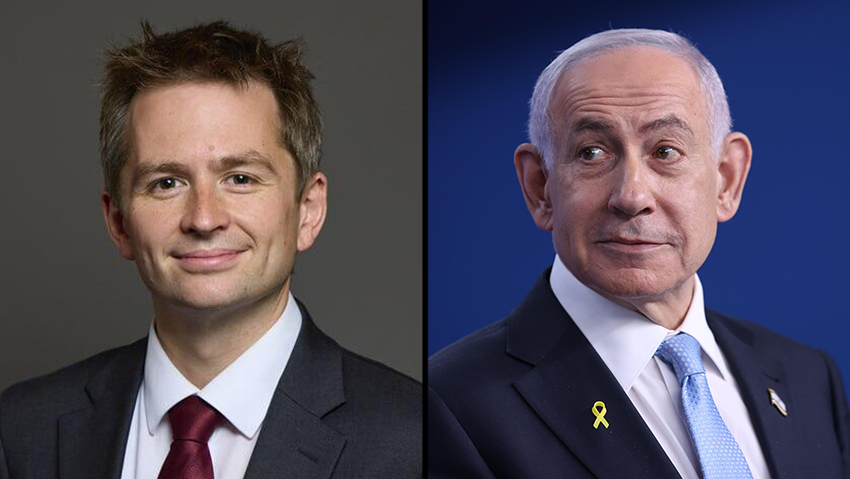
Mark Sewards, Benjamin Netanyahu
(Photo: Alex Kolomoisky, Roger Harris\ UK Parliament)
As chair of Labour Friends of Israel, Sewards said his goal is to “reset relations” between London and Jerusalem ahead of potential political change in both countries, while maintaining influence rather than disengaging.
“It would be a mistake to walk away or to demonize the world’s only Jewish state,” he said. “Peace is achieved through dialogue, not abandonment.”
Gaza war and criticism from the left
Sewards acknowledged that his role has become more difficult amid the Gaza war, particularly given criticism from within the British left.
“There is no question that the past two years have been horrific,” he said. “Israel suffered a brutal terrorist attack on October 7 by an Iran-backed proxy, and it had the right to defend itself and to seek the return of every hostage.”
At the same time, he said disagreement with Netanyahu’s policies should not translate into severing ties with Israel itself.
“This is Labour Friends of Israel, not Labour Friends of Netanyahu,” he said. “We must distinguish between a government and the state.”
He rejected claims that supporting Israel conflicts with progressive or human rights-based politics, arguing that Israel’s founding principles align with Labour values.
“Israel’s declaration of independence spoke about freedom and equality for all people,” he said. “That goes to the heart of what it means to be a Labour politician.”
Rising antisemitism in Britain
Sewards also addressed growing concerns within Britain’s Jewish community, which has reported feeling increasingly unsafe since October 7.
“There has been an explosion of antisemitic hatred across the UK and Europe,” he said, noting that some incidents occurred even before Israel launched its military response.
He said the Labour government under Prime Minister Keir Starmer has committed 10 million pounds to the Community Security Trust to protect Jewish institutions, alongside an additional 7 million pounds for antisemitism education in schools and universities.
“But we cannot just build higher walls and taller gates,” Sewards said. “We have to tear antisemitism out by its roots.”
He pointed to reforms within the Labour Party after 2020, saying Starmer had worked to eliminate antisemitism within its ranks, and argued the same approach must now be applied nationwide.
Iran, regional security and Gaza diplomacy
On regional security, Sewards praised Britain’s role in defending Israel against Iranian threats, including Royal Air Force participation in allied defensive efforts.
“I was proud to see the UK stand with Israel against Iran,” he said. “We should do so again if necessary.”
He defended Britain’s decision not to join a proposed international “board of peace” linked to Gaza, citing Iran’s alliance with Russian President Vladimir Putin.
“We cannot sit on a body that includes Putin while he wages an unjust war against Ukraine,” Sewards said, adding that Britain remains committed to peace efforts through other channels, including former Prime Minister Tony Blair’s participation in regional initiatives.
Despite disagreements over tactics, Sewards said Britain remains committed to helping secure peace between Israel, the Palestinians and the wider region.
“This region is changing,” he said, pointing to his upcoming visit to Bahrain as evidence. “What was unthinkable a decade ago is now possible. The opportunity is there. The responsibility is to seize it.”
First published: 12:54, 01.27.26