

The IDF launched a massive strike early Sunday against Hezbollah underground military infrastructure and weapons sites in southern Lebanon near the Crusader fortress of Beaufort Castle. Explosions were reportedly heard in several areas in northern Israel, where residents were informed that the blasts came from Israeli strikes.
"The existence of the site and the activity within it constitute a violation of the understandings between Israel and Lebanon," the IDF said in a statement. "The IDF will continue to operate to remove any threat posed to the State of Israel."
IDF strikes in southern Lebanon


The Mateh Asher Regional Council said the operation focused on the eastern sector of the Lebanese front. “The explosions heard in the Galilee and northern Golan Heights are considered normal,” the council said. “At this stage there is no change in the security assessment or public guidance.”
The strikes came two days after two Lebanese soldiers were killed and two others wounded when an Israeli drone exploded near them. Brig. Gen. Avichay Adraee, the IDF’s Arabic-language spokesperson, apologized to the Lebanese army and said the explosion was accidental. “The operation targeted Hezbollah attempts to rebuild its military infrastructure, contrary to understandings between Israel and Lebanon. No Lebanese army personnel were deliberately targeted,” Adraee said.
Adraee said the strike targeted an engineering vehicle in the An-Nakura area of southern Lebanon. A technical malfunction caused the munition to fail to detonate on impact and fall to the ground, later wounding several Lebanese soldiers. The Lebanese army reported that when personnel approached the wreckage of an Israeli drone Thursday it detonated, killing an officer and another soldier and wounding two others.
Lebanon is expected to present a plan this week for Hezbollah’s disarmament. The United States announced last week that Beirut would outline measures to persuade Hezbollah to give up its weapons. Sources cited by the Hezbollah-linked Lebanese outlet Al-Akhbar said Lebanese Army Commander Gen. Rodolphe Haykal was alarmed by U.S. pressure and warned he would rather resign than risk Lebanese casualties caused by the army.
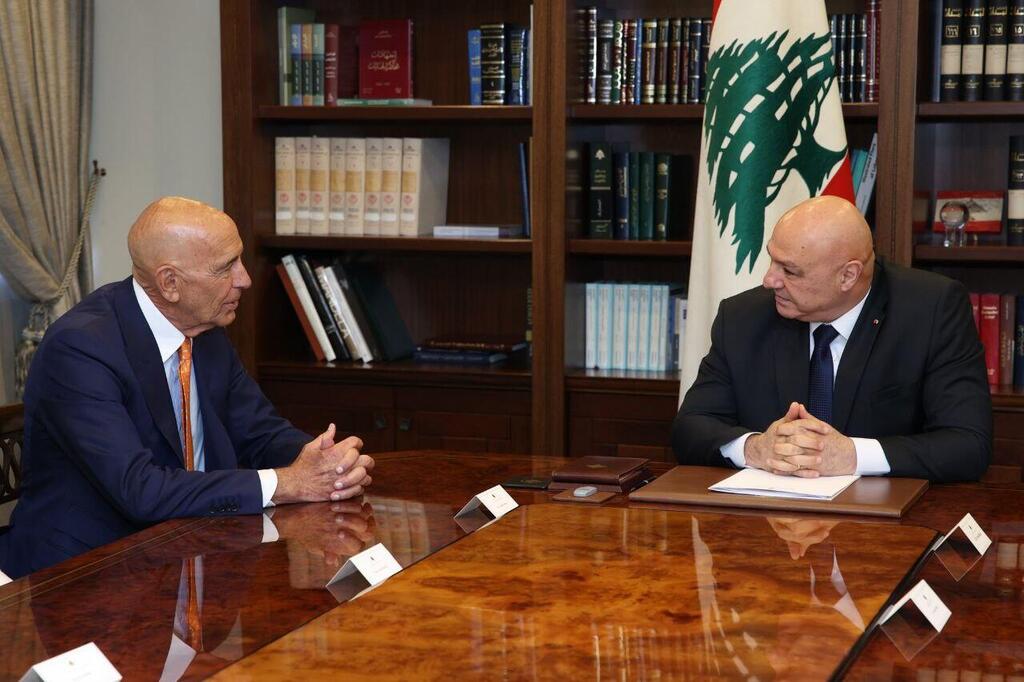
U.S. envoy Thomas Barrack meeting with Lebanese President Joseph Aoun
The sources added that the army refuses to develop a detailed disarmament plan with targets and timelines, a position known to Lebanese President Joseph Aoun. In an upcoming discussion officials may announce that Lebanon will take no further steps until Israel and Syria approve the U.S. framework, effectively freezing the government’s disarmament decision. Prime Minister Nawaf Salam, however, reportedly remains determined to move forward.
The U.S. delegation offered intelligence support to the Lebanese army to monitor Hezbollah positions, with some reportedly suggesting Israeli drones could assist in identifying targets. The Lebanese army later denied reports that it would refuse to enforce the arms embargo, saying it carries out its missions “with the highest levels of responsibility and professionalism.”
On Thursday the U.N. Security Council announced that the U.N. peacekeeping force in Lebanon, UNIFIL, will begin withdrawing in 2027. The resolution extends UNIFIL’s mandate until the end of 2026, after which responsibility will shift to the Lebanese army, which is expected to advance Hezbollah’s disarmament.