

Former prime minister Naftali Bennett warned Tuesday that the IDF faces a severe manpower crisis, seizing on Prime Minister Benjamin Netanyahu’s warning of possible attacks ahead of the Oct. 27 election to intensify a campaign dispute over the conscription of ultra-Orthodox Jewish men.
Bennett, who leads the Beyachad party, spoke at Tel Aviv’s Hostages Square, where relatives of people killed or taken hostage in the Hamas-led Oct. 7, 2023, attack and former hostages have established a protest installation they call the “Sukkah of Failure.” The temporary structure, erected during the Jewish holiday of Sukkot, focuses on what organizers describe as political and security failures surrounding the Oct. 7 attack.
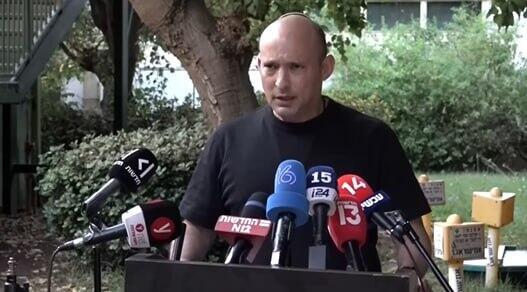
Former prime minister Naftali Bennett
(Photo: Ido Erez)
His comments came after Netanyahu said Tuesday that Israel had “indications” that unspecified enemies could try to attack the country ahead of the election. Speaking during a visit to Tel Nof Air Force Base, Netanyahu warned Israel’s adversaries against doing so but did not identify the intelligence behind his warning or name a specific threat.
“Netanyahu is now warning that our enemies are planning to attack us, but as long as he continues to encourage mass draft evasion and bring the IDF to the brink of collapse, who exactly will fight the enemy?” Bennett said.
“I am issuing a grave strategic security warning here today: The IDF is facing collapse,” Bennett said. “We simply do not have enough soldiers to provide security for Israel’s citizens — to deal with all the threats Netanyahu is talking about.”
Bennett’s warning comes amid a documented personnel shortage in the Israel Defense Forces following years of fighting and exceptionally heavy reliance on reservists. In May, Brig. Gen. Shai Tayeb, head of the IDF’s Human Resources Planning and Management Division, told a parliamentary committee that the military was short about 12,000 soldiers, including 6,000 to 7,500 combat troops. He described the operational need as immediate.
The military has repeatedly sought legislation to increase its manpower, including by expanding ultra-Orthodox enlistment and extending mandatory service. The issue has become one of Israel’s most contentious political disputes, pitting the military’s personnel requirements against ultra-Orthodox parties that have long sought to preserve exemptions for full-time yeshiva students.
Bennett said IDF Chief of Staff Lt. Gen. Eyal Zamir had repeatedly warned that the military was short tens of thousands of troops, accusing Netanyahu, Shas leader Aryeh Deri and Finance Minister Bezalel Smotrich of ignoring the warnings.
“I go into the field and speak with combat officers, and they tell me that the shortage of soldiers is costing us soldiers’ lives,” Bennett said.
He said officers had told him troops were being wounded and killed in drone attacks because there were not enough observers and snipers to protect them. He also argued that unusually long deployments were exhausting troops and reducing their operational alertness, contributing to casualties.
During combat, Bennett said, troops sometimes have to abandon positions because there are not enough personnel to hold territory already captured, forcing forces to retake the same positions multiple times.
“This is because of draft evasion — because we don’t have enough soldiers,” he said.
Bennett’s claims about specific battlefield deaths and positions being abandoned were not independently verified. But senior IDF officials have publicly warned of a substantial manpower gap. Earlier this year, Tayeb told lawmakers the shortage could grow from about 12,000 to 17,000 troops.
The controversy centers largely on military service by Haredi, or ultra-Orthodox, men. Most Jewish Israeli men and women are subject to compulsory military service, but for decades many ultra-Orthodox men studying full time in religious seminaries received exemptions or deferments. The arrangement has come under growing political and legal pressure as the military’s manpower needs have increased.
Official figures cited in government and parliamentary proceedings show that Haredi enlistment has remained far below the military’s needs despite tens of thousands of draft notices being issued. The Bank of Israel has also said current enlistment targets fall well short of supplying the thousands of additional combat troops the IDF says it needs.
Bennett cast the issue in stark terms, contrasting soldiers demanding reinforcements with politicians seeking to protect Haredi exemptions.
“Against a government of ‘we’ll die before we enlist,’ our soldiers are crying out, ‘We’ll die if you don’t enlist,’” he said. “We need reinforcements. Our sons need reinforcements.”
Bennett warned that unless substantially more ultra-Orthodox men are drafted during the next government’s term, “the IDF will simply collapse.”
He accused Netanyahu and Deri of intending to preserve broad exemptions and continue directing billions of shekels in government funding to people who do not serve.
Bennett then turned the military service dispute into an explicit election issue, arguing that voters supporting parties that preserve broad draft exemptions would be acting against soldiers and reservists.
“We will draft everyone, stop the money going to draft evaders and strengthen the IDF,” Bennett said. “That is what this election is about, and on this the State of Israel will stand or fall.”