

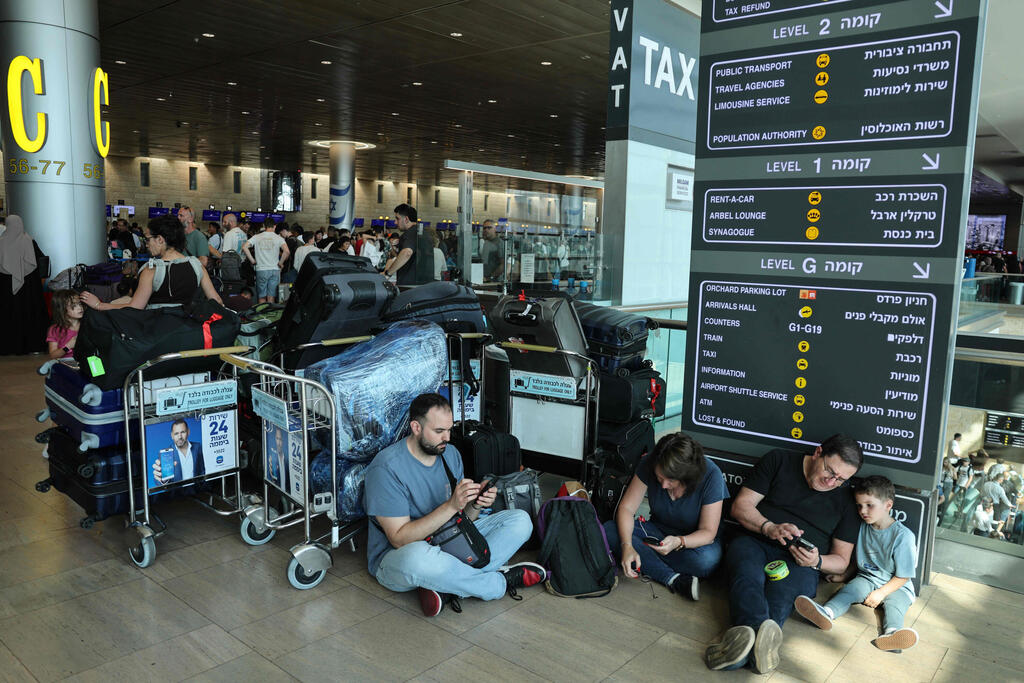
Thousands of Israelis trying to leave the country through Ben Gurion Airport on Thursday spent hours in enormous lines, amid scenes of complete chaos and, for part of the day, rows of deserted check-in counters. Some flights were canceled, forcing passengers who had already packed into the terminals to return home.
What caused the breakdown, however, has become the subject of a fierce dispute among airport management, the workers’ committee, government officials and political figures.
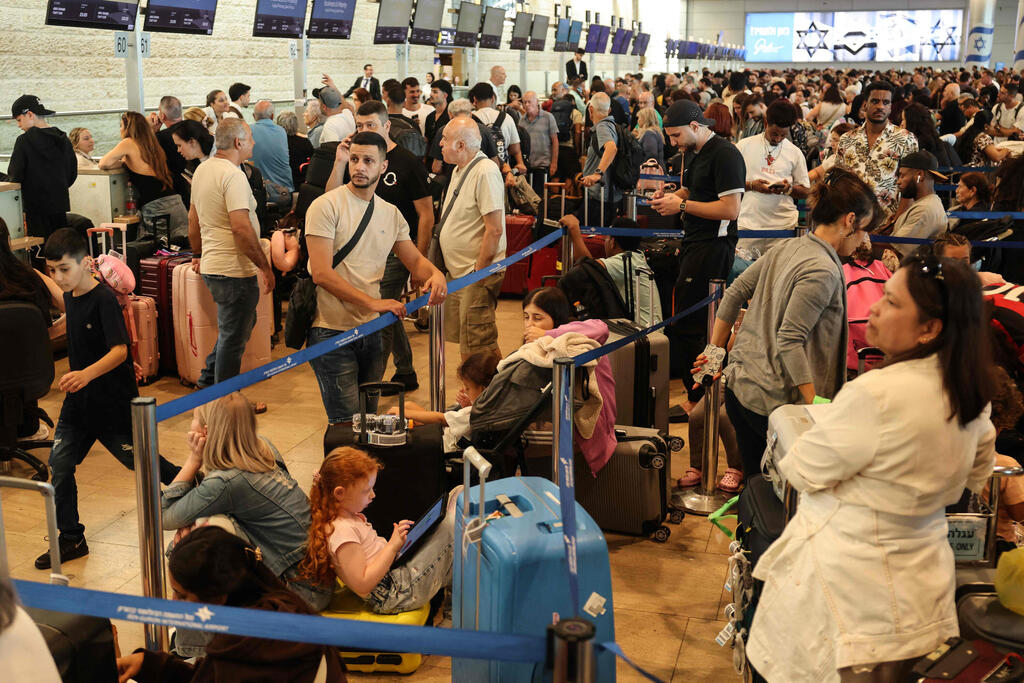
Throughout the day, Israel Airports Authority management issued several statements accusing the authority’s workers’ committee of directing “work disruptions.” At around 1 p.m., the authority said it was “dealing at this time with work disruptions under the direction of the employees’ committee, which are affecting operational activity and service to the traveling public.”
Management called on employees “to immediately stop any action that could harm normal operations and restore full activity,” adding that it viewed “with severity any deliberate action that could harm passengers and the proper operation of Ben Gurion Airport, particularly during the summer peak and a period of high activity.”
Later, the authority announced that because of the committee’s instructions, air traffic would be reduced beginning at 2 p.m. until landings were halted altogether. Departures continued gradually under an updated flight schedule. Operations began resuming around 3 p.m., but the disruption continued and thousands of passengers remained stranded.
‘Do you want people to collapse?’
Pinchas Idan, chairman of the Israel Airports Authority employees’ committee, rejected the claim that workers had launched a planned strike. Instead, he insisted that the airport was suffering from a serious staffing shortage and that repeated warnings had been ignored.
“They can’t call it a strike and invent stories because everyone wants to cover themselves,” Idan said. “In June, I sent a letter saying there was a staffing shortage. Then they said, ‘There’s no shortage, there are Americans, there is Greece.’ Fairy tales.”
“A baggage handler cannot work 13 hours a day in this heat,” he said. “What do you want, for people to collapse?”
Idan said employees had not stopped working. “Everyone says there is no staffing shortage. Come, I’ll take you on a tour and you tell me whether it’s normal for a baggage handler to start at 3 a.m. and finish at 3 p.m.”

Pinchas Idan
(Photo: Moti Kimchi)
“The morning shift started at 3 a.m. and ended at noon. At 1 p.m., the afternoon shift returned to normal work. All the baggage handlers are working. They finished nine hours and went home. They deserve that.”
A regular workday lasts eight hours, but union officials said shifts had been extended to 12 hours because of the staffing shortage. According to union sources, some employees had become exhausted and were no longer able to withstand the workload. They said Idan decided Thursday that 12-hour shifts would end and employees would work only eight-hour shifts.
One airport employee told ynet during the height of the crisis that the breakdown began when “the committee decided there would be no more overtime.”
“I don’t know if this is a strike,” the employee said. “Everything is simply at a standstill because a crazy bottleneck has formed upstairs at check-in because they aren’t accepting luggage.”
“In my department, I heard that 10 employees didn’t show up. Personally, I wasn’t instructed not to work, but everything is at a standstill. They aren’t accepting luggage because the systems are completely overloaded. I spoke to veteran employees who say they’ve never seen anything like this before.”
Histadrut denies ordering strike
The Histadrut labor federation also said it had not been involved in any decision to halt work at the airport. It said Histadrut chairman Arnon Bar-David had long been aware of staffing shortages at Ben Gurion Airport and their effect during peak travel days but had not been involved in any initiative to shut down operations.
“No such instruction was issued by the Histadrut or by the Transportation Workers Union,” it said.
After learning of Thursday’s events, Bar-David spoke with Idan and instructed him “to do everything possible to resolve the crisis that had been created and assist the traveling public,” according to the statement.
The congestion at Ben Gurion did not begin Thursday. Heavy disruptions had already been reported since the previous weekend, and employees had told ynet a day earlier that the authority’s employment model was contributing to high turnover and insufficient staffing.
“There is tons of work and no manpower,” one employee said at the time. “Every winter they part with veteran workers who are nearing permanent status, and then in the summer there aren’t enough workers.”
(Photo: Jack GUEZ / AFP)
The Airports Authority rejected that explanation Wednesday, arguing that recent congestion stemmed in part from restrictions in European airspace, particularly around Greece and Cyprus, as well as the activity and presence of refueling aircraft.
“There is no connection to the authority’s employment model,” it said. “What matters is the number of employees, not the method by which they are employed.”
By Thursday, however, the authority’s language had changed. Following talks with the workers’ committee, it said “a significant effort will be made to increase staffing levels and address operational needs,” effectively acknowledging the manpower problem.
Israel Airports Authority Chairman Yiftah Ron-Tal also acknowledged the strain.
“There are claims from the workers’ organization, and I respect those claims,” he said. “They work incredibly hard. These are people who are baggage handlers. They take bags into the aircraft, take them out and put them on the conveyor belt. It is hard work that continues for many hours.”
“Obviously, we are doing everything we can to strengthen staffing, because many people also leave the job as a result and don’t last very long. It needs to be dealt with, and I think we know how to deal with it, and that is what will be done.”
After touring the check-in halls Thursday evening, Ron-Tal said the airport was returning to full capacity and even operating above normal levels in an effort to close the gaps.
“We are increasing the number of departing flights, practically doubling them in the coming hours,” he said. “I very much hope that by tomorrow morning the airport will return to normal operations.”
Likud suspects political motive
The crisis quickly developed a political dimension. Prime Minister Benjamin Netanyahu and Transportation Minister Miri Regev had toured Ben Gurion Airport only a day earlier. Regev was photographed smiling with Idan, himself a Likud member, during the visit. Afterward, Regev and senior ministry officials left for Morocco.
Netanyahu’s office and Regev’s office were furious over the reports coming from the airport. Within Likud and Netanyahu’s circle, officials also began examining whether politics had played a role behind the scenes.
Much of the suspicion focused on Idan. Some Likud officials argued that those behind the chaos deliberately timed the disruption to damage Regev and, indirectly, Netanyahu.
“There was no labor dispute declared,” one senior Likud official said. “There were no threats or preliminary steps indicating that such a dramatic strike was coming.”
“A move this extreme usually comes after a labor dispute is declared or after some severe cut or intolerable reform. None of that happened here. So what did happen? A clear attempt to hurt Regev and, indirectly, Netanyahu.”
Other Likud officials said they suspected that figures within the Airports Authority waited until Regev left the country before the disruption began. According to those officials, Netanyahu believed the circumstances were unusual enough to issue an unusually sharp response.

Netanyahu and Regev at Ben Gurion Airport
“Ben Gurion Airport will remain open and operate as usual,” Netanyahu said. “Anyone who gets in the way will be sent home.”
Regev’s office launched its own investigation, with heated conversations taking place behind the scenes. Officials initially suspected an internal Airports Authority dispute aimed at ousting CEO Sharon Kedmi, but Netanyahu’s circle increasingly believed the dispute was connected to Regev and Likud.
One theory cited by Likud figures was that Regev had performed strongly in the party primaries without the backing of the Airports Authority political network.
Regev said she would not hesitate to remove members of the authority’s management if they were found responsible.
“If this is connected to workers who abandoned their shift, every single one of them will be summoned to a hearing, and you will recruit new workers,” Regev told airport management during a heated conversation.
“And if it is connected to management, we will deal with them as well. We will investigate the event to the end. Whoever is responsible will be held accountable.”
Another political source offered a different explanation.
“Regev and Netanyahu should not be surprised,” the source said. “Those who only three days ago helped shape the Likud Knesset list know nothing will happen to them. They went on strike simply because they can.”
Opposition: ‘Government of chaos’
Opposition figures, meanwhile, blamed the government. Former prime minister and Beyachad chairman Naftali Bennett arrived at the airport and said: “Ben Gurion Airport is in chaos because of a government of chaos.”
“Israel’s airport has been paralyzed, not because of a natural disaster, but because of a government that is itself a disaster,” Bennett said. “The State of Israel is not being managed.”
“Tens of thousands of Israelis were abandoned by the government on one of the busiest days at Ben Gurion Airport because of political interests,” he added. “This is a government being extorted from every direction. Haredi political operatives, Likud operatives, union operatives, they care only about their personal interests, and the people of Israel pay the price.”
“No one will extort us,” Bennett said, “because we owe nothing to anyone.”