

The United States has destroyed an Iranian submarine and 16 other vessels as part of its ongoing military campaign against Iran, while two CIA facilities in the region were reportedly damaged in Iranian drone attacks.
Adm. Brad Cooper, the commander of U.S. Central Command, said American forces have struck nearly 2,000 targets in Iran using more than 2,000 munitions since the start of the operation, which the U.S. has dubbed Operation Epic Fury.
Adm. Brad Cooper, the commander of U.S. Central Command
(Video: X)


In a briefing, Cooper said U.S. forces are carrying out strikes against Iran “24/7” and that the Iranian regime’s ability to retaliate is rapidly weakening.
“In retaliation, the Iranian regime has launched over 500 ballistic missiles and over 2,000 drones,” Cooper said. “We are seeing Iran’s ability to hit us and our partners is declining, while our combat power, on the other hand, is building.”
Cooper said U.S. bombers have conducted major strikes against Iranian military infrastructure. B-2 stealth bombers and B-1 bombers carried out what he described as “uncontested surgical strikes against multiple missile facilities,” while B-52 bombers targeted ballistic missile sites and command-and-control posts.
He said the campaign has also dealt a major blow to Iran’s naval forces.
“We are also sinking the Iranian Navy — the entire navy,” Cooper said. “Thus far, we’ve destroyed 17 Iranian ships, including the most operational Iranian submarine, that now has a hole in its side.”
“For decades, the Iranian regime has harassed international shipping,” he added. “Today, there’s not a single Iranian ship underway in the Arabian Gulf, Strait of Hormuz or Gulf of Oman.”
“And we will not stop,” Cooper said. “We’re hunting Iran’s last remaining mobile ballistic missile launchers to eliminate what I would characterize as their lingering launch capability.”
Cooper said the United States believes it is ahead of schedule in the operation.
“According to my overall operational assessment, we are ahead of the timeline set in the plan,” he said.
He also said the United States had deployed large numbers of suicide drones during the campaign, which he described as having caused “massive results” in the damage inflicted on Iranian targets.
“I want to emphasize that these drones were originally Iranian-made,” Cooper said. “We brought them to America, made them better — and fired them back at Iran.”
According to Cooper, more than 50,000 U.S. troops and over 200 fighter jets are currently taking part in the operation across the Middle East, alongside aircraft carriers and strategic bombers — the largest U.S. force concentration in the region in a generation.
(Photo: U.S. Army Reserve/REUTERS)
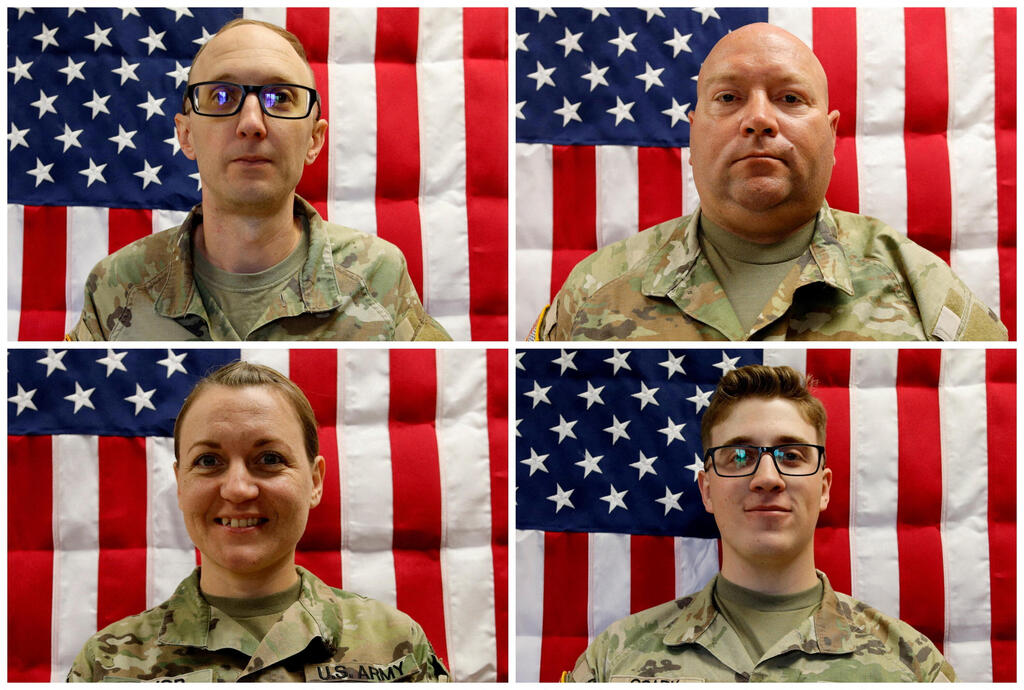
Meanwhile, the U.S. military released the names of four of the six American service members killed in an Iranian drone attack earlier this week in Kuwait: Capt. Cody Cork, 35, of Florida; Sgt. 1st Class Noah Tjaden, 42, of Nebraska; Sgt. 1st Class Nicole M. Amor, 39, of Minnesota; and Sgt. Declan J. Cawdy of Iowa.
According to the Pentagon, the troops were killed Sunday when an Iranian drone struck a logistics facility at the industrial port of Shuaiba in Kuwait.
The soldiers belonged to a logistics supply unit based in Iowa and were inside what officials described as a logistics center when the drone penetrated air defenses and struck the structure.
The Associated Press reported the troops had moved into the container-like facility only about a week earlier, raising questions about the security measures taken in anticipation of potential Iranian retaliatory attacks.
Shortly after the drone strike, Kuwaiti radar detected three aircraft approaching the country in what became one of the war’s more unusual incidents.
According to several officials familiar with the matter who spoke to The Wall Street Journal, a Kuwaiti Air Force F/A-18 mistakenly shot down three U.S. F-15 fighter jets.
A U.S. official said the Kuwaiti jet fired three missiles at the American aircraft. All three jets were destroyed, but their pilots were able to eject safely.
Iran has continued launching attacks across the Gulf region.
US striking Iranian Navy vessels
In Kuwait, an 11-year-old girl was killed overnight after being struck by shrapnel that hit a residential compound during one of the Iranian attacks. She was taken to a hospital, where she was later pronounced dead.
Saudi Arabia’s Defense Ministry said it intercepted nine drones before they entered Saudi airspace and later reported intercepting two cruise missiles.
Saudi Arabia’s Foreign Ministry said the kingdom “will take all necessary measures” to ensure its security and defend its territory, citizens and residents.
Meanwhile, the U.S. Embassy in Riyadh was struck by drones earlier this week.
The Washington Post reported that a CIA facility was damaged in the drone attack that hit the embassy compound. An internal State Department message obtained by the newspaper said part of the embassy’s roof collapsed and the building filled with smoke, forcing staff members to shelter in place.
CBS News also reported that a separate CIA facility in Iraq was struck by two drones. According to an intelligence source and a Gulf-based official cited in the report, no Americans were present at the facility at the time of the attack and no injuries were reported.