

Israel has sent a message to Syria telling it, in effect, “Don’t let the Turks take you for a ride,” three days after the unusual strike on the Abu al-Duhur military air base in the Idlib area of northern Syria, where Israeli officials said Turkey intended to deploy its forces. According to the message conveyed to Damascus, “Israel does not intend to escalate either with Syria or Turkey — but it will not accept a Turkish foothold on Syrian soil.”
In this context, Israel’s ambassador to the United States, Yechiel Leiter, told ynet on Thursday evening that “Israel received clear intelligence indicating that Turkey intended to significantly expand its military presence in Syria. We are not seeking escalation with Turkey or Syria. But a red line was crossed. This was a blatant violation by Turkey of the understandings that the status quo in Syria would remain in place. Those who needed to be exposed to the intelligence received it. We made clear that this was a violation of the understandings — and that is why Israel had to act.”
Gallery
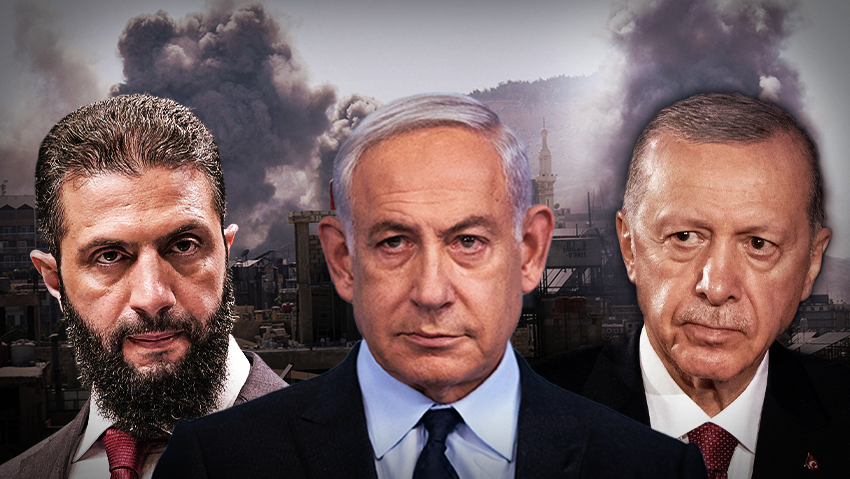
A three-way game. Al-Sharaa, Netanyahu and Erdogan
(Photo: MEHMET ALI OZCAN/Anadolu via AFP, shutterstock, Rafi Kutz, Alex Kolomoisky, Kobi Koeneks, REUTERS/Khalil Ashawi, AP Photo/Leo Correa, SAUL LOEB/AFP, Evelyn Hockstein/POOL/AFP, Andrew Harnik/GETTY IMAGES NORTH AMERICA/AFP, JOE RAEDLE/GETTY IMAGES NORTH AMERICA/AFP, REUTERS, SATELLITE IMAGE ©2025 MAXAR TECHNOLOGIES/AFP)
Meanwhile, Prime Minister Benjamin Netanyahu held a meeting Thursday evening with the heads of Israel’s defense establishment, including intelligence agencies, to discuss future developments in the region, particularly regarding Syria and the current tensions with Turkey. The meeting came against the backdrop of a statement by the Turkish Defense Ministry that denied a Turkish delegation had been at the base before or during the strike, while also declaring that Turkey intended to continue its “determined” support for the administration of Ahmed al-Sharaa in Syria.
The assistance is a major concern for Israel, which fears a Turkish foothold in Syria that could pose a threat to Israel and potentially restrict its freedom of action in Syrian airspace.
The day before, Netanyahu said explicitly that through the strike, he had conveyed a “Don’t” message to Turkey. On Thursday, Burhanettin Duran, head of communications for the Turkish presidency, responded: “Netanyahu’s threats and lies against Turkey and Syria reflect his international isolation, political fears and delusions. We will continue to stand with countries pursuing peace in our region, especially Syria, and fight the destabilizing actions of Netanyahu, the perpetrator of genocide.”
Duran, a senior spokesman for President Recep Tayyip Erdogan, added: “History clearly shows that there is nothing we cannot do for our people, the survival of our state and the prosperity of our nation. We have enough experience not to be dragged into the games of people like Netanyahu who undermine peace and stability. We are a country respected around the world for our peaceful approach. Turkey’s peaceful foreign policy will thwart the games of dubious figures like Netanyahu, who do not hesitate to set the entire region ablaze to secure their political future.”
According to Duran, Netanyahu is attempting to “mislead international public opinion” by “inventing enemies and threats,” but he said this is no longer effective given what he described as broad international agreement over the problematic nature of Netanyahu’s policies. He added that criticism from the United States, Britain and the international community of Israel’s regional policies is growing stronger.
Turkey, he said, “will not fall into the trap” of someone who, in his words, is trying to set the region ablaze to secure his political future.
‘A political lifeline’
Duran went on to link the rhetoric against Ankara to Netanyahu’s domestic political considerations. According to Duran, the prime minister “sees hostility toward Turkey as a kind of political lifeline” ahead of Israel’s upcoming elections and amid competition with political forces he described as “more extreme.”
Duran added that Israel is attempting to “shift the stain” stemming from its policies in Gaza, Syria and Lebanon, as well as from its failure to address what he called “settler terrorism,” onto countries in the region — chiefly Turkey, including over its activities in Syria.
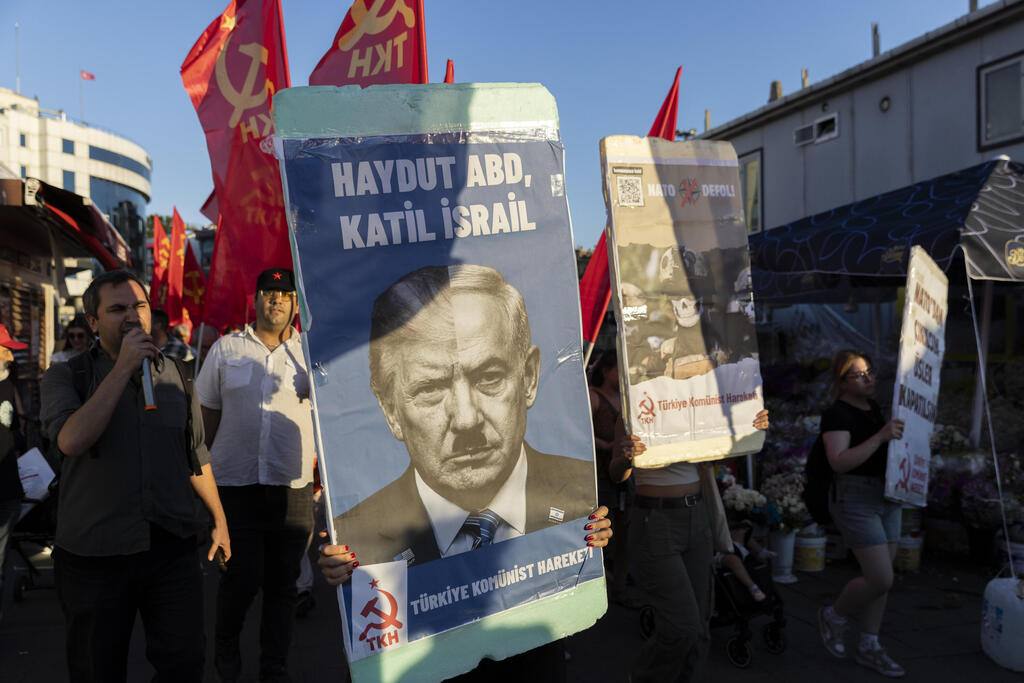
Anti-Israeli demonstration in Turkey
(Photo: radley Secker/Getty Images)
Asked whether Netanyahu’s direct appeals against Turkey could indicate an expansion of Israel’s “circle of aggression” to include Turkey as well, Duran said the international community and countries in the region oppose what he called Netanyahu’s “occupationist approach” and his attempt to drag the region into a wider war.
He claimed that Netanyahu’s government in its current composition “has abandoned any attempt at dialogue and diplomacy” and equates security with continued aggression rather than stability.
Duran said Turkey seeks to bring an end to bloodshed in the region and that this is why the Palestinian issue and the situation in Gaza are important to Ankara. He added that criticism of the prime minister’s policy toward Turkey has also been voiced within Israel, claiming that members of the Israeli opposition had described it as “irresponsible, excessive and foolish” and said it was causing public concern.
Duran went on to say that as a NATO member, Turkey has strengthened its regional and international standing in recent years and bolstered its capabilities. In his view, the rational step for Israel would be to advance a two-state solution to the Israeli-Palestinian conflict and halt what he called “destabilizing measures” in the region, rather than threatening its neighbors, taking actions around the Al-Aqsa Mosque in Jerusalem and planning new settlements in the West Bank.
Duran’s harsh remarks are the latest in a long series of accusations exchanged between Jerusalem and Ankara in recent months. In November 2025, prosecutors in Istanbul issued arrest warrants for Netanyahu and a number of other senior Israeli officials on allegations of genocide in Gaza. In the months that followed, the two sides traded further accusations, including comparisons by Turkish officials between Netanyahu and Adolf Hitler, followed by a response from Defense Minister Israel Katz, who described Erdogan as someone who had fled into “the realm of antisemitism.”
Netanyahu, for his part, recently called Erdogan an “antisemitic dictator” who supports Hamas. Meanwhile, U.S. President Donald Trump has sought to ease tensions between the two countries, citing his close personal relationship with Erdogan.
First published: 23:33, 08.20.26