


Although the strikes in Iranian territory reflect unprecedented U.S.-Israeli cooperation, there is a significant difference in how the two militaries present the attacks publicly.
While the IDF spokesman frequently releases statements detailing the results of Israeli strikes, U.S. Central Command has largely shown footage of fighter jets taking off from aircraft carriers, Tomahawk missile launches and rockets fired from mobile launchers. The Americans have rarely presented documentation of the results of their strikes.
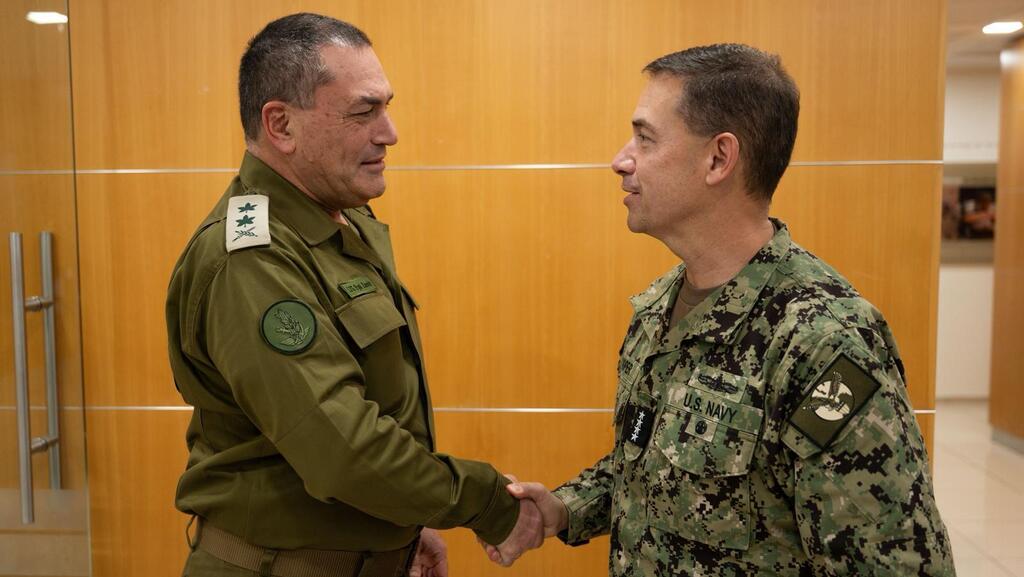
Commander of US Central Command Adm. Brad Cooper with IDF Chief of Staff Lt. Gen. Eyal Zamir
(Photo: IDF)
CENTCOM appears to be deliberately refraining from providing updates on the attacks it is carrying out in Iran, even though the U.S. military is conducting numerous bombing missions. The Americans have also asked the Israelis not to comment on their strikes. To the best of current knowledge, joint strikes have also been carried out without documentation from either side.
According to sources in Israel, over the past 24 hours the IDF has dropped 1,200 munitions as part of the operation, while the United States has launched 1,050. Israel is operating primarily in western Iran, while the United States is focusing on the eastern part of the Islamic Republic — an unofficial division of labor.
In the opening blow, Israel eliminated the Iranian leadership at a compound of Supreme Leader Ayatollah Ali Khamenei, along with 30 additional senior officials, including the commander of the Islamic Revolutionary Guard Corps, Iran’s chief of staff, the head of Iranian military intelligence and senior advisers to Khamenei.
The IDF spokesman has inundated reporters with extensive information about Israeli strikes in Iran, background on the circumstances that led to the operation and footage of IDF attacks on Iranian territory.
On Sunday, IDF spokesman Brig. Gen. Effie Defrin released footage of a strike on two Iranian fighter jets that were preparing for takeoff at an airport in Tabriz in western Iran. “The strike was carried out in order to disrupt the activity of the Iranian air force and to deepen the damage to the regime’s defense systems,” the IDF said in a statement.
Earlier, the IDF released footage under the headline: “Strikes on ballistic missile launchers and destruction of unmanned aerial vehicles: The air force continues to operate in Iranian skies.” The spokesman also distributed initial footage from a large-scale Israeli Air Force flyover in the heart of Tehran, during which a headquarters of what Israel described as the Iranian terror regime was destroyed.
Footage of strikes in Iran released by the IDF spokesman
(Video: IDF)


On Saturday evening, the IDF spokesman gave a briefing detailing the achievements of the opening strike of Operation Lion’s Roar, in which seven senior members of Iran’s leadership were killed.
By contrast, CENTCOM has been far more restrained in releasing information. Its X account has largely posted footage of fighter jets taking off from U.S. aircraft carriers en route to Iran, as well as Tomahawk missiles launched from large warships. The Americans also uploaded a video showing rockets fired from mobile launchers in the desert. The video briefly shows hits on an Iranian radar installation, a missile launcher and a drone.
The difference in messaging between the IDF and the U.S. military is therefore striking. The Americans are in no rush to provide details, while the Israeli approach reflects the idea that if you did not publicize it, it is as if you did not carry it out.
Second, the Americans do not want to appear to be fighting on Israel’s behalf, but rather for the liberation of Iran. It is important for them to project their own strength rather than appear focused on defending Israel. It is also possible that CENTCOM prefers to reserve certain battlefield “achievements” for President Donald Trump to announce personally, ensuring he receives the credit.
Fox News reported that four B-2 bombers flew round-trip missions from the United States to Iran, dropping dozens of bombs on underground ballistic missile sites.
On the first day of the war, CENTCOM posted on X: “The first 24 hours of Operation ‘Righteous Fury.’ The president ordered bold action, and our brave soldiers, sailors, airmen, Marines and Coast Guardsmen answered the call. Adm. Brad Cooper, Commander, U.S. Central Command.”
In another post showing American rocket launches toward Iranian targets, CENTCOM wrote: “The Iranian regime was warned. CENTCOM is now operating swiftly and decisively as directed.”
The US defense secretary provided details, but did not mention Israel
Defense Secretary Pete Hegseth described the campaign as the most lethal, complex and precise air operation ever conducted, saying Iran had been given an opportunity to reach an agreement but refused and was now facing the consequences. He accused Tehran of attacking and killing Americans for decades while pursuing the world’s most powerful weapons to advance its radical aims.
Hegseth said President Donald Trump was confronting the threat directly and vowed that the United States would not tolerate missiles aimed at Americans. He said Iran’s missile capabilities and production facilities would be destroyed, along with its navy, and reiterated that Iran would never be allowed to obtain a nuclear weapon. He added that although the United States did not start the conflict, it would end it, warning that any harm to Americans would be met with lethal force. Israel was not mentioned in his remarks, apparently by design.
CENTCOM footage from the strikes
CENTCOM pushed back against what it described as Iranian propaganda, denying claims that American service members were killed, that a U.S. Navy ship was struck or that U.S. bases sustained severe damage. It said no American casualties were reported, no naval vessels were hit and any damage to facilities was minimal and did not affect operations.
In additional posts, CENTCOM said its Task Force Scorpion Strike had for the first time deployed one-way attack drones in combat during Operation Epic Fury, using low-cost systems modeled on Iran’s Shahed drones. It said the objective of the campaign was to protect the American people by eliminating immediate threats from the Iranian regime and that U.S. forces were carrying out a sustained and forceful offensive.
In a formal statement, CENTCOM said it launched Operation Epic Fury on Feb. 28 at the president’s direction, with U.S. and partner forces beginning strikes at 1:15 a.m. Eastern time. The operation targeted what it described as key elements of Iran’s security apparatus, including Islamic Revolutionary Guard Corps command and control facilities, air defense systems, missile and drone launch sites and military airfields.
Israeli officials said: “The United States is striking no less than we are, even if that is not reflected in the videos being released. The Iranians are firing at American targets, apparently more than they are firing at Israel, which underscores the need for cooperation with Gulf states. In the Gulf as well, Israel is seen as the prominent and stable force in the region. There is not always confidence that the Americans will remain over time. Israel chose to allow Trump to receive initial credit for eliminating Khamenei, even though it was already known he was dead, because it is important for us that they be at the forefront.”