


Indian Prime Minister Narendra Modi is set to visit Israel on Wednesday in a trip officials say will elevate bilateral ties to what they describe as “special strategic relations,” the highest level of diplomatic partnership, a designation Israel also uses for its relationships with the United States and Germany.
During the visit, Modi is scheduled to address the Knesset and meet with Prime Minister Benjamin Netanyahu and President Isaac Herzog. The two sides are expected to sign a memorandum of understanding expanding cooperation across multiple sectors, with a primary focus on defense.
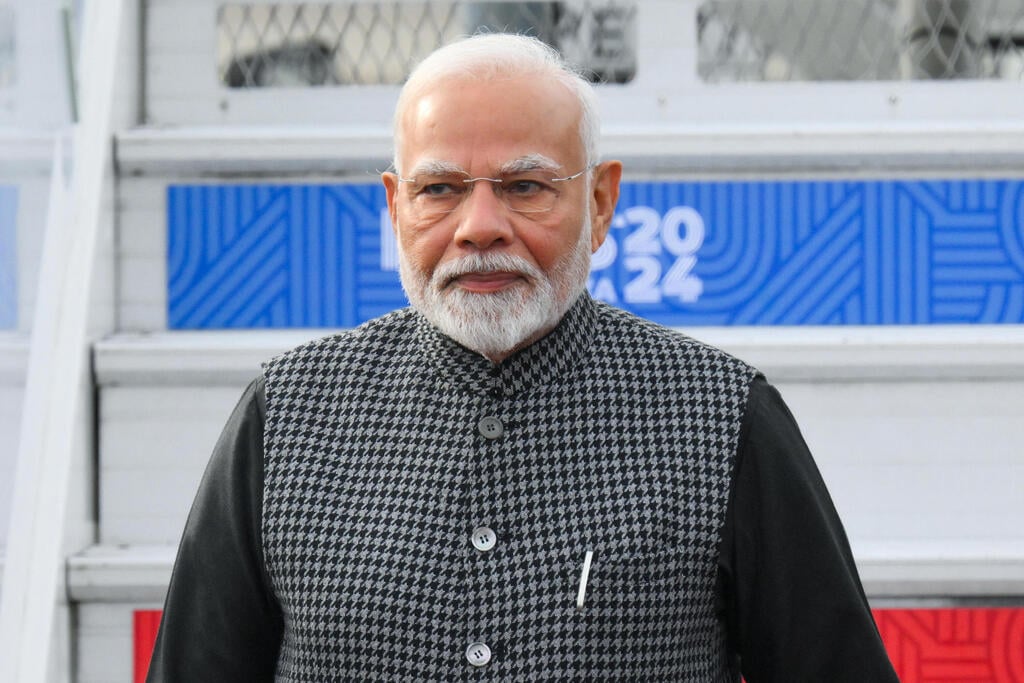
(Photo: Ilya Pitalev/BRICS-RUSSIA2024.RU Host Photo Agency via REUTERS)
Under the agreement, officials said, a new classified framework will be established to allow expanded defense cooperation, including opening previously restricted categories to India such as advanced air defense systems. The framework is also expected to enable Indian integration into Israel’s developing laser-based air defense system, known as “Iron Beam.”
A senior diplomatic official described the move as a major shift.
“This increases flexibility for the defense establishments to manage their efforts and allows the sides to rely on one another in times of need,” the official said. “This is a significant transformation.”
Officials said the upgraded partnership could help mitigate the impact of potential future arms embargoes, noting that during the ongoing war Israel faced restrictions from some suppliers. According to foreign reports, India has already provided drones and explosives during the current conflict.
Beyond defense, the two countries are expected to sign agreements focused on emerging technologies including artificial intelligence, quantum computing and cybersecurity. Officials said India has strong capabilities in scaling early-stage technologies for large-scale implementation.
Israel’s ambassador to India, Reuven Azar, described the visit as “a very significant leap forward” not only in defense but also in food security, agriculture and water, finance and infrastructure.
“We have worked to bring Indian companies to bid on major infrastructure projects in Israel, such as the Tel Aviv metro,” Azar said. “This is a new era in relations.”
Azar said he hopes additional direct flight routes between Israel and India will be launched. Currently, Air India operates the only direct short route. Israeli officials have approached other Indian carriers about opening service, and there are contacts regarding a possible Arkia route to Mumbai.
Ahead of the visit, the government approved a 148 million shekel ($40 million) plan to strengthen ties in a range of fields. Key elements include expanding academic and innovation cooperation, deepening agricultural collaboration, enhancing financial cooperation, strengthening Israel’s centers of excellence in India, and boosting collaboration in transportation and energy. The plan also promotes cooperation between Bollywood and Israel’s film industry.
Among the initiatives are the establishment of a high-level steering committee led by the two countries’ foreign ministers, to convene every two years; the opening of 10 additional centers of excellence in India focused on agriculture, water and innovation; and increasing the number of Indian trainees in Israel.
The plan also envisions the creation of a joint defensive cybersecurity center of excellence, advancement of a free trade agreement, cooperation in renewable energy and telemedicine projects in remote areas of India.
Some initiatives are contingent on matching funding from India, and full implementation is subject to approval of the 2026 state budget in the Knesset, officials said.