


Amid a mounting humanitarian crisis and international criticism, Prime Minister Benjamin Netanyahu issued a rare English-language statement late on Monday, pledging to bolster humanitarian aid to the Gaza Strip.
“Israel will continue to work with international agencies as well as the U.S. and European nations to ensure that large amounts of humanitarian aid flow into the Gaza Strip,” Netanyahu said after a closed-door security cabinet meeting attended by ministers Itamar Ben-Gvir, Bezalel Smotrich and others.
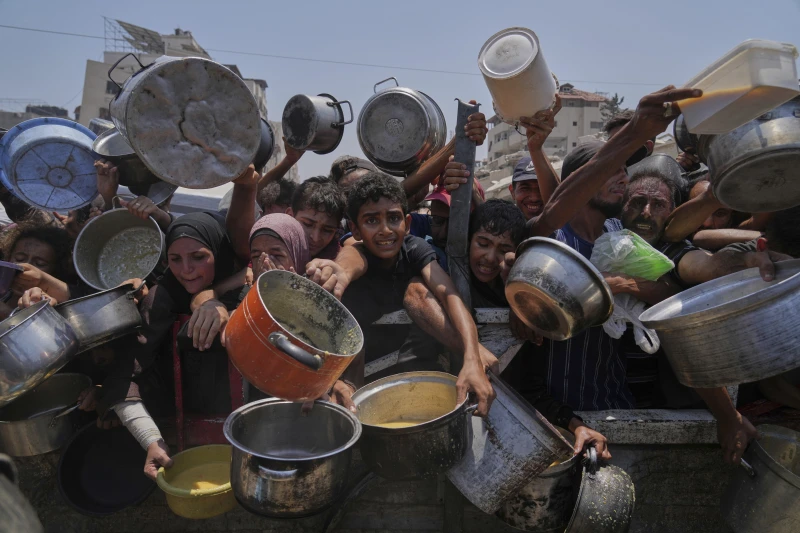
Netanyahu outlined new measures to facilitate aid, including daily pauses in IDF operations from 10:00 a.m. to 8:00 p.m. in densely populated areas and designated “safe routes” for aid convoys from 6:00 a.m. to 11:00 p.m. “We already allow significant amounts of humanitarian aid into Gaza every single day, including food, water and medicine,” he said.
Yet these promises have done little to ease concerns on the ground. Despite Netanyahu’s claim that “there is no starvation in Gaza,” the World Health Organization (WHO) reported that 63 people—including 24 children under five—died this month from malnutrition-related causes, a steep rise from just 11 deaths over the previous six months.
According to the Associated Press (AP), Gaza’s Health Ministry, recognized by the UN as the most reliable source for casualty figures – despite being controlled by Hamas- reported 82 deaths this month alone, with 14 in the past 24 hours.
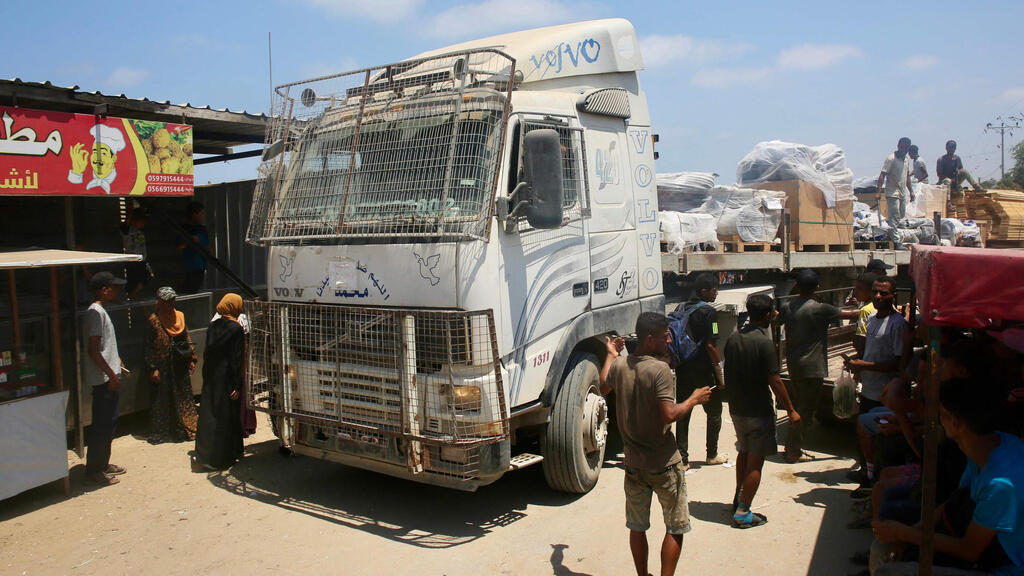
Aid distribution in Gaza
(Photo: AFP)
A northern Gaza hospital said it had recorded the first deaths of children with no underlying health conditions. Adults with diabetes and heart or kidney conditions were also dying from hunger exacerbated by lack of treatment.
U.S. President Donald Trump publicly rebuked Netanyahu’s claim. “Those children look very hungry,” he said Monday, referencing widely circulated images of skeletal children and overcrowded feeding centers.
Witnesses at aid sites described chaos and despair to the outlet. “This aid, delivered in this way, is an insult to the Palestinian people,” said Hassan al-Zalaan, who witnessed a scramble over airdropped cans of chickpeas.
The UN said its four malnutrition treatment centers in Gaza are overwhelmed. Acute malnutrition has tripled in northern Gaza, affecting nearly one in five children under five, while central and southern regions have seen rates double. The Integrated Food Security Phase Classification (IPC) has warned of famine for months but has yet to officially declare one, citing a lack of access to Gaza to gather data—an outcome of Israeli restrictions.
Get the Ynetnews app on your smartphone: Google Play: https://bit.ly/4eJ37pE | Apple App Store: https://bit.ly/3ZL7iNv
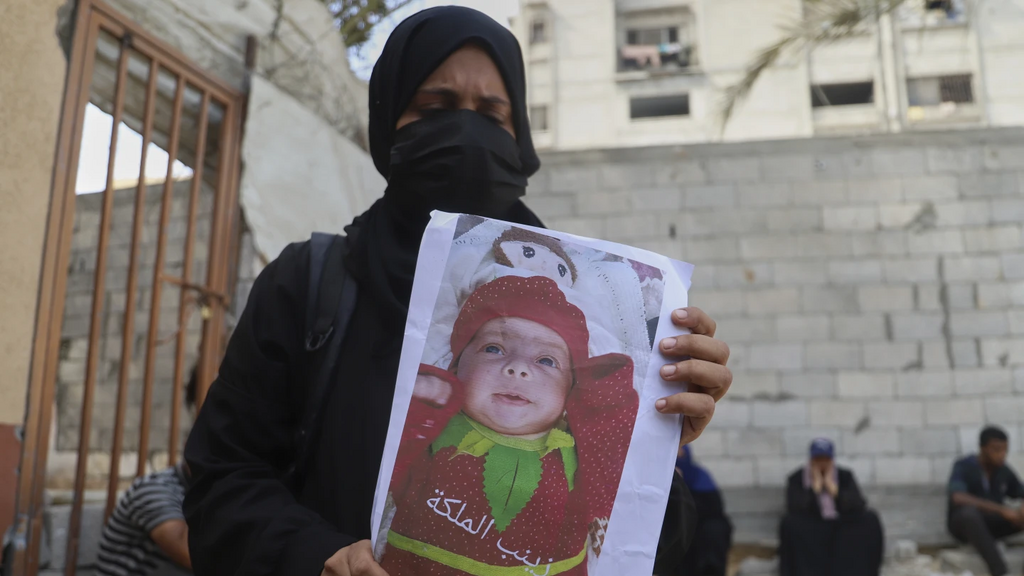
Gazan mother with picture of malnourished baby
(Photo: AP/Mariam Dagga)
The aid distribution effort is plagued by breakdowns. According to the UN World Food Program, 55 trucks that entered Gaza via Zikim and Kerem Shalom crossings on Monday were “looted by starving people” before they reached storage facilities. Air-drops, also part of Israel’s response, are limited in impact and have caused injuries or deaths on the ground. On Sunday and Monday, the IDF dropped just 48 food packages.
Israel blames Hamas for siphoning off aid and inciting chaos. Netanyahu reiterated, “Hamas, which openly uses civilians as human shields, operates from hospitals and uses schools and kindergartens to store weapons, has been stealing aid from the Gaza population many times by shooting Palestinians.”
He added, “While the situation in Gaza is difficult and Israel has been working to ensure aid delivery, Hamas benefits from attempting to fuel the perception of a humanitarian crisis.”
Despite these claims, the UN and partner organizations say looting isn't systematic and generally stops when enough aid flows in. Aid workers have also reported hundreds of Palestinian deaths at distribution sites due to crowd crushes or IDF fire. Israel said IDF troops fire warning shots to disperse threats.

Jordanian military air-dropping aid to Gaza
(Photo: רויטרס/REUTERS/Jehad Shelbak)
The UN says trucks are the most effective way to deliver aid, each carrying about 19 tons of supplies. But Israeli restrictions slow or block distribution. For every aid delivery left near the border, the UN must request IDF permission to collect it. Over half of such requests have been delayed or denied in the past three months.
Even when collected, aid trucks are frequently overwhelmed by hungry crowds or armed gangs. Hamas’s civilian police once secured routes but stopped after IDF airstrikes targeted them. Netanyahu emphasized that the war's aims remain unchanged. Speaking Monday at IDF base, he said, “We have work to complete—eliminating Hamas and bringing our hostages home. We won’t relent for a moment. These two goals are intertwined.”
Still, cracks are emerging. A senior Israeli official said after a Cabinet meeting, “Right now, the only thing certain is that Netanyahu wants a deal—but it’s far from clear that Hamas does. In the coming days, Israel will try to exhaust the chances for a deal and if that fails, it will need to make tough decisions.”
Meanwhile, at a UN conference hosted by France and Saudi Arabia on a two-state solution, Palestinian Authority Prime Minister Mohammad Mustafa called on Hamas to relinquish control of Gaza. “The Palestinian Authority is ready to take responsibility for governance and security in Gaza with Arab and international support,” he said.