


Prime Minister Benjamin Netanyahu has spent recent days focused on holding together what remains of his increasingly fragile coalition, as internal disputes intensify and the threat of early elections grows.
Netanyahu has backed National Security Minister Itamar Ben Gvir amid confrontations with legal authorities, offered assurances to Shas party leader Aryeh Deri, sought to soften United Torah Judaism lawmaker Moshe Gafni’s opposition over the draft exemption bill, and signaled to Finance Minister Bezalel Smotrich to push ahead with the 2026 state budget, projecting confidence that it can pass.
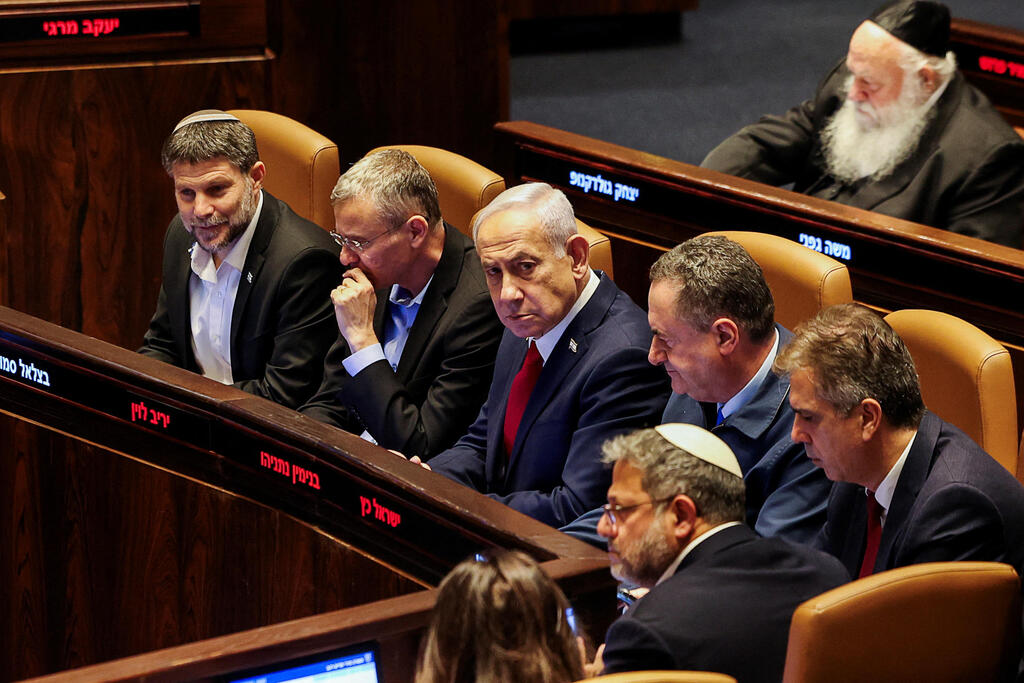
(Photo: REUTERS/Ronen Zvulun)
Behind the scenes, however, coalition officials acknowledge the situation is far more complex.
The coalition has been engaged in a prolonged holding action, and a new ultimatum issued Sunday by ultra-Orthodox parties — warning that without a draft exemption law there will be no budget — underscored how tenuous the government’s position has become.
Netanyahu wants to keep the coalition intact until the latest possible date ahead of elections currently expected in September. But he may have little room to maneuver. Two weeks ago, ynet reported that Netanyahu instructed aides to prepare for elections as early as June. While he would prefer to avoid that timeline, political sources say he recognizes how quickly the situation could deteriorate.
Netanyahu had assumed the ultra-Orthodox parties needed the state budget as much as he needed political time, since continued participation in the coalition ensures funding that might not be available under a different government. But recent developments highlighted that one issue outweighs all others in the ultra-Orthodox public: military conscription.
Initially, Netanyahu’s circle responded calmly to the latest threat, believing the prime minister could still persuade the ultra-Orthodox factions to support the budget, at least in its first reading. As hours passed, that assessment grew less certain. The parties increasingly appear to be operating in campaign mode, with rhetoric growing sharper.
The controversy intensified after United Torah Judaism lawmaker Yitzhak Goldknopf compared sanctions on draft evaders to the yellow star imposed on Jews during the Holocaust, drawing condemnation both from outside the coalition and within it. Smotrich said there was “no place in our coalition for detached and insensitive people,” while Minister Amichai Chikli also denounced the remarks.
The draft exemption bill has become a political trap for Netanyahu and his partners. Any version of the legislation risks alienating key voters, and anger that initially emerged on the fringes of ultra-Orthodox society has moved into the mainstream and into the Knesset. Ultra-Orthodox lawmakers now privately concede that, regardless of Netanyahu’s promises, the bill is unlikely to pass.
The dilemma cuts both ways. Leaving the coalition would mean forfeiting budgets and heading into elections from a weaker position, without control of major government ministries. Still, some in Likud believe the standoff could ultimately benefit Netanyahu.
Political advisers argue that Netanyahu is the only leader capable of delivering a draft law acceptable to the ultra-Orthodox under current political conditions, and that it may serve him better to delay the legislation until after elections. Passing the law now, they warn, could damage him politically while freeing the ultra-Orthodox parties to negotiate freely with any future coalition partners.
In the meantime, regardless of whether the Knesset dissolves by March or not, Israel’s political system is already deep in campaign mode — and the intensity is only expected to grow.