


The prayers that morning, Oct. 7, 2023, were interrupted by gunfire from the street. Three soldiers from hesder yeshivas, religious institutions that combine Torah study with IDF service, were just three weeks away from completing their combat training in the Givati Brigade when they sprang into action.
Armed with their personal rifles and still wearing white shirts for the Simchat Torah holiday, they fought their first battles in the streets of Sderot. Nearly three years later, they returned to a short video that captured only a fraction of the fighting they experienced that day.
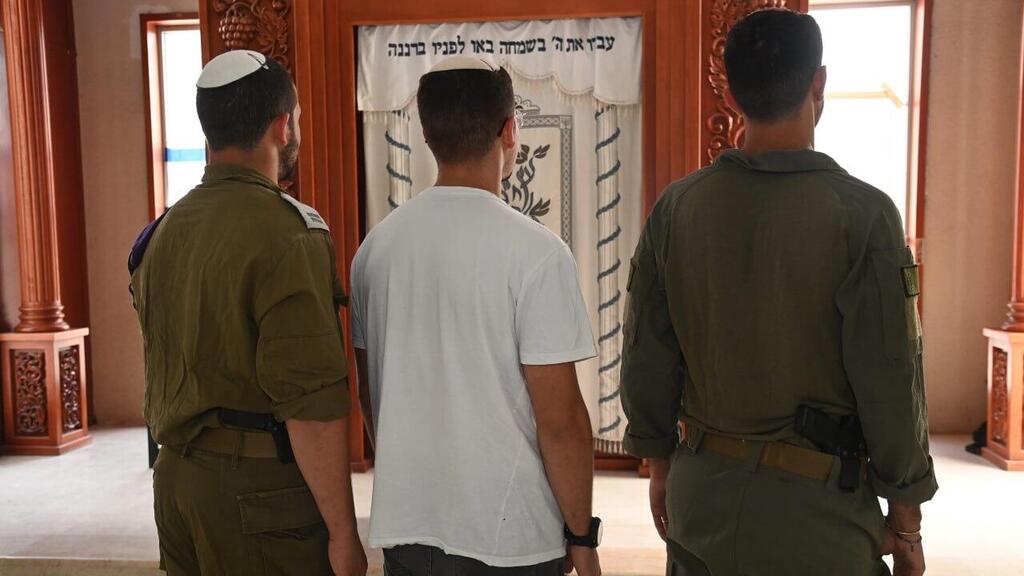
Lt. B., 23, from Sha’arei Tikva, Lt. Matan, 23, from Be’er Sheva, and reserve Staff Sgt. Nehorai, 23, from Haifa, enlisted in March 2023 in Givati’s hesder track.
Their original plan was to return to the army after Simchat Torah for another 21 days of training, culminating in the march marking the end of their combat course.
“Before we went home, we asked our platoon commander, just this once, to let us leave without our weapons,” Nehorai recalled. “We knew we would be at the yeshiva celebrating Simchat Torah. We wanted to dance and celebrate properly without carrying them.”
But the commander refused.
“He said, ‘No chance, because of the tiny possibility that you might encounter a terrorist,’” Nehorai said.
On the morning of Oct. 7, they understood just how consequential that decision had been.
‘There are gunshots outside’
The three met as planned at the Afikei Da’at yeshiva for early Saturday morning prayers.
“Then there was a siren,” B. recalled. “We weren’t particularly alarmed. In Sderot, we were used to sirens.”
But when the alerts kept coming, they began to suspect something was different.
Footage of Matan and Nehorai fighting in Sderot on Oct. 7


“It became very intense,” Matan said. “We saw huge numbers of launches from Gaza, quantities we had never seen in Sderot. We understood that something strange was happening.”
The three readied their weapons. Then a civilian burst into the synagogue and shouted: “There are gunshots outside.”
They immediately ran out.
“We advanced about 200 meters and encountered 15 armed terrorists wearing headbands,” Matan said.
“The pickup stopped right in front of me, outside the police station,” B. recalled, referring to the vehicle whose images became some of the first indications for many Israelis that terrorists had penetrated deep into Israeli territory.
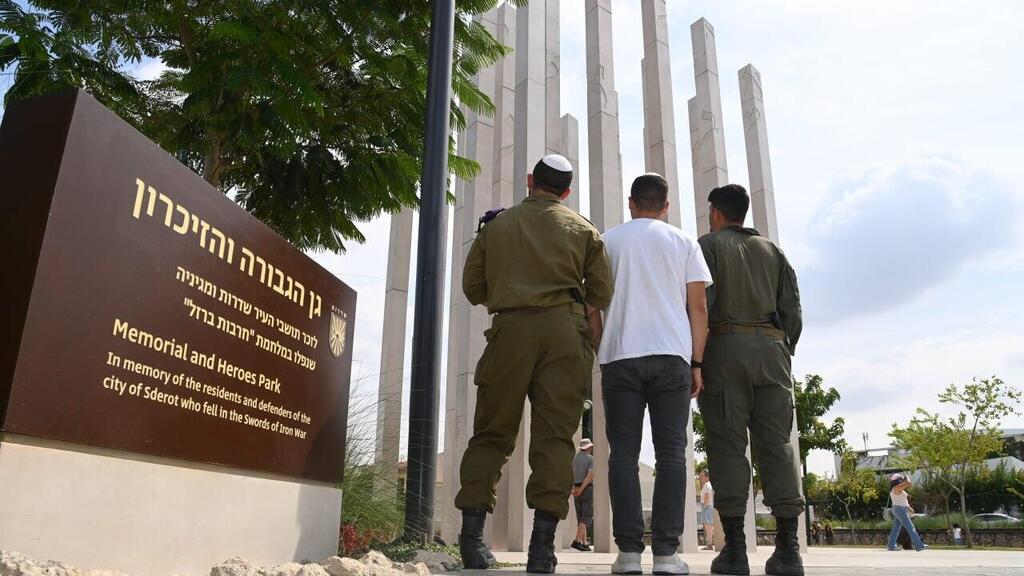
Near the memorial site for the battle in Sderot
(Photo: Herzl Yosef)
“Nothing in training can prepare you for a moment like that,” Nehorai said. “When we opened fire, for a moment I still felt like I was at a shooting range on a training base.”
At first, they hoped that street battle would be the only fighting they encountered that day.
“Hours later, when we returned to the yeshiva, someone from our platoon mentioned terrorists at the party near Re’im and said something extreme was happening,” Nehorai recalled.
“Until then, I thought it was one pickup truck with 15 terrorists at the police station. That was the first time I got a slightly broader picture of what was happening. The switch happens very quickly.”
‘We had weapons, Shabbat clothes and 30 rounds’
After the initial battle, the soldiers split up to carry out different missions across Sderot.
“At the end of the day, we had weapons, Sabbath clothes and 30 rounds. We didn’t have much,” B. said. “After the intense part of the fighting at the police station, before the terrorists barricaded themselves inside and larger forces arrived, we began to understand what was happening.”
Some of the soldiers moved to secure one side of the city. Others helped evacuate families from homes hit by mortar fire, guarded the yeshiva or directed police officers and soldiers toward locations in a city they knew well.
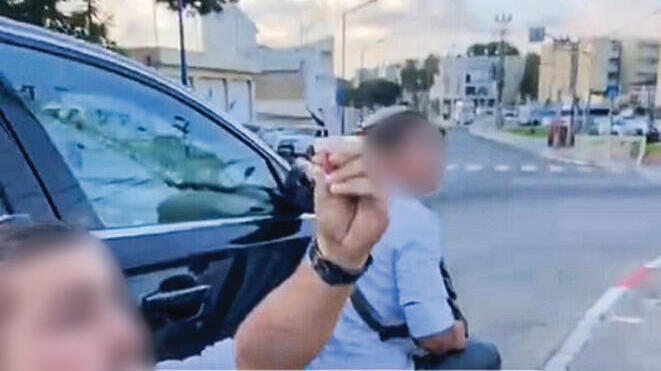
‘Nothing in training can prepare you for a moment like that.’ Lt. B. and Lt. Matan during the Oct. 7 battle
“In everything we did, we already felt the meaning of it, how important we were,” B. said.
He remembers one yeshiva student approaching him in tears because his wife and baby were near the market, where terrorists had been reported.
“I ran with him to his house while carrying my weapon,” B. said. “After he went inside, I realized I was alone. I saw people still walking around outside, so I pushed them back into their homes while moving wounded people and bodies out of the way.”
B. eventually returned to the yeshiva, where he reunited with Matan and Nehorai.
“The head of the yeshiva called our company commander and asked him to let us stay there for the time being,” Nehorai said. “We couldn’t leave the city anyway, and they needed someone to protect them. We had maybe 20 guns guarding around 250 people.”
The following day, Oct. 8, the three reported back to their base and, together with the rest of their unit, moved farther south, closer to Gaza.
“Suddenly we had commanders again. We weren’t each fighting on our own,” Matan said. “I felt safer, like part of an army. We were fighting the way we had been taught.”
As they waited in staging areas ahead of the ground offensive in Gaza, B. remembers a sense of anticipation among the soldiers.
“This is what we enlisted for,” he said. “Throughout training, they talked to us about combat, and now it was becoming real. I was waiting to join the fighting, especially after what we had experienced and seen the terrorists do while we were fighting in Sderot.”
Matan said he did not feel afraid at the time.
“I was waiting for it,” he said. “But when I went in again later as a commander, with my own soldiers, that’s when I was afraid, mainly for them, because I was responsible for bringing them home healthy and safe.”
Seeing the battle from the outside
Before they entered Gaza, the three came across footage showing the first moments of their fighting in Sderot.
The short video, which circulated widely online, had been filmed by a civilian they did not know who ran toward them that morning.
“Do you see terrorists?” Matan can be heard shouting from a crouched position, with Nehorai covering him and the terrorists’ pickup truck ahead of them.
“Every time I watch that video, it brings back a lot,” Nehorai said. “Suddenly you see everything in a tangible way. I connected the puzzle from all the moments I remembered before: who was hit by a bullet at which point, which direction the police officer ran.”
“It’s interesting to look at my face and expression too, to see how I reacted in that situation, when the stress and adrenaline were extremely high,” he added. “Those are things you don’t notice while it is actually happening. Only when you look back do you understand what was going on there.”
‘There was no other option’
Nearly three years have passed since that day.
B. is nearing the end of his role as a platoon commander in Givati’s Shaked Battalion. He said the war played a decisive role in his decision to remain on the command track.
“That was the major factor,” he said. “It was obvious that we would stay as long as there was a war and contribute whatever we could.”
Throughout his command role, he said, the responsibility for his soldiers remained constantly on his mind.
“At the end of the day, your mission is to bring them home healthy and safe to their families,” he said. “It isn’t simple, but because of that responsibility, you have to succeed. There is no other option.”
Matan completed his service as deputy company commander in a squad-commanders course at the IDF’s School for Infantry Professions and Squad Commanders. He is now in the final stage of the hesder program and is expected to return soon to his yeshiva for three months of study.
“The war played a large part in my decision to become a commander, and even more so the friends who were killed and the feeling that I needed to continue their path,” he said.
“I trained the next generation of commanders. I wanted them to finish their training with the feeling that we are part of something bigger: a people, an army, 2,000 years of history. When you see things that way, the small difficulties look different.”
Nehorai has already completed his regular service and last served as a platoon commander’s radio operator.
“Since Oct. 7, we were fighting nonstop,” he said. “During our platoon’s last entry into Gaza, the force hit an explosive device. Four friends were wounded: the platoon commander, the sergeant and two other soldiers.”
Afterward, the unit spent much of its final month on base, giving the soldiers an opportunity to begin processing what they had experienced.
“Suddenly we had time to digest everything we had been through,” Nehorai said. “We understood our mission. It’s an incredible feeling to be part of something so enormous.”