


Former senior Israeli security officials are pushing back against Prime Minister Benjamin Netanyahu’s claim that he was not awakened before the October 7 Hamas attack because officials wanted to avoid a “miscalculation” with the terrorist group, arguing that the term is being distorted and that Netanyahu himself repeatedly used the same logic in security decisions before and after the war.
The dispute comes after the Prime Minister’s Office published a new timeline of Netanyahu’s movements and decisions on the morning of October 7, saying it was responding to “inaccurate reports.”
Gallery
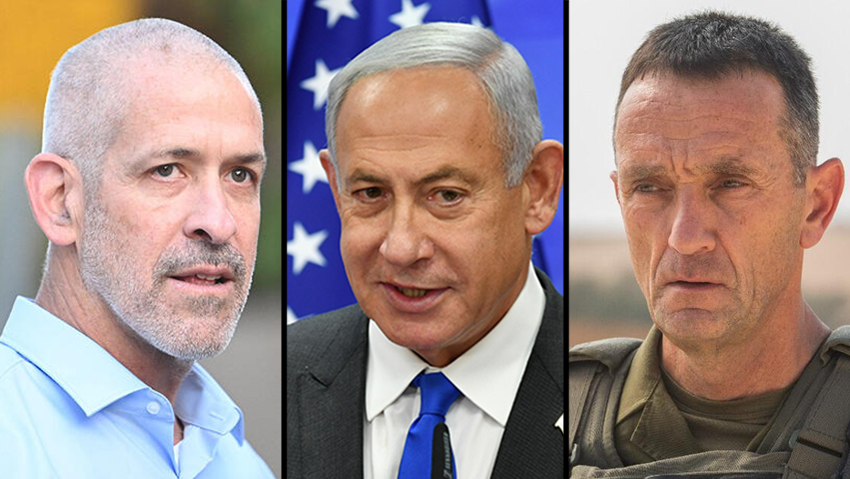
Former Shin Bet chief Ronen Bar, Prime Minister Benjamin Netanyahu, and former IDF chief of staff Herzi Halevi
(Photo: Yair Sagi, Yoav Dudkevtich, IDF)
That timeline included parts of then-defense minister Yoav Gallant’s schedule but not that of Netanyahu’s military secretary, Avi Gil, a choice that could be interpreted as reinforcing claims that the prime minister had been deliberately kept out of the loop before the attack.
Former security officials involved in the events say that characterization is wrong.
One former senior official said the entire political and security establishment had operated for years under a policy aimed at spacing out major conflicts and avoiding unnecessary escalation.
“The mindset of all the political and security systems, the policy and the national security concept at the time, was that we prosper as a nation between conflicts,” the official said. “Therefore, you try to keep the confrontations as far apart as possible.”
Under that approach, “miscalculation” meant avoiding steps that could trigger a war the other side was not believed to want.
“Gaza is awful, and if we don’t have to fight in Gaza, we don’t fight in Gaza,” the official said.
Netanyahu himself used the same logic
One of the clearest examples came on October 1, 2023, six days before the Hamas attack.
During a security assessment that day, Shin Bet chief Ronen Bar and IDF chief of staff Herzi Halevi recommended preparing possible operations in Gaza, including strikes against operatives directing terrorism in the West Bank, action against Yahya Sinwar or preparations for what Halevi described as a “broad campaign in Gaza.”
Netanyahu’s summary focused instead on normalization with Saudi Arabia.
On Gaza, he said Israel should carry out “retaliatory and punitive actions, but manage things delicately in order to preserve stability.”
That reflected a broader Israeli policy under Netanyahu of avoiding repeated rounds of fighting with Hamas unless necessary. According to former officials, Bar and Halevi operated under that same assumption.
Warning signs, but the wrong conclusion
Small indications of unusual activity in Gaza began appearing on the Friday before October 7.
By around 1 a.m. on Saturday, the signs were growing stronger. Israeli intelligence detected the activation of SIM cards in certain areas and signs of preparations in Hamas’s fire array.
There was also intelligence indicating that Palestinian Islamic Jihad had contacted Hamas to ask what was happening and had been told it was an exercise.
Security assessments began overnight.
Bar and Halevi conducted separate consultations, but the prevailing conclusion across the system remained that Hamas was either carrying out an exercise or some other form of preparation, not launching an imminent mass attack.
Both Bar and Halevi warned against highly visible Israeli measures such as moving tanks forward or reinforcing forces in a way that could be interpreted by Hamas as preparations for war.
“If we carry out a series of steps, bring forces down, move tanks to the front, Hamas, which does not want war, will think we are about to start one,” they told their teams, according to the account.
That was the essence of the “miscalculation” concept: the assessment was that Hamas did not intend to start a war, but that overt Israeli preparations could cause it to believe Israel was about to attack and trigger escalation.
Former officials acknowledge that the intelligence assessment itself was catastrophically wrong.
“Did we fail to understand the situation and read the picture correctly? The answer is unequivocally yes,” one former senior Israeli official said. “There is no dispute about that.”
But, he argued, given the assessment at the time that an attack was not imminent, officials avoided steps that Netanyahu himself would likely also have avoided because of the risk of escalation.
“If they had thought Hamas intended to launch an attack, with or without the prime minister, they would have taken a series of steps to stop it,” he said.
A small covert team was sent south
One action Bar did take overnight was to send a small Shin Bet counterterrorism unit, known as a Tequila team, to the Gaza border area as a precaution.
A former official familiar with the details said Bar concluded that there were “more noises than signals,” meaning there were suspicious indications but not enough to overturn the prevailing assessment.
The assumption remained that nothing major was happening, and large, visible military movements were avoided to prevent escalation.
Still, Bar decided to send the small covert team south in case the intelligence picture was wrong and Hamas was preparing a limited raid.
Netanyahu’s intelligence aide was alerted
The central dispute concerns whether senior officials deliberately chose not to wake Netanyahu.
According to former officials, the facts point elsewhere.
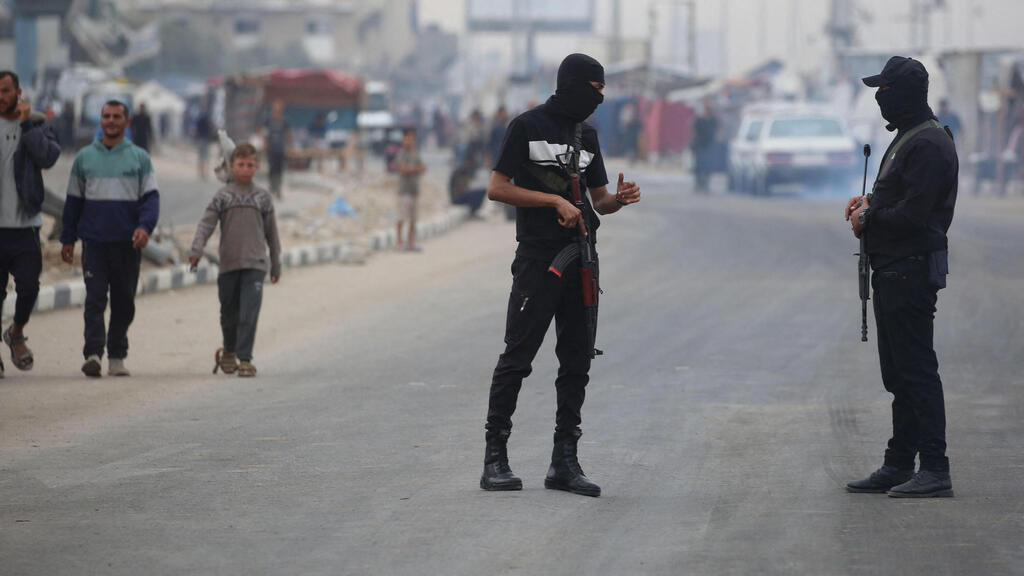
No unusual activity detected. Hamas terrorists in Gaza
(Photo: Eyad BABA / AFP)
At around 4 a.m., roughly two and a half hours before the attack began, the IDF Intelligence Directorate’s operations room contacted Netanyahu’s intelligence aide.
Throughout the night, intelligence updates had been circulating in a classified group used by senior intelligence officials. Under procedure, if a significant development emerged, Netanyahu’s intelligence aide was to be contacted directly.
That is what happened.
The aide was told that SIM cards had been activated in certain areas of Gaza over the previous day and overnight, but that similar tests had also been conducted by Hamas the previous year.
The message said that the Gaza Division and Southern Command assessed that Hamas had not changed from its routine posture.
It added that the information was preliminary and that further discussions were scheduled for 8:30 a.m. by Southern Command intelligence and 10 a.m. by the head of Southern Command.
Netanyahu’s intelligence aide read the message and decided not to wake the prime minister.
Under the established procedure, the prime minister is awakened when an immediate decision is required. According to the officials, that threshold had not been met based on the intelligence available at the time.
One former official defended the decision.
“That was the authentic intelligence at the time,” he said. “It wasn’t that they told some nonsense story to the aide so he wouldn’t wake Netanyahu.”
“The intelligence the IDF and Shin Bet had was passed to the Prime Minister’s Office, to the military secretariat and to the intelligence aide. The aide has discretion. He read a message that reflected the prevailing assessment, that there were explanations for the phenomena they were seeing, and decided not to wake him.”
“The central point contradicting the claim that they tried to hide something is that the aide’s decision was completely reasonable,” he said.
Military secretary was also updated
Another senior official who was brought into the picture was Netanyahu’s military secretary, Avi Gil.
At around 5:30 a.m., after Bar completed a situation assessment, ordered the Tequila team sent south and asked for Gil to be updated, the call was ultimately made at 6:15 a.m., shortly before the Hamas attack began.
Former officials also rejected the claim that Netanyahu was deliberately kept in the dark.
“Even if they had awakened Avi Gil at 5:30, there would not have been enough time to hold a full situation assessment before 6 or 6:15,” one said.
“And suppose they had woken the prime minister. Given the intelligence picture at the time, would Netanyahu have ordered them to open fire? Allow me to laugh.”
Gil woke Netanyahu at 6:29 a.m. and again at 6:40, after the attack had begun.
According to reporting by Kan News and the timeline later released by the Prime Minister’s Office, Netanyahu did not ask at that stage to speak directly with the IDF chief of staff.
The first such conversation came only after Netanyahu arrived at the Kirya military headquarters and held a formal situation assessment at 9:55 a.m., more than three hours after the attack began.
That was also the first time Netanyahu entered the underground command center that morning.
Border closure order came at 9:55
In June, Haaretz reported that contrary to Netanyahu’s claim that the “first thing” he ordered on the morning of the attack was to prevent kidnappings, sources said no such order was given at that early stage.
The official timeline released by Netanyahu’s office now says the order to hermetically seal the Gaza border was given only during the 9:55 a.m. situation assessment.
At that meeting, Netanyahu also rejected an IDF recommendation for a partial reserve call-up and ordered a full mobilization, while instructing the military to issue war orders and prepare for the possibility of a northern front.
‘He is distorting the term’
One former senior security official said Netanyahu is now using “miscalculation” in a way that implies officials were trying to trick or sideline him.
“Netanyahu is distorting the word ‘miscalculation’ as if someone was trying to set him up,” the official said.
“The intelligence officer knew what everyone else knew and made a legitimate decision not to wake Netanyahu.”
“The system informed the Prime Minister’s Office of what it knew. The assessment was that there were more noises than signals and therefore probably nothing was happening.”
The official said the security establishment did deliberately avoid certain visible military actions to prevent an escalation it did not believe Hamas wanted.
But he argued that even if Netanyahu had held a situation assessment at midnight, little would likely have changed.
“Netanyahu would have heard from all the heads of the security establishment that they assessed with high probability that Hamas was not heading toward war,” he said.
“If we concentrated forces, moved troops and brought tanks down, Hamas could conclude that we intended to attack. So it is reasonable that Netanyahu’s instruction would also have been to reduce exposure of forces so Hamas would not open fire.”
Former officials said the same logic had been used repeatedly in Israeli decision-making, including by Netanyahu himself.
One cited Operation Shield and Arrow, when Israel fought Palestinian Islamic Jihad in Gaza while deliberately avoiding steps that could draw Hamas into the conflict.
Israel refrained from massing tanks and sent messages through Egypt that Hamas was not being targeted.
“That is exactly the miscalculation everyone was talking about, including Netanyahu,” the former official said.
“Netanyahu used the term ‘miscalculation’ throughout his tenure as prime minister, and at times he himself decided not to take certain actions in order to avoid miscalculation with Israel’s enemies.”
PMO timeline
According to the timeline released by the Prime Minister’s Office:
6:29 a.m. — Netanyahu’s military secretary first informs him that an attack is underway from Gaza.
6:44 a.m. — In a second update, Netanyahu asks why nothing had appeared in the intelligence provided to him, and asks whether a broad reserve call-up is required and whether Hamas’s leadership can be targeted.
7:30 a.m. — Netanyahu leaves for the Kirya after his convoy is prepared.
During the drive, he speaks with the defense minister, who says there is no clear operational picture. Netanyahu instructs that a situation assessment be convened in the underground command center.
Around 8 a.m. — Netanyahu arrives at the Kirya, according to his office. Shin Bet records put the time at 8:22.
8:30-9:30 a.m. — Netanyahu requests and receives intelligence and battlefield updates from his military secretariat.
8:40 a.m. — The defense minister convenes the IDF chief of staff and Shin Bet director to prepare a picture of the situation ahead of the meeting with Netanyahu.
9:47 a.m. — Netanyahu’s military secretary receives for the first time the document summarizing the Shin Bet situation assessment held at 5:15 a.m.
9:55 a.m. — Netanyahu convenes a situation assessment with the defense minister, IDF chief of staff, Mossad director, Shin Bet chief, National Security Council head and IDF Operations Directorate chief.
At that meeting, Netanyahu orders a complete sealing of the Gaza border to prevent hostages from being taken into Gaza and additional terrorists from entering Israel, rejects the IDF’s recommendation for a partial reserve mobilization and orders a full call-up, while directing the military to issue war orders and prepare for a northern front.