

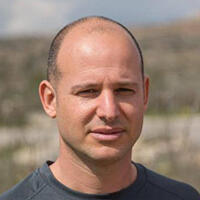
In each of the major incidents since the start of the fighting against Hezbollah in southern Lebanon, including the one in which Staff Sgt. Ori Greenberg of the Golani Brigade’s reconnaissance unit was killed, and the clash in which four soldiers from the Nahal Brigade’s reconnaissance unit were killed, Capt. Noam Madmoni, Staff Sgt. Ben Cohen, Staff Sgt. Maxsim Entis and Staff Sgt. Gilad Harel — the first to reach the scene, rescue the wounded and evacuate them for medical treatment were the air crews of the Israeli Air Force’s 123rd “Desert Birds” helicopter squadron, together with troops from Unit 669, the Air Force’s tactical special rescue unit.
More than 40 IDF soldiers have been wounded in various incidents during the fighting in Lebanon, both in clashes and by rocket fire and anti-tank missiles brought down on them. Evacuating them under fire and getting them to the hospital in the shortest possible time is one of the most complex missions facing the IDF during the ground maneuver on the northern front.
Gallery
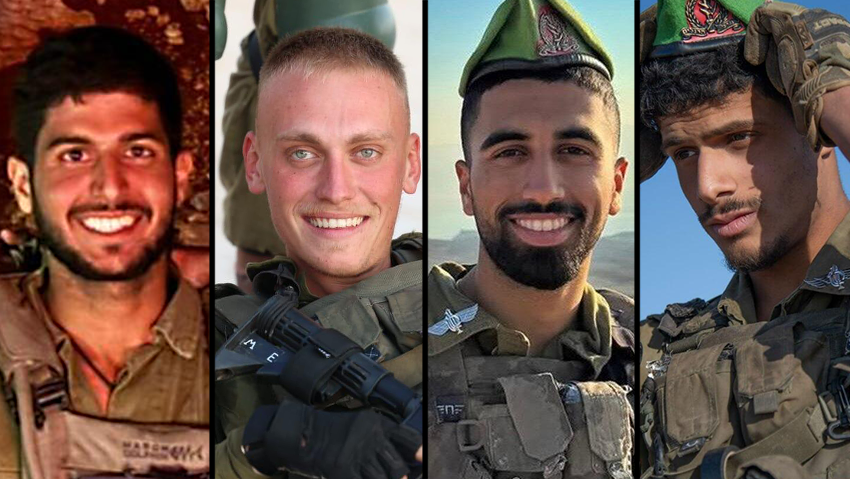
Capt. Noam Madmoni, Staff Sgt. Maxsim Entis, Staff Sgt. Ben Cohen and Staff Sgt. Gilad Harel
(Photo: IDF)
“To make the evacuation process as fast as possible, we are stationed at a site in the north, 10 to 15 minutes from takeoff,” said Maj. A., the squadron’s deputy commander. “We have pilots, navigators, Unit 669 troops and mechanics, and we reach the forces in staging areas or inside Lebanon. It happens incredibly fast. Our goal is to reach the wounded in the shortest possible time and make sure that within an hour of the injury, he is already receiving treatment at a hospital. That is what the medical world calls the ‘golden hour.’”
Rescue efforts in southern Lebanon are highly dangerous and extremely complex. “Southern Lebanon is saturated with rocket fire, and Hezbollah terrorists have already shown us in the past that they can hit aircraft,” he explained.
“Because of the valleys in southern Lebanon, we fly low, which allows us to enter the valleys and then emerge from them without being spotted before reaching the maneuvering forces. We are careful, for example, about power lines, which are the kind of hazards found at low altitude. In this arena, it is a different method of flying.”
Direct contact with the force on the ground
According to Maj. A., direct communication and coordination between the forces in the air and those on the ground are the most important elements in any rescue operation. “During evacuations, you can see the synchronization between the ground forces and the forces in the air. We also provide cover ahead of the evacuation, essentially giving them the full umbrella of the Israeli Air Force," he said.
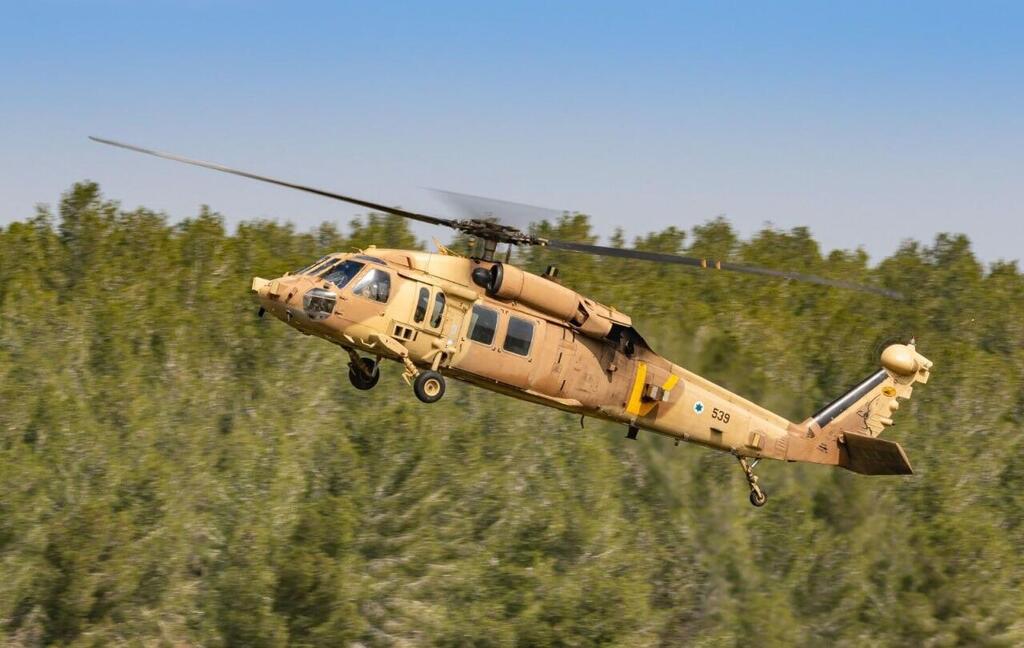
Israeli Air Force 123rd helicopter squadron aircraft
(Photo: IDF)
"We make sure the helicopters’ approach is synchronized with the troops on the ground. As a pilot, I have to understand exactly where the wounded soldier is and what he needs, so that exactly that is waiting for him at the hospital.”
“In all the incidents so far, there has not been a single case in which a wounded soldier was left waiting for the helicopter, and these are events with a tremendous amount of chaos and noise. I establish direct contact with the force on the ground that came under fire — that is the most important thing for me as a pilot in order to understand the full picture.
"At first, I receive details from the Israeli Air Force control cell, which gets them from the brigade the force belongs to, but in the end there is no substitute for direct contact. There are major communications challenges: sometimes reception problems, sometimes disruptions to navigation systems and other things that happen, but the goal is to understand as quickly as possible what is happening.”
The initial contact between the pilot and the infantry force that came under fire and has wounded soldiers is handled by the Israeli Air Force control cell, which is in contact with the infantry forces. Lt. Col. A., an Air Force control officer, recalled: “We do this very quickly, and we have achievements that are unprecedented compared with other militaries around the world. My personal record was in the Gaza sector a few years ago. From the moment a sniper hit a soldier in Gaza, 27 minutes passed before he was in the operating room. That is a life-saving event.”
According to him, “the system works very quickly — from the medic in the field to the hospital. We have experience with more than 2,400 IDF soldiers evacuated since Oct. 7, and in the course of that work, we have refined and streamlined the system. Sometimes the wounded person has to be stabilized in the field, or it has to be ensured that the helicopter can take off without any threat in the area, but I can say with full confidence that there is no army in the world that carries out evacuations this quickly.”
'Sometimes we can see the enemy with our own eyes'
According to Lt. Col. A., during a real-time incident, silence prevails in the Air Force control cell, and everyone there knows their role. “Each person is on his own headset, and only what is necessary is said. It is highly professional work. Each person is speaking either with the ground forces command or with the squadron, and at that moment I have to make sure the orchestra is playing properly. There is a huge amount of information, and my goal is to define the mission correctly, with maximum precision, and pass it on to the pilot in the cockpit.”
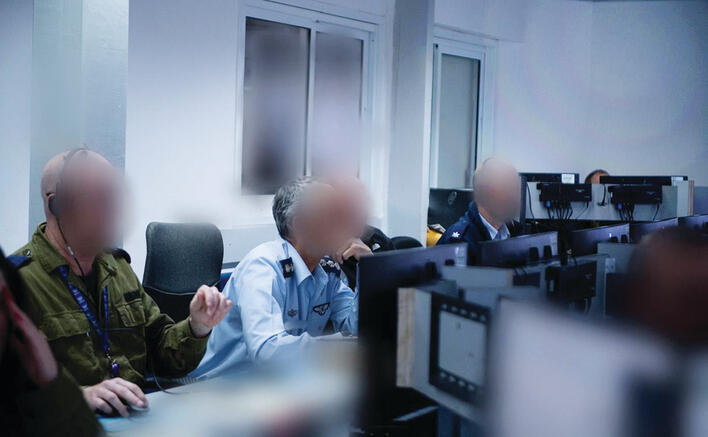
Israeli Air Force control cell
(Photo: IDF)
It is an especially complex mission, since pilots often land in the heart of the fighting itself. “In some of the rescue operations, we as pilots can literally see the enemy with our own eyes,” said Maj. A., the squadron’s deputy commander. “In many evacuations, we have to land exactly where the force is, because the force is sometimes in a situation where it cannot move the wounded back. So when you head out on a rescue mission, you may find yourself at a rear landing zone, but sometimes right in the middle of the battle.”
A few days ago, Hezbollah operatives successfully shot down an IDF drone with a surface-to-air missile. “Hezbollah,” Air Force officials explained, “very much wants to shoot down an Israeli helicopter, certainly when it is engaged in rescuing wounded soldiers, and that is why it carries out aggressive fire at helicopters in flight. But we will not give Hezbollah that image, even though the pilots are intensely driven and want to reach the wounded as quickly as possible. Sometimes you really have to tell them, ‘Wait, we need to make sure everything is clear and in order first.’”