


While the IDF remains fully focused on the war with Iran, humanitarian aid operations in Gaza continue to move forward. The military remains engaged in Operation Gideon’s Chariots, which carries a heavy toll, but due to a reduction in available forces, its activity in Gaza has shifted. Alongside combat operations, distribution of aid packages by the Gaza Humanitarian Foundation (GHF) continues at several points throughout the strip.
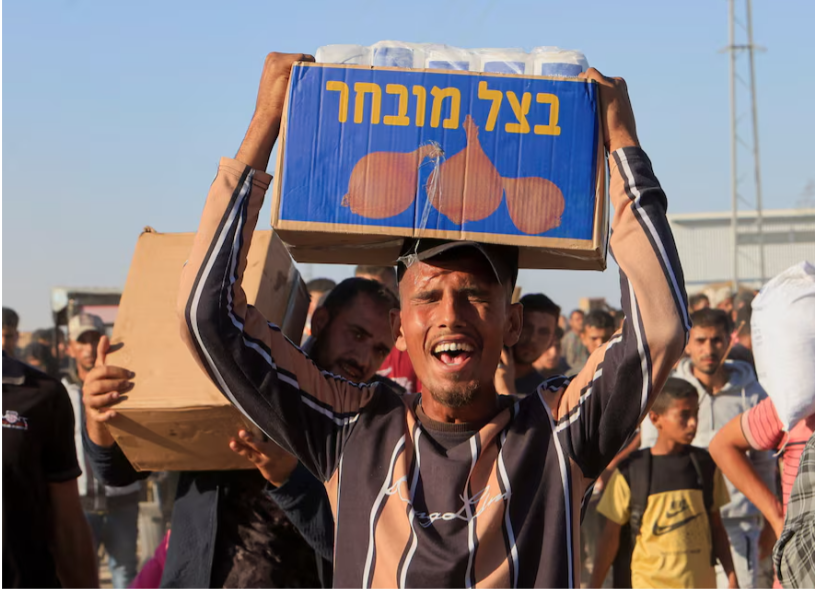
Gaza resident with some of the aid
(Photo: REUTERS/Hatem Khaled Purchase Licensing Rights)
On Tuesday morning, a crowd of Gazans gathered near an aid truck that had broken down in the Khan Younis area, close to IDF troops operating in the sector. As the crowd approached the truck and the troops, gunfire was opened toward the Gazans. Local reports indicate several casualties. An IDF spokesperson stated: “The details are under review. The IDF regrets any harm to non-combatants and acts to minimize such incidents as much as possible while ensuring the safety of IDF troops.”
For the first time since the American organization began operations, all four distribution points were open to Gaza residents on Monday. According to security sources, since the beginning of the aid distribution, 442,080 packages have been handed out, with each package designed to support five people for one week.
Security officials explain that the aid distribution continues to erode Hamas’ control and governance. Gazans are coming to the distribution points and simply taking care of themselves. The war with Iran has impacted Gaza mainly in terms of deterrence but has also fueled public frustration. Many residents feel that with the world’s attention focused on the war with Iran, the negotiations and efforts to end the conflict in Gaza — which they desire — have been sidelined.
Aid distributed in southern Gaza


Hamas, for its part, is trying to assert authority over the distribution points but has so far failed to do so. “In fact,” a security source explains, “this is the most serious governance crisis Hamas has faced since the war began, and the intention is to keep up this pressure.”
The humanitarian operation may expand further, with an additional four distribution points expected to open, which would also establish a daily routine for Gazans. However, there are still gaps that the American foundation and the security establishment are working to address. Currently, there is no reliable system for tracking who receives aid packages. As a result, people are sometimes coming to the distribution points repeatedly, day after day.
The American organization is working to improve the situation, aiming for each distribution center to serve a designated list of individuals who can collect aid packages once a week. Due to the lack of monitoring, reports have surfaced of a black market where individuals collect multiple aid packages and resell them to other Gazans at inflated prices.
At this stage, the security establishment sees no signs that Hamas is taking control of the humanitarian aid. A few days ago, a video circulated on social media showing a Gazan — allegedly a former Hamas member — arriving at one of the distribution points. “This further undermines Hamas’ authority, embarrassing and humiliating it,” a security source explained.
Aid distribution in Tel-Sultan, Gaza
(Video: IDF Spokesperson's Unit)
The collapse of Hamas’ authority and the breaking of the population’s fear barrier has created pockets of anarchy in certain areas. Trucks delivering medical supplies and cooking equipment to northern Gaza, in coordination with Israeli government approvals, are sometimes looted before reaching their destinations — as happened again in the Khan Younis incident. Still, there are no indications that Hamas was behind these events.
Following adjustments made to the distribution points, several key questions remain. Will the aid operation — which is severely damaging Hamas — be suspended as part of negotiations for hostage releases? Will Hamas demand an end to the aid in response to the pressure and humiliation it faces? And if so, how will Israel respond, and could an agreement be reached to relocate distribution points to the Gaza border?
Get the Ynetnews app on your smartphone: Google Play: https://bit.ly/4eJ37pE | Apple App Store: https://bit.ly/3ZL7iNv
To deal with the pockets of anarchy, security officials are considering a proposal for the IDF to isolate certain areas from Hamas, allowing aid trucks to enter those zones and enabling civilians to manage the process on a district-based system. For now, this idea remains distant and is naturally tied to the outcome of ongoing hostage negotiations.
The defense establishment currently views the American humanitarian aid operation as one of the most significant developments in the war. The goal is to continue this plan in order to sever Hamas’ hold over the Gaza population as much as possible and eventually allow the emergence of a new, demilitarized leadership.