


Residents of northern Israel reacted with shock Thursday evening to news of a temporary ceasefire announced in Lebanon. The announcement came from U.S. President Donald Trump, with no immediate official statement from the Israeli government.
Only two hours later, Prime Minister Benjamin Netanyahu released a video saying, “I accepted the request and agreed to a timeout, or more precisely a temporary ceasefire of 10 days, to try to advance the agreement we began discussing at the ambassadors’ meeting in Washington.”

Moshe Davidovich, head of the Mateh Asher Regional Council and chair of the Confrontation Line Forum, said agreements may be “signed with a tie in Washington,” but the price is paid “in blood, in destroyed homes and in dismantled communities” in northern Israel. A ceasefire that does not include “lethal enforcement against Hezbollah for any violation” and a terror-free security zone up to the Litani River “is not a diplomatic achievement, it is a sentence of waiting for the next massacre,” he said. “Residents of the north are not extras in an international public relations show.”
He added that until Hezbollah is dismantled and communities are truly protected, “any victory celebration is nothing more than misleading the public.”
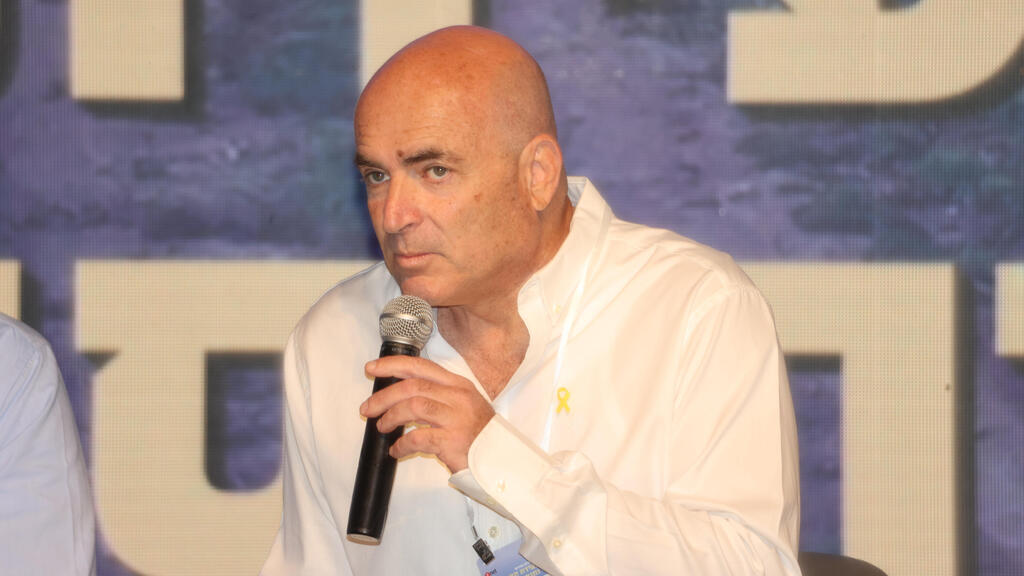
Moshe Davidovich
(Photo: Yariv Katz)
Netzah Topaz, a Kiryat Shmona city council member, wrote to residents: “Welcome to the security reality of the 1990s. Get used to operations, wars and shelters.” He accused the government of betraying residents.
Metula council head David Azulai of the Yisrael Beitenu party said northern residents “feel betrayed once again,” adding that the fact the U.S. president announced the ceasefire “only underscores how disconnected” Israel’s prime minister is from residents’ reality. “Your basic duty as prime minister is to provide security. In practice, you fail time and again,” he said.
Amit Sofer, head of the Merom HaGalil Regional Council, said linking the Lebanese arena to Iran would condemn northern residents to years of ongoing threat. He called for allowing the Israel Defense Forces, or IDF, to achieve the political leadership’s stated goal of disarming Hezbollah, though he expressed hope current leadership efforts would succeed.
Shimon Guetta, head of the Ma’ale Yosef Council, said his community has long paid the price of instability and rejected any ceasefire that does not include Hezbollah’s full disarmament and guaranteed security. “Without clear conditions and firm enforcement, agreements on paper have no meaning,” he said.
Ofik Shik, deputy head of the Lower Galilee Council and chair of Lev BaGalil, said: “A ceasefire may sound good in Washington, but in the Galilee we know better. Temporary quiet is not a solution.”
Residents also voiced anger and frustration. Lia Cherniev of Kiryat Shmona said the move felt like déjà vu. “Once again, they are stopping the fighting at its peak, just like in 2024,” she said, noting that despite claims Hezbollah had been weakened, rocket and drone fire resumed in 2026. “It feels like we are returning to the same scenario.”
Moshe Kakon, also of Kiryat Shmona, called the move “a cynical capitulation to Iranian demands,” wrapped in negotiations with a “broken state” unable to deliver. Shalev Suissa said residents felt “sold out,” arguing the ceasefire would not hold.
Zeev Krauthammer of Nahariya described the agreement in one word: “defeat,” saying it abandons the north and that Hezbollah has dictated the pace of fire throughout the conflict.
The “Lobby 1701” group of northern residents said the government is “losing the north and its sovereignty,” accusing it of hiding behind Trump’s announcement and abandoning the region’s security future. “We are residents of Israel, not the United States,” the group said.
First published: 22:19, 04.16.26