

Ten days have passed since the beginning of nationwide protests and strikes against the Islamic Republic in Iran. Despite the government's struggles and the bloody suppression of the people, the intensity of these protests—which many in Iran are calling a Revolution—has not diminished. Signs of collapse are already visible within the regime, while the government has finally been forced to cut off mobile internet in almost the entire capital and most major cities.
By Wednesday, more than 220 cities and towns across Iran had joined the widespread protests and strikes. These protests erupted spontaneously following the strike of shopkeepers and merchants on December 28, triggered by the sharp fall of the national currency resulting from the government's monetary policies and economic collapse, and immediately spread across the country. It is reported that nearly 30 people, most of whom were young, have been killed by live ammunition or by hundreds of shotgun pellets fired at their faces, and hundreds have been injured. Human rights activists also say at least a thousand protesters have been arrested.
However, many people in Iran are saying one thing: This time is different!
Since the beginning of the Persian year, the scope of widespread protests and strikes, accompanied by the sudden drop in the value of the national currency, has expanded day by day. I predicted in an article written a few weeks ago that the economic collapse would lead to widespread nationwide protests that would put the government at risk of collapse.
With the Israeli attack on Iran and the 12-day war, the Islamic Republic hoped to prevent the intensification of strikes and demonstrations by provoking nationalist sentiments and highlighting the danger of foreign attack. However, even in the midst of the war, people continued their opposition to the regime and held Khamenei responsible for a war that led to the deaths of hundreds of civilians.
In fact, the regime's intelligence and security agencies had warned months ago about the surge of protests in the final months of the Persian year, and the government had conducted manoeuvres to counter them. This included several large-scale manoeuvres by the IRGC and Basij forces to deal with street riots.

Saghar Etemadi, 22, is one of the hundreds of protesters whose face was struck by shotgun pellets and is reportedly still in a coma. She was targeted by security forces' shotgun pellets on January 4th in Farsan, western Iran, and conflicting reports have been published regarding her condition.
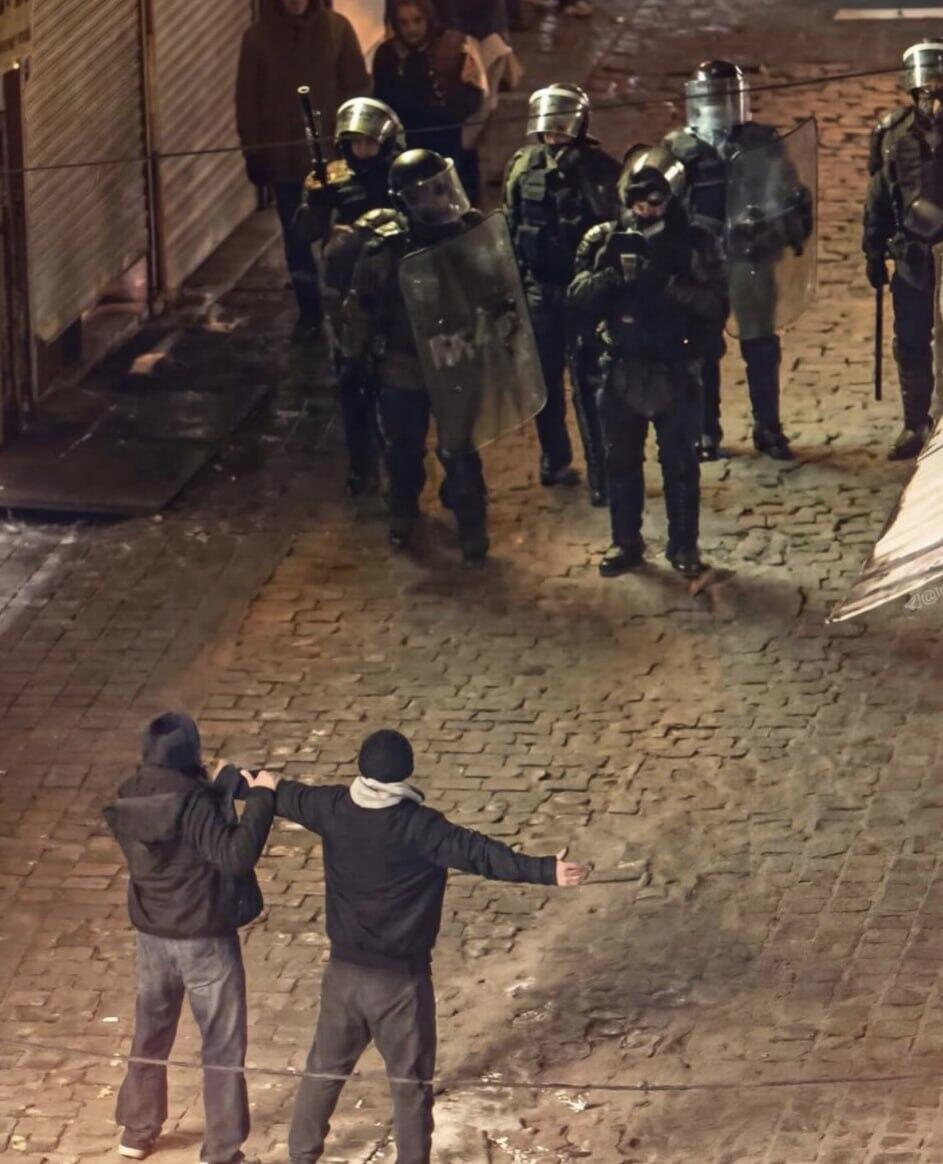
Nevertheless, after 10 days, the security and military forces are rapidly becoming exhausted because, despite severe suppression, demonstrations and clashes have continued every day and night in various parts of the capital and different cities.
The flame of these demonstrations was ignited by a 66% increase in gasoline prices to 5,000 Tomans, which led to a sharp increase in inflation and the price of basic goods and services. Rumours about the possibility of another gasoline price hike were met with public anger. A sharp increase in gasoline prices had previously caused another major protest in November 2019, which led to the killing of hundreds of people by the IRGC and police in various Iranian cities.
The gasoline price hike in early December caused the fall of the national currency against the US dollar to accelerate, and within a few days, the US dollar soared in Iran's economy.
The exchange rate of the US dollar against the Iranian Rial broke the daily price increase record on January 5, reaching 4.2%. This happened while, following criticisms of the Central Bank's policies which created currency rents for the government's economic oligarchy led by the IRGC, the Central Bank governor was replaced. Abdolnaser Hemmati, a close associate of Pezeshkian, took the helm of the Central Bank with promises of currency reforms and fighting multiple exchange rates. However, Iran's state-controlled economy is heavily dependent on currency rents, and unifying the exchange rate practically cannot help in controlling inflation.
This graph shows how Iran's national currency has fallen sharply against the US dollar over the past few months, but on Wednesday, the price of each dollar in Iran exceeded 150,000 Tomans.
Protesters and Iranian security forces clash in Tehran


According to the dollar price increase chart from the Tgju.org site over the past year, the dollar's exchange rate has experienced a surge of 12.8% in the last month.
With the fall of the national currency in early January, the prices of basic goods for the majority of Iranian society, defined as living below the poverty line, began to rise, and sometimes the prices of items such as eggs, bread, milk, meat, and canned goods increase three times during a single day.
While the government announces the official inflation rate with a delay, the annual inflation rate for the month of Azar (early December) was officially announced at 42.2%, a significant increase compared to the previous month. This was despite the fact that during the war with Israel and the two months following it, when the country was in an unstable state and there was a possibility of another war, the official inflation rate had not exceeded 41%.
However, many economists say the actual inflation rate in Azar was around 60%. Hossein Abdoh Tabrizi, an economist and former director of the Tehran Stock Exchange, says that with the continuation of such a situation and the budget deficit in the coming Persian year, inflation will reach 3,000%.
A few weeks ago, the ILNA news agency reported on the people becoming poorer and their tables becoming emptier with increasing inflation, writing: the number of people in the absolute poverty group living on less than two dollars a day has increased. It is estimated that about 30% of the people live in absolute poverty (about $2 a day), and more than 40% of others live in relative poverty with about $7 a day, meaning their monthly expenses have become unbalanced compared to their income due to rising prices.

Minoo, a 30-year-old teacher in Tehran, says she can no longer afford to live on a $100 monthly salary; her image has been blurred and altered to prevent identification.
Minoo, a 30-year-old teacher in Tehran, told me on Wednesday: "In the morning, I went to the shop near my house to buy milk and a tin of tuna and paid about $2; in the evening, the price of the same items was $3." She earns only $100 a month and has been forced to return to her mother's house and live in a small room to escape the sharply rising rent. Her daily food consists of canned goods, bread, dairy, and low-cost meals like spaghetti and soup. Minoo says she and her mother last ate meat a month ago, and chicken and fish are also being removed from their diet.
Pezeshkian's government, which on one hand tries to save itself from collapse through the severe suppression of protesters, has announced that it will allocate a one-million-toman commodity coupon (equivalent to $7) per person to compensate for the decrease in purchasing power. With this $7, one can now buy half a kilo of poor-quality minced meat, three ordinary loaves of bread, a bottle of milk, and a six-pack of eggs. If this coupon is used in state stores three days from now, the customer's shopping basket will be even lighter than today.
On the other hand, images published on social media show that the government is also giving cash rewards to its military and security forces to make them endure the daily protests, distributing 500,000 and 1,000,000-toman credit cards among them. One of the protesters told me on Tuesday night that when they attacked and disarmed a Basij member who was shooting at them with a pellet gun in Tehranpars, East Tehran, he gave them two 1,000,000-toman gift credit cards out of fear of being beaten. The protester says he does not take his mobile phone with him during protests, worrying about being tracked or arrested; otherwise, he would have recorded this scene. However, other images show that the government has been forced to pay larger sums to tens of thousands of Basij forces across the country who are on standby to encourage them to suppress their own neighbours in various districts of Tehran and other major cities.
Although it seems that despite the dispersion of protests across the country, demonstrations of hundreds of thousands have not yet formed in the cities, in some western cities, including in Ilam province and in some areas of Tehran like East Tehran, people practically take control of the city during nightly demonstrations and security forces cannot confront them due to the massive crowds. But many say this time is different.
Beyond the economic collapse that has even aligned the rank and file of the security forces with the dissidents, the inefficiency of Pezeshkian’s reformist government—which is Khamenei's last hope for survival—following the return of international sanctions and the possibility of renewed conflict with Israel that will lead to the destruction of the economy, intense political and social dissatisfaction even among those close to the government who share in economic rents, and on the other hand, the Trump administration's attention to these protests and the promise of support, have led many to believe: this time the protests are different and can bring larger masses of people to the streets and overthrow Khamenei.

Sharareh, an art student in Tehran, says these protests are different from previous ones and 'this time we will defeat the Islamic Republic'. her image has been blurred and altered to prevent identification.
Even some close to the government have begun expressing disgust toward him on social media, publicly declaring: "Khamenei is not my leader." Although the IRGC is trying to prepare itself for the conditions of overthrow by creating division among opponents, the course of events in Iran these days is moving with such speed that it may fall behind in controlling it.
Sharareh, an art student in Tehran who was returning from a demonstration while the government tries to limit communication with the outside world and each other by reducing internet speed or cutting it off, wrote in a message to me: "It might be interesting for you that even regime supporters have no motivation to continue supporting the Islamic Republic in these last few days." She also believes: "The Islamic Republic will be overthrown because this time is different."