


The race to become the next UN secretary-general is heating up, with a frontrunner emerging after another round of voting in the Security Council: Rebeca Grynspan, Costa Rica's candidate, who is Jewish and the daughter of Holocaust survivors. In a secret ballot held Friday in New York, Grynspan secured the support of 11 of the council's 15 members, while four opposed her candidacy. It was her strongest showing yet in the seven rounds of voting held to select a successor to incumbent Secretary-General Antonio Guterres.
Grynspan, a former vice president of Costa Rica who has held several senior positions at the United Nations, comes from a Jewish family originally from Poland. Her parents fled Europe to escape Nazi persecution and settled in Costa Rica after World War II. If elected, she would become the first woman in the organization's history to serve as secretary-general.
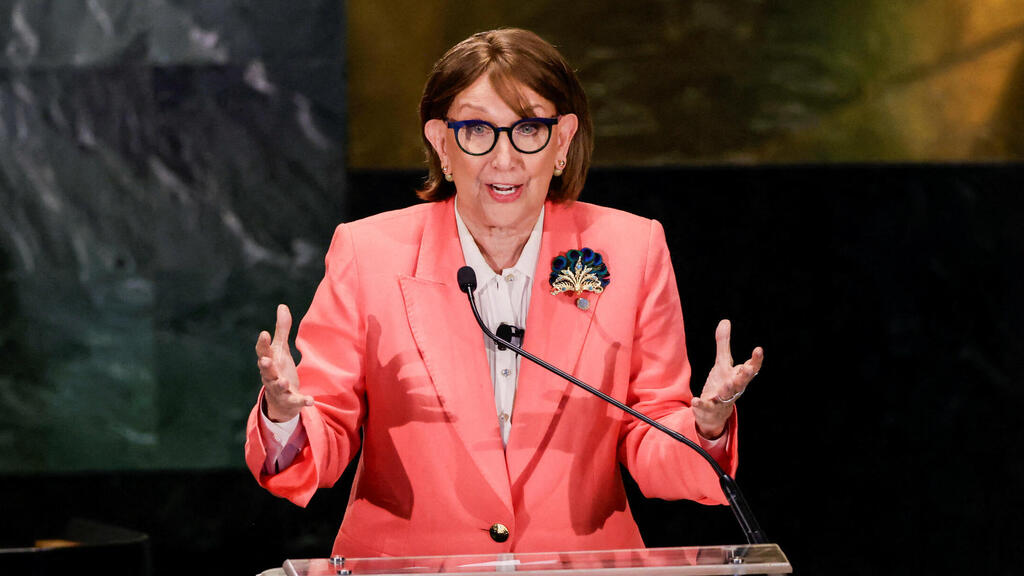
The latest results reflect growing support for Grynspan, who received nine votes in favor and five against in the previous round. She now leads the other candidates, including Rafael Grossi of Argentina, head of the International Atomic Energy Agency, who secured nine votes in favor, and Guyana's ambassador to the United Nations, Carolyn Rodrigues Birkett, who received eight. By contrast, the United Arab Emirates' candidate, Lana Nusseibeh, who entered the race only recently, recorded a disappointing result, securing just seven votes in favor, six against and two abstentions. It was the first time her candidacy had been put to a vote in the Security Council.
Despite Grynspan's growing lead, the race remains far from decided. For the Security Council to recommend a new secretary-general, a candidate must secure the support of at least nine of its 15 members without opposition from any of the five permanent members: the United States, Russia, China, France and Britain, all of which hold veto power. The four votes cast against Grynspan in the latest round could therefore pose a significant obstacle, as it remains unclear whether any came from a veto-wielding power.
In the previous round, when color-coded ballots were used to distinguish between permanent and nonpermanent Security Council members, two permanent members were found to have opposed her candidacy. No such distinction was made in the latest vote, leaving it unclear whether Grynspan has managed to overcome opposition from the major powers.

Viktor Orbán; has not formally entered the race despite reports
(Photo: Petr David Josek/AP)
Former Hungarian Prime Minister Viktor Orban has also been mentioned in recent days as a possible candidate, amid reports of potential support from figures within the U.S. administration. However, Orban has not formally entered the race, and his name was therefore not included in the vote.
Another development in the race has come from Turkey, which has put forward its own candidate. Ynet has learned that Ankara nominated veteran diplomat Feridun Sinirlioğlu, a former Turkish foreign minister who currently serves as secretary-general of the Organization for Security and Co-operation in Europe (OSCE). According to a report by Turkey's Anadolu news agency, President Recep Tayyip Erdogan formally submitted his candidacy Friday.
Sinirlioğlu, 70, is regarded as one of Turkey's most experienced diplomats. He served as Turkey's ambassador to Israel from 2002 to 2007 and later as his country's ambassador to the United Nations. His diplomatic career has given him extensive knowledge of Israel and connections with Israeli officials.
Nevertheless, his candidacy is expected to face significant obstacles. According to assessments, Israel is likely to oppose his appointment because of his close ties to Erdogan and the severe tensions between Jerusalem and Ankara. On the international stage, he will also need to secure broad support from Security Council members, particularly the five permanent powers.
The next UN secretary-general is scheduled to take office Jan. 1, 2027, following the conclusion of Guterres' second term. The selection process will first require the Security Council to agree on a candidate, whose nomination will then be submitted to the UN General Assembly for approval.