

Ra'am party leader Mansour Abbas said Tuesday that joining a new government could bring meaningful change to the country's Arab minority, after exit polls projected his Islamist party would win seven seats in parliament amid a significant increase in Arab voter turnout.
"If we join a government of change, we will be able to see substantial changes, not just empty talk," Abbas told ynet after the first exit polls were released.
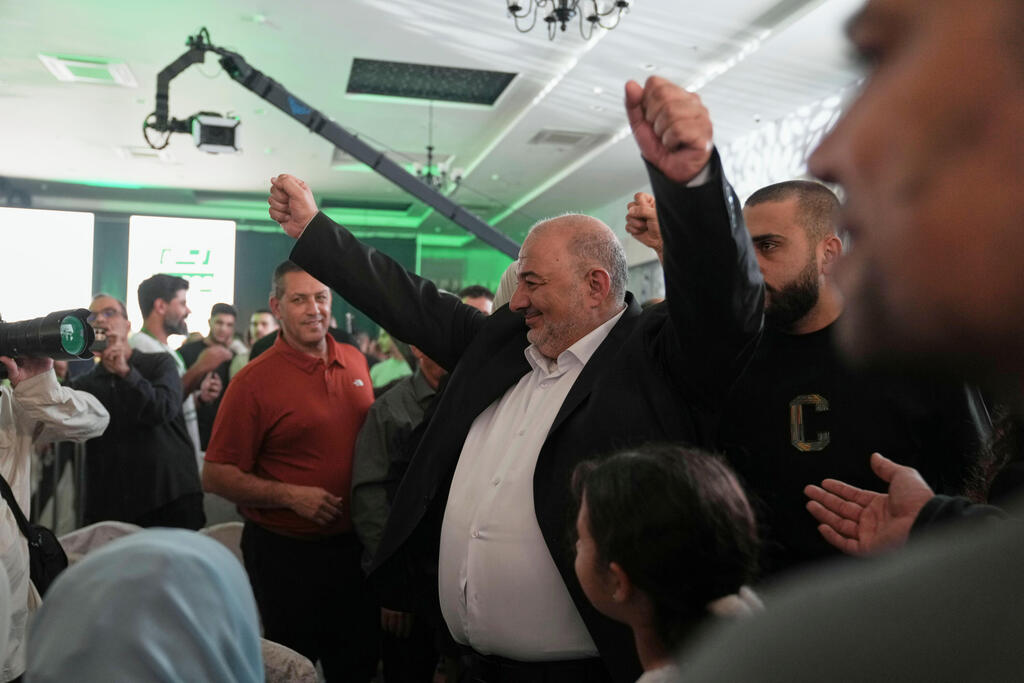
Ra'am party leader Mansour Abbas celebrates exit poll results
(Photo: AP Photo/Mahmoud Illean)
Early projections showing a narrow advantage for the opposition's pro-change bloc initially suggested that Ra'am could emerge as a pivotal player in negotiations to form Israel's next government.
But overnight revisions shifted the advantage toward Prime Minister Benjamin Netanyahu's right-wing bloc, sharply reducing the likelihood of a minority government supported by Ra'am from outside the coalition.
Under Israel's parliamentary system, a governing coalition generally needs the support of at least 61 lawmakers in the 120-seat Knesset. Arab parties could play a decisive role if neither major political bloc secures a majority on its own.
Despite the shifting projections, Abbas welcomed the substantial increase in voting among Arab citizens of Israel, including unusually high participation by religious figures.
"We received seven seats according to the polls. We hope to secure an eighth seat so we can bring down the current government and become part of the camp for change, with the aim of fighting crime and violence, home demolitions and racism," Abbas said.
Crime and violence in Arab communities, along with disputes over housing demolitions and allegations of discrimination, have been central issues in Ra'am's political agenda.
Abbas acknowledged that his party still faced significant challenges in translating electoral support into political influence.
"We still have a long way to go before we have an influential voice and a meaningful position on the ground," he said. "We must bring about change across all institutions and invest every effort and resource available to us to achieve that."
He thanked Arab voters for their support, singling out residents of the Negev region in southern Israel, where Ra'am has a significant political base.
"We have invested tremendous efforts to reach where we are today. We have faced challenges and paid a price," Abbas said. "We have endured criticism and attacks, including on a personal level, but despite everything, we will continue on our path with determination."
Abbas reports calls after exit polls
Abbas said he had received numerous telephone calls following the release of the exit polls but declined to identify the callers or disclose the substance of their conversations.
"I received many phone calls after the poll results were published, and I will not reveal their contents," he said. "We want to carefully examine the political landscape, and we will adopt a series of positions and decisions that serve the Arab public."
Ra'am, officially known as the United Arab List, is an Arab Islamist party affiliated with the southern branch of Israel's Islamic Movement. Under Abbas, it has pursued a pragmatic approach to parliamentary politics, emphasizing cooperation with Jewish parties to secure government resources and address problems affecting Arab communities.
The party made history in 2021 when it joined the coalition government led by Naftali Bennett and Yair Lapid, becoming the first independent Arab party to formally participate in a governing coalition.
Its potential involvement in another government has become a central point of contention in the current coalition negotiations, with Netanyahu rejecting any government dependent on what he describes as anti-Zionist Arab parties.
Ra'am lawmaker Walid Taha described the projected election result as a major achievement.
"We have achieved historic success as an independent party," Taha said. "Now the work begins. If we manage to secure the eighth seat, our strength will be even more significant, and that will have an impact on the government."
Fellow Ra'am lawmaker Iman Khatib-Yasin said the party's campaign reflected years of frustration among Arab citizens over violence, crime and what she described as hostile government policies.
"For four years, we have suffered from many problems that have harmed Arab society," she said. "How deeply we have suffered over the murders and the cries of mothers. We want to act to confront this harsh reality."
Khatib-Yasin also criticized those who had accused Ra'am members of betraying their community.
"What hurt us most was hearing people call us traitors and slander us," she said. "But that did not deter us or divert us from our path. We will continue working with determination and investing tremendous effort."
The final distribution of Knesset seats will depend on the official vote count, leaving Ra'am's ultimate parliamentary strength and its potential role in forming the next government uncertain.